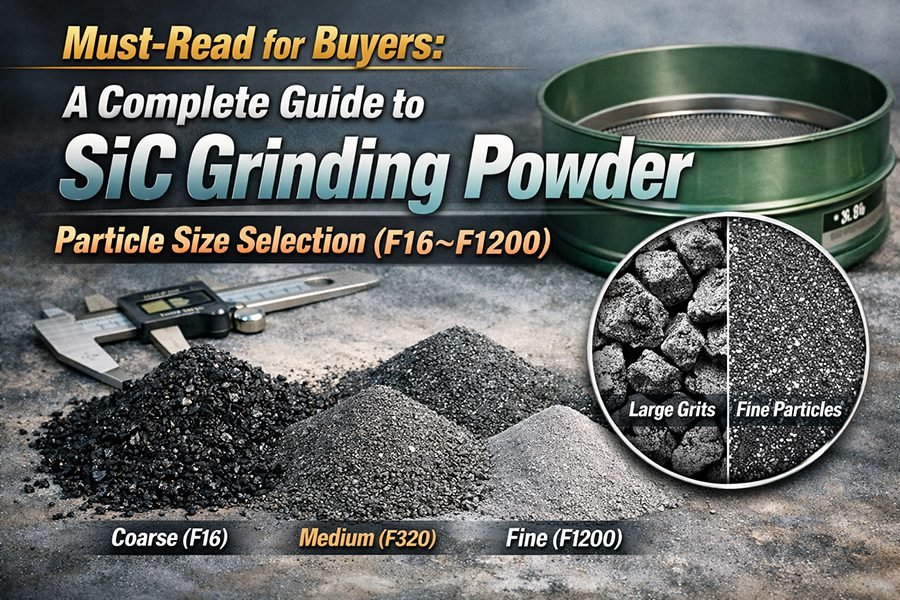
Choosing the wrong grit size for your Silicon Carbide (SiC) grinding powder can mean wasted material, damaged workpieces, or a surface finish that misses specification entirely. This definitive buyer’s guide walks you through every grit grade from F16 to F1200 — what each range is for, how to match it to your process, and how to avoid the most common purchasing mistakes.
What Is SiC Grinding Powder and Why Does Particle Size Matter?
Silicon Carbide (SiC) is one of the hardest synthetic abrasive materials on earth, with a Mohs hardness of approximately 9.5. Available in both black and green grades, it is used across precision grinding, lapping, polishing, wire-saw cutting, and refractory manufacturing. Its performance is fundamentally controlled by one variable above all others: particle size.
Particle size determines the depth of cut per abrasive grain, the material removal rate, and the resulting surface roughness (Ra/Rz values). A coarse F16 grit can remove stock 30× faster than F1200 — but leaves a surface roughly 200× rougher. Selecting the right grade is not optional; it is the foundation of process control.
International Grit Standards You Must Know
SiC grinding powder is graded primarily under two international standards:
- FEPA F-grades (ISO 8486) — the dominant standard for bonded and coated abrasives in Europe, Asia, and North America, covering F16 through F1200.
- JIS (Japanese Industrial Standard) — widely used in Japanese precision manufacturing; JIS values correlate closely but not identically to FEPA F-grades.
- ANSI/CAMI — common in North American coated abrasive markets; use conversion tables when cross-referencing with FEPA.
Buyer Tip: Always confirm which standard your supplier grades to. A “400 grit” powder quoted under JIS and FEPA can differ by 15–25% in median particle diameter — enough to cause visible surface finish inconsistencies.
The Full Grit Range Explained: F16 to F1200
The FEPA F-series divides abrasive powders into macro grits (F16–F220) and micro grits (F230–F1200). Each zone has distinct behaviors, machinery requirements, and ideal applications.
Macro Grits: F16 – F220 (Coarse to Medium)
Macro grits are measured primarily by sieve analysis. Individual particles in this range are large enough to be seen with the naked eye and deliver aggressive, high-volume material removal.
| FEPA Grade | Nominal D50 (µm) | Primary Applications |
|---|---|---|
| F16 | ~1320 µm | Heavy stock removal, refractory shaping, concrete grinding |
| F24 | ~875 µm | Rough grinding of hard metals, casting cleaning |
| F36 | ~625 µm | Weld removal, aggressive surface preparation |
| F46 | ~480 µm | General grinding wheels, floor grinding |
| F60 | ~355 µm | Medium grinding of ceramics, carbides |
| F80 | ~212 µm | Bonded wheels, honing, tool sharpening |
| F120 | ~125 µm | Semi-finish grinding, optical glass roughing |
| F180 | ~82 µm | Lapping, surface preparation before polishing |
| F220 | ~58 µm | Fine grinding, pre-polish lapping |
Key Insight for Coarse Grit Buyers
- F16–F36 powders are ideal for removing large volumes of material from stone, concrete, and hard ferrous metals.
- F46–F80 offer the best balance between removal rate and surface quality for bonded abrasive wheel manufacturing.
- F120–F220 are the workhorses of precision ceramic and glass roughing operations worldwide.
Micro Grits: F230 – F1200 (Fine to Ultra-Fine)
Micro grits are characterized by sedimentation and laser diffraction rather than sieve analysis, allowing far tighter particle distributions. Surface finish quality becomes the dominant consideration.
| FEPA Grade | Nominal D50 (µm) | Primary Applications |
|---|---|---|
| F230 | ~53 µm | Lapping, precision surface conditioning |
| F320 | ~36 µm | Semiconductor wafer grinding, optical lapping |
| F400 | ~22 µm | Fine lapping of hard metals, ceramic components |
| F500 | ~16 µm | Precision lapping, sapphire substrate preparation |
| F600 | ~9.3 µm | Pre-polish lapping, gemstone grinding |
| F800 | ~6.5 µm | High-precision optics, metallographic sample prep |
| F1000 | ~4.5 µm | Near-mirror finish lapping, advanced ceramics |
| F1200 | ~3.0 µm | Ultra-fine polishing, final lapping stage, solar cell substrates |
How to Select the Right SiC Grit for Your Process
There is no universal “best” grit. Selection should be driven by four factors evaluated together:
1. Target Surface Roughness (Ra)
As a rule of thumb, Ra (µm) ≈ 0.025 × D50 (µm) for lapping operations. If your specification demands Ra ≤ 0.1 µm, you likely need F800 or finer as your finishing stage. Always work backwards from the required finish.
2. Material Being Processed
- Hard ceramics & carbides: Start at F46–F120 for roughing; move to F400–F800 for finishing.
- Optical glass: Begin at F120–F220; final lap at F800–F1200.
- Silicon wafers / semiconductors: Typically F320–F600 for backgrinding.
- Sapphire & LED substrates: F400–F1200 in progressive stages.
- Stone & concrete: F16–F60 for profiling and surface prep.
3. Multi-Stage vs. Single-Stage Processing
For high-value precision parts, a staged approach is always preferred. Jump no more than 2–3 grit sizes per step (e.g., F120 → F320 → F800 → F1200). Skipping stages to save time typically increases total processing time due to the extra work required to remove deep scratches left by coarser grits.
4. Equipment and Carrier Media Compatibility
Coarser powders (F16–F120) are commonly used dry or in resin/vitrified bonds. Fine micro grits (F400–F1200) are typically used in aqueous slurry or oil-based suspension. Confirm that your slurry viscosity is appropriate for the particle size — powders that settle rapidly can cause uneven lapping pressure and inconsistent finishes.
Pro Tip: Request a particle size distribution (PSD) report — not just a D50 value — from your supplier. The D3 and D97 tail values reveal how tight the grading is. Wide distribution tails are the #1 hidden cause of scratch defects in precision lapping.
Black SiC vs. Green SiC: Does It Affect Grit Selection?
Both black and green Silicon Carbide are available across the F16–F1200 range. The distinction is purity and hardness: Green SiC (≥99% SiC) is slightly harder and more brittle, making it ideal for harder materials like tungsten carbide, ceramics, and gemstones. Black SiC (≥98% SiC) is tougher and more economical, preferred for general-purpose grinding and non-ferrous metals.
For precision micro-grit applications (F600–F1200), green SiC is the dominant choice because its consistent crystal structure produces more predictable, uniform surface finishes. For macro-grit applications (F16–F120), black SiC often delivers equivalent results at lower cost.
Frequently Asked Questions
Q: What is the difference between F220 and F230 SiC grinding powder?
F220 is the coarsest macro grit (measured by sieve), while F230 is the finest micro grit (measured by sedimentation). Despite overlapping particle sizes (~53–58 µm), their size distribution methods differ, and F230 typically has a tighter distribution tail, making it more consistent for precision lapping applications.
Q: Which SiC grit size is best for lapping optical glass?
Optical glass lapping typically begins with F220 or F320 for stock removal and progresses through F500–F800 for intermediate stages, finishing with F1000 or F1200 to achieve the sub-0.1 µm Ra values required before polishing with cerium oxide or colloidal silica.
Q: Can I use SiC F1200 powder for final polishing of metal parts?
F1200 SiC produces a very fine finish (Ra ≈ 0.05–0.1 µm) and is used as a near-final lapping stage for hard metals and ceramics. However, for mirror-level finishes on metals, diamond compound or alumina polishing media is typically used after SiC lapping, as SiC particles can leave characteristic grinding marks under high magnification.
Q: How do I store SiC grinding powder to prevent particle agglomeration?
Store SiC powders — especially micro grits F400 and finer — in sealed, moisture-resistant containers away from humidity and vibration. Fine powders are prone to agglomeration if exposed to moisture, which can cause oversized particle clusters that scratch precision surfaces. Use dry nitrogen purging for long-term storage of F800–F1200 grades.
Q: What minimum order quantities should I expect for SiC powder from a Chinese manufacturer?
Most Chinese SiC powder manufacturers offer MOQs of 500 kg to 1 MT for standard macro grits (F16–F220). For specialty micro grits (F600–F1200), MOQs can be as low as 25–100 kg. Reputable suppliers like Henan Superior Abrasives offer flexible packaging from 1 kg sample bags to 1 MT bulk sacks, with full PSD certification and SGS-verifiable quality reports.
Q: Is FEPA-graded SiC powder compatible with JIS specifications?
FEPA F-grades and JIS grades are closely related but not interchangeable without verification. For example, JIS #240 and FEPA F240 share similar D50 values but differ in their particle distribution window. Always request a PSD data sheet and verify against your process specification before substituting between standards.
Get the Right SiC Powder — First Time, Every Time
Henan Superior Abrasives (HSA) supplies FEPA-certified Silicon Carbide grinding powder from F16 to F1200 to precision manufacturers in 60+ countries. Full PSD reports, flexible MOQs, and technical support from our abrasives engineers.
Request a Free Sample