Introduction: The Purity Paradox in Abrasive Selection
When shopping for green silicon carbide (GC), many buyers instinctively gravitate toward the highest purity option available—typically 99% SiC content—assuming that “higher purity equals better performance.” But is this assumption always correct?
The truth is more nuanced. While 99% green silicon carbide offers exceptional properties for specific high-precision applications, it isn’t automatically the optimal choice for every grinding, cutting, or refractory application. Understanding when premium purity truly matters—and when it represents unnecessary cost—can significantly impact your production efficiency and bottom line.
This comprehensive guide breaks down the science, applications, and economics behind green silicon carbide purity levels to help you make an informed purchasing decision.
What Makes Green Silicon Carbide “Green”?
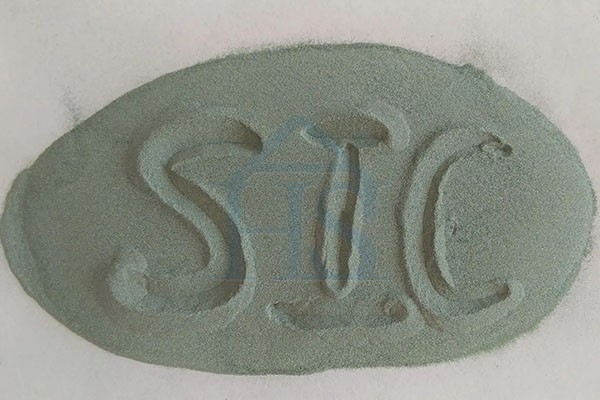
Green silicon carbide is produced through a resistance furnace process using high-purity quartz sand and petroleum coke as raw materials. The resulting product typically contains 97%-99.5% SiC, distinguished by its characteristic green color and higher purity compared to black silicon carbide.
The “greenness” comes from trace amounts of aluminum and other elements, but more importantly, green SiC contains lower free carbon and free silicon content than its black counterpart, resulting in:
- Higher hardness (Mohs 9.2-9.5)
- Greater brittleness
- Sharper cutting edges
- Better thermal conductivity
- Enhanced chemical stability
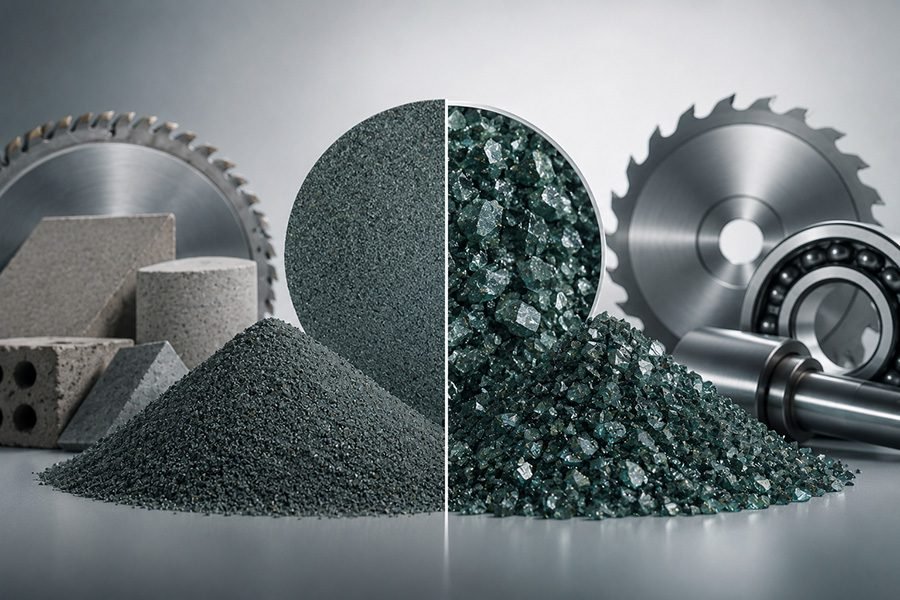
These properties make green silicon carbide the preferred choice for precision applications involving hard, brittle materials.
The Case FOR 99% Purity: When It Truly Matters
1. Precision Grinding of Hard Materials
For applications involving tungsten carbide, ceramics, optical glass, and other extremely hard or brittle materials, 99% purity green SiC delivers:
- Superior cutting sharpness: Fewer impurities mean more consistent crystal structure and sharper cutting edges
- Reduced thermal damage: Higher purity translates to better thermal stability, minimizing heat-induced microcracking in workpieces
- Extended tool life: Consistent hardness throughout the abrasive grain reduces premature wear
2. Semiconductor and Electronics Manufacturing
In wafer slicing, lapping, and polishing applications where surface finish quality is paramount, even minor impurities can cause:
- Micro-scratching on delicate substrates
- Inconsistent material removal rates
- Contamination of sensitive electronic components
For these applications, the premium cost of 99% purity is justified by reduced defect rates and higher yield.
3. High-End Refractory Applications
When silicon carbide serves as a raw material for advanced ceramics or high-performance refractories, purity directly correlates with:
- Thermal shock resistance
- Chemical inertness in aggressive environments
- Long-term structural stability at extreme temperatures
The Case AGAINST Always Choosing 99% Purity
1. Cost-Performance Mismatch for General Applications
For standard grinding wheels used in general metalworking, woodworking, or routine surface preparation, 97%-98% green silicon carbide often performs identically to 99% grade while costing 10%-20% less. The additional purity simply isn’t utilized in less demanding applications.
2. Diminishing Returns in Certain Processes
In some bonded abrasive formulations, the bonding matrix itself becomes the limiting factor for performance—not the abrasive grain purity. In these cases, upgrading to 99% SiC provides negligible performance improvement while increasing material costs.
3. Application-Specific Requirements
Different processes have different tolerance levels for impurities:
| Application | Recommended Purity | Reasoning |
|---|---|---|
| Precision optics grinding | 99%+ | Zero tolerance for scratches |
| Semiconductor wafer processing | 99%+ | Critical surface finish requirements |
| Tungsten carbide tool sharpening | 98-99% | Balance of performance and cost |
| General metal grinding wheels | 97-98% | Standard performance sufficient |
| Sandblasting/surface prep | 95-97% | Cost-efficiency prioritized |
| Refractory raw material | 97-99% | Depends on end-use temperature requirements |
Key Factors Beyond Purity Percentage
Particle Size Distribution (Grit Size)
Even at 99% purity, inconsistent grit sizing can undermine performance. Look for suppliers who provide:
- Tight particle size distribution curves
- Consistent shape factor (angular vs. blocky grains)
- Low percentage of oversized or undersized particles
Free Carbon and Free Silicon Content
These secondary impurities matter as much as overall SiC percentage:
- Free carbon: Excessive levels can cause inconsistent burning during high-temperature applications
- Free silicon: Can affect chemical reactivity in certain processing environments
Crystal Structure Integrity
The internal crystal structure affects fracture patterns during use. Even high-purity material with poor crystal formation may underperform compared to slightly lower purity material with excellent crystal integrity.
How to Determine the Right Purity Level for Your Application
Step 1: Define Your Performance Requirements Identify the specific demands of your process—surface finish tolerance, material hardness being processed, thermal exposure, and chemical environment.
Step 2: Calculate True Cost-Per-Performance Don’t just compare price per kilogram. Factor in:
- Tool/wheel life expectancy
- Rejection rates and rework costs
- Processing speed and efficiency
- Downstream quality requirements
Step 3: Request Sample Testing Reputable suppliers should provide samples for trial runs, allowing you to validate performance against your specific application before committing to bulk orders.
Step 4: Consult with Technical Experts Work with suppliers who can provide application-specific recommendations rather than simply pushing the highest-margin product.
Making the Smart Choice: Balance, Not Blind Premium Selection
The answer to “Is 99% green silicon carbide always better?” is a clear no—not universally. The right choice depends entirely on your specific application requirements, cost constraints, and performance objectives.
For critical precision applications where surface quality and consistency directly impact product value, 99% purity delivers measurable ROI. For general-purpose grinding and standard industrial applications, mid-purity options (97-98%) often provide the optimal balance of performance and cost-efficiency.
The smartest procurement strategy isn’t defaulting to the highest purity available—it’s matching purity specifications precisely to your application’s actual requirements.
Frequently Asked Questions (FAQ)
Q1: What’s the price difference between 97% and 99% green silicon carbide?
A: Typically, 99% purity green SiC commands a 10-25% price premium over 97-98% grade material, depending on market conditions and order volume. The exact differential varies by supplier and region.
Q2: Can I mix different purity grades for cost optimization?
A: In some applications, yes. For example, using 99% purity for finishing passes while using 97% purity for rough grinding stages can optimize both cost and performance. Consult with your abrasive supplier for specific formulation recommendations.
Q3: How can I verify the actual purity of green silicon carbide I’m purchasing?
A: Request third-party laboratory test certificates (COA) for each batch, specifying SiC content, free carbon, free silicon, and iron oxide levels. Reputable suppliers should provide this documentation as standard practice.
Q4: Does higher purity always mean better color consistency?
A: Generally yes, higher purity green SiC displays more consistent light-green to green coloration. However, color alone shouldn’t be your primary quality indicator—always rely on chemical analysis and performance testing.
Q5: Is 99% purity necessary for refractory applications?
A: It depends on the specific refractory application. For ultra-high-temperature environments (above 1600°C) or applications requiring maximum chemical inertness, 99% purity is often warranted. For standard refractory products used in moderate temperature ranges, 97-98% purity typically suffices.
Q6: What industries typically require 99% purity green silicon carbide?
A: Semiconductor manufacturing, precision optics, aerospace component finishing, high-end ceramic production, and specialized cutting tool manufacturing typically demand 99% purity for optimal results.
Get Expert Guidance on Silicon Carbide Selection
Don’t overpay for purity you don’t need—or underinvest in quality that compromises your production results. Let our technical team help you identify the exact green silicon carbide specification that matches your application requirements.
✅ Free technical consultation to analyze your specific application needs
✅ Sample testing program to validate performance before bulk purchasing
✅ Multiple purity grades available (97%, 98%, 99%, 99.5%) to match your budget and requirements
✅ Comprehensive quality documentation with every shipment
✅ Competitive pricing with volume-based discount structures
Contact us today for a customized silicon carbide solution that maximizes your ROI—not just your purity percentage.
- sales@superior-abrasives.com
- +86-18638638803
About HSA
HSA (Henan Superior Abrasives) is a leading manufacturer and supplier of premium abrasive materials, specializing in green silicon carbide, black silicon carbide, brown fused alumina, and white fused alumina products. With state-of-the-art production facilities and rigorous quality control systems, HSA serves customers across precision manufacturing, refractory production, metalworking, and specialty abrasive industries worldwide.
What sets HSA apart is our commitment to application-specific solutions rather than one-size-fits-all products. Our technical team works closely with clients to understand their exact process requirements, helping them select the optimal purity grade, particle size, and specification—ensuring maximum performance without unnecessary premium costs.
With comprehensive in-house testing laboratories, HSA provides full transparency through detailed certificates of analysis for every batch produced. Our flexible production capacity allows us to accommodate both large-volume industrial orders and specialized small-batch requirements for R&D or specialty applications.
Whether you need standard 97% green silicon carbide for general grinding applications or ultra-high 99.5% purity for precision semiconductor processing, HSA has the expertise, capacity, and quality assurance systems to meet your exact specifications.
Partner with HSA—where technical expertise meets manufacturing excellence in silicon carbide solutions.