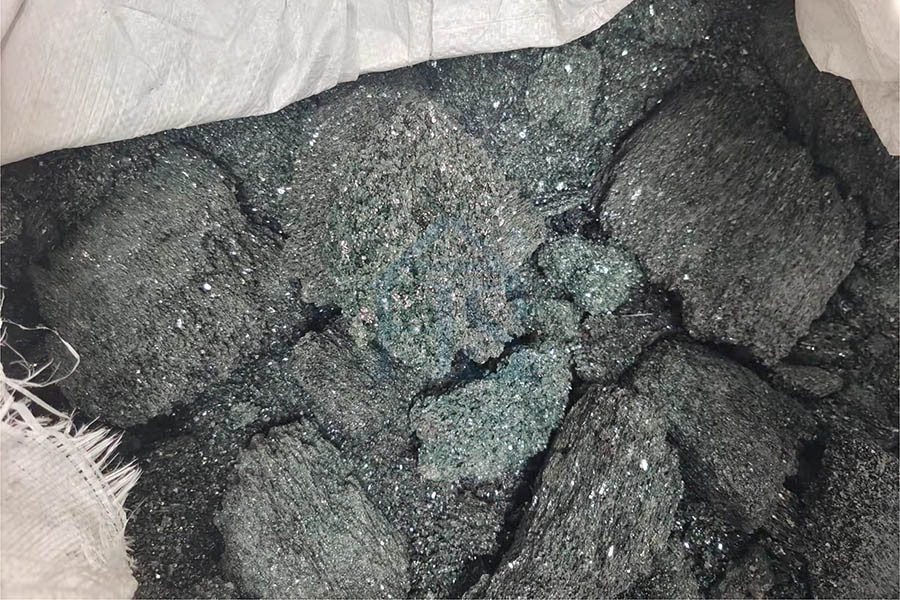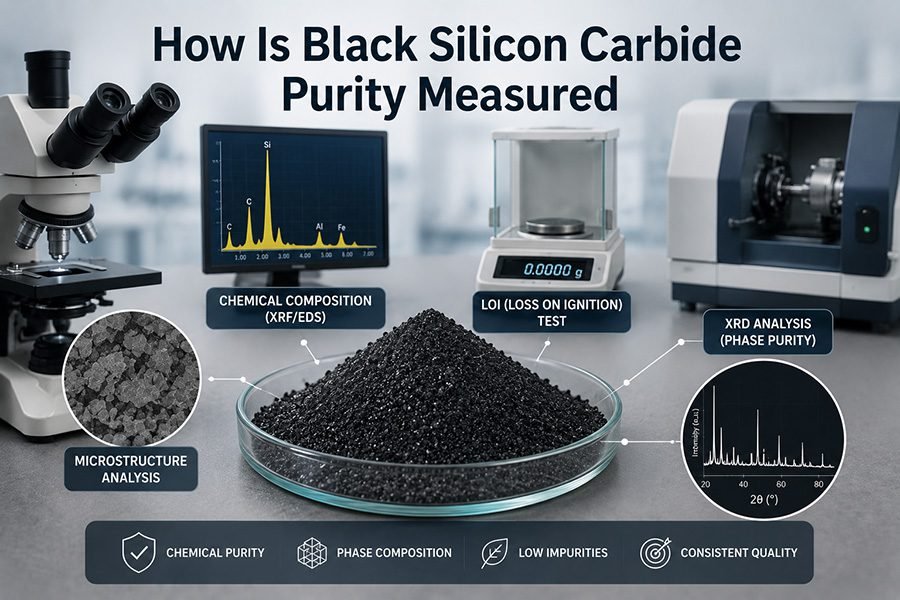
Ordering black silicon carbide without verifying purity is a gamble with predictable consequences: premature wheel breakdown, inconsistent surface finish, contaminated refractory castings, or failed incoming inspection at a customer’s facility. Purity in SiC is not a single number — it is a profile of analytical results that together determine whether a material will perform at the temperature, load, and chemical environment your application demands.
What “Renhed” Actually Means in Black Silicon Carbide
Sort siliciumcarbid (β- and α-SiC mixture) is synthesized via the Acheson process, in which silica sand and petroleum coke react at approximately 2,200–2,500 °C. The resulting crystalline mass contains primary SiC alongside residual phases: free silicon (Si), free carbon (C), silicon dioxide (SiO2), and metallic impurities introduced through raw materials or furnace linings. Total SiC content is the principal purity metric — but it is meaningless without co-reporting those secondary phases.
A batch labeled “98.5% Sic” from one supplier may carry 0.8% free carbon and 0.3% free Si; the same label from another may contain elevated iron (Fe₂O₃) from contaminated coke. Both pass the headline number, yet they behave entirely differently in grinding, blasting, og ildfaste applikationer. Understanding what is measured — and how — is the only reliable safeguard.
Standard Analytical Methods Used to Measure SiC Purity
Several complementary techniques are applied in combination by serious quality labs. No single method captures the full impurity picture.
- Combustion / gravimetric analysis: Measures total carbon and free carbon separately. The sample is combusted in oxygen; CO₂ evolved represents total carbon. A separate acid-leach step removes SiO₂ and free Si, leaving free carbon to be weighed directly.
- X-ray fluorescence (XRF): Delivers elemental composition across the full periodic table in minutes. Particularly useful for quantifying Fe₂O₃, Al₂o₃, Cao, TiO₂, and other metallic oxides that originate from raw material impurities or furnace brickwork contamination.
- X-ray diffraction (XRD): Identifies crystalline phases — α-SiC polytypes (4H, 6H, 15R), β-SiC (3C), free Si, and cristobalite (SiO2). Phase ratios affect hardness distribution and thermal shock resistance in refractory linings.
- Inductively coupled plasma optical emission spectrometry (ICP-OES): Required when trace metals must be quantified at ppm levels — critical for electronic-grade material or refractory applications where alkali metals accelerate slag corrosion.
- Acid solubility test (HF/HNO₃ digest): A rapid field-compatible method that dissolves free Si and oxides; the residue mass back-calculates approximate SiC content and gives a fast check on oxide loading.
Reputable suppliers provide a certificate of analysis (CoA) citing the specific method used for each reported parameter, not just a headline purity figure. Requesting method traceability — ideally referencing ISO, ASTM, or GB standards — is a basic procurement hygiene step when sourcing at volume.
Black SiC Purity Tiers: What the Numbers Mean by Grade
Commercial black silicon carbide is broadly segmented into purity tiers that correspond to end-use requirements. The table below maps typical purity ranges to the analytical limits most frequently specified by engineers across abrasive, ildfast, and functional applications.
| Grade Tier | SiC Content (min %) | Free Carbon (max %) | Fe₂O₃ (max %) | Typical Application |
|---|---|---|---|---|
| Standard Abrasive | 97.0 | 0.30 | 0.20 | Coated abrasives, blasting media, grinding wheels |
| High-Purity Abrasive | 98.5 | 0.15 | 0.10 | Præcisionsslibning, klapper, fine-grit finishing |
| Refractory Grade | 97.5 | 0.50 | 0.30 | Kiln furniture, castables, wear linings |
| Functional / Advanced | 99.0+ | 0.05 | 0.05 | SiC power semiconductors, sintret keramik, armor |
Note that refractory grade tolerates higher free carbon because carbon acts as an antioxidant at service temperatures — whereas the same free carbon level in a bonded grinding wheel weakens the bond matrix and accelerates wheel wear. Grade selection must always be application-driven, not purely cost-driven. For context on how comparable quality disciplines apply to other advanced abrasives, the methods parallel those used when evaluating nuclear boron carbide testing protocols, where impurity control carries safety-critical implications.
How Impurity Type Drives Specific Failure Modes
Each impurity class attacks performance through a distinct mechanism. Knowing which impurity dominates in a suspect lot points directly to the root cause of a field problem.
Free carbon in abrasive grain reduces effective hardness (Mohs 7 vs. SiC’s 9.5), creating soft inclusions that smear rather than cut. In refractory castables cured above 1,000 °C in oxidizing atmospheres, free carbon oxidizes away, leaving micro-porosity that undermines thermal shock resistance. Free silicon melts at 1,414 °C — well below SiC service temperatures in many kilns — producing liquid-phase infiltration that destabilizes the refractory microstructure. Elevated iron oxides accelerate vitreous bond degradation in ceramic-bonded wheels and promote slag reactions in steelmaking linings, shortening campaign life measurably.
In precision surface treatment applications — including finishing of hard alloys or technical ceramics — even modest contamination shifts scratch depth distribution and compromises the Rₐ values engineers have specified. For demanding finishing work, comparing green silicon carbide for surface treatment against black SiC is worthwhile, since green SiC’s higher baseline purity (typically ≥99%) eliminates some of these risks at a cost premium.
Grit Size and Purity Interact — A Frequently Overlooked Variable
Finer grit sizes amplify the performance impact of impurities. A free-carbon inclusion measuring 50 µm is insignificant in F24 blast media but represents a substantial fraction of an F220 abrasive grain. At fine grits, impurity-driven hardness variance translates directly into non-uniform scratch patterns and unpredictable wheel loading. This interaction is particularly important when specifying material for lapping or polishing operations, where grit concentration and consistency are as critical as nominal grit size — a topic examined in detail in the context of Siliciumcarbid 120 grus performance characteristics.
Buyers specifying coated abrasives or precision grinding wheels should request not only mean grit size (D50) and distribution width (D10/D90 ratio) but also a purity CoA that covers both bulk SiC content and the specific impurity suite relevant to their process chemistry.
Practical Checklist for Verifying Purity When Sourcing Black SiC
A structured incoming inspection protocol reduces the risk of accepting off-spec material. The following verification steps are applicable whether sourcing from a domestic distributor or directly from a China-based manufacturer.
- Request a CoA that names the analytical method for each parameter — not just reported values.
- Confirm SiC content is reported as a direct measurement, not calculated by difference from impurity totals.
- Verify free carbon and free silicon are reported separately, not lumped into a generic “other” category.
- Cross-check Fe₂O₃ against your application limit — steelmaking and semiconductor applications have tighter tolerances than general blasting.
- For critical applications, request or conduct XRD to confirm the α/β phase ratio, particularly if thermal stability above 1,600 °C is a design requirement.
- Retain a physical sample from each lot for incoming reference — essential if a warranty or rework claim arises months after delivery.
These same diligence principles apply when evaluating any precision abrasive or ceramic raw material. Engineers specifying white fused alumina powder, for instance, follow analogous purity validation steps focused on Al₂O₃ content and Na₂O control — the contaminant suite differs but the discipline is identical.
Ofte stillede spørgsmål
Q: What is the minimum SiC content acceptable for bonded grinding wheels?
EN: Most bonded abrasive manufacturers specify a minimum of 97.0% SiC for standard wheels, with high-precision applications requiring ≥98.5%. Free carbon should be held below 0.20% to prevent bond matrix weakening; free silicon below 0.15% to avoid hardness inconsistency across the wheel face.
Q: Which test method most accurately measures free carbon in black SiC?
EN: The acid-leach gravimetric method is the industry standard for free carbon determination. The sample is treated with a hydrofluoric/nitric acid mixture to dissolve SiO₂ and free Si; the residual carbon is then filtered, dried, and weighed. Results are typically expressed as weight percent and should be reported alongside total carbon from combustion analysis for full carbon speciation.
Q: How does iron oxide (Fe₂O₃) content affect black SiC performance in refractories?
EN: Fe₂O₃ above 0.30% accelerates slag penetration in steelmaking refractory linings by forming low-melting iron silicate phases above approximately 1,050 °C. In kiln furniture exposed to alkaline atmospheres, iron acts as a flux that promotes surface vitrification and spalling. Critical refractory applications typically cap Fe₂O₃ at 0.15–0.20%.
Q: Is there a difference in purity measurement between black and green silicon carbide?
EN: The same analytical methods apply — XRF, combustion analysis, XRD — but green SiC starts at a higher baseline purity (typically ≥99.0% SiC) due to its position closer to the furnace core during synthesis. Green SiC specs focus heavily on total carbon (<0.05%) and metallic impurities, while black SiC specs additionally address free silicon and phase composition variability.
Q: Can ICP-OES replace XRF for routine incoming inspection of black SiC?
EN: ICP-OES provides superior sensitivity for trace metals (detection limits in the sub-ppm range) but requires acid digestion and longer analysis times, making it better suited for qualification lots or dispute resolution than for routine incoming inspection. XRF offers faster throughput with typical detection limits of 50–100 ppm, which is sufficient for most abrasive and refractory quality gates. High-value or safety-critical applications — such as nuclear or power electronic uses — justify the additional ICP-OES cost.
Om Henan Superior Abrasives (HSA)
Henan Superior Abrasives (HSA) is a China-based global supplier of high-performance abrasive and advanced ceramic materials for industrial applications worldwide. Our core product range includes black silicon carbide, green silicon carbide, elektronisk siliciumcarbid (Sic), white fused alumina, brown fused alumina, Borkarbid, fused calcium aluminates, and SG abrasives.
Serving customers in 30+ lande, HSA supplies reliable materials for abrasives, ildfasteorier, Teknisk keramik, semiconductor applications, precision polishing, sandblæsning, metallurgy, and high-performance construction materials.
Get a Quote or Free Sample
Looking for a reliable supplier of premium abrasive and advanced ceramic materials? Contact our technical team today — we respond within 24 hours and can arrange free samples for qualified projects.
- 📧 E -mail: sales@superior-abrasives.com
- 💬 Whatsapp: +86-186-3863-8803