When a power module overheats at the die-attach interface, the failure mode is rarely the solder itself — it is the thermal resistance stack beneath it. Thermal interface materials (TIM'er) filled with low-grade or poorly graded particles introduce phonon scattering boundaries that inflate junction temperatures by 8–15 °C, accelerating electromigration and reducing mean time between failures by an order of magnitude. Selecting the right filler is not an aesthetic decision; it is a reliability engineering decision with direct cost consequences at scale.
Why Green Silicon Carbide Outperforms Conventional TIM Fillers
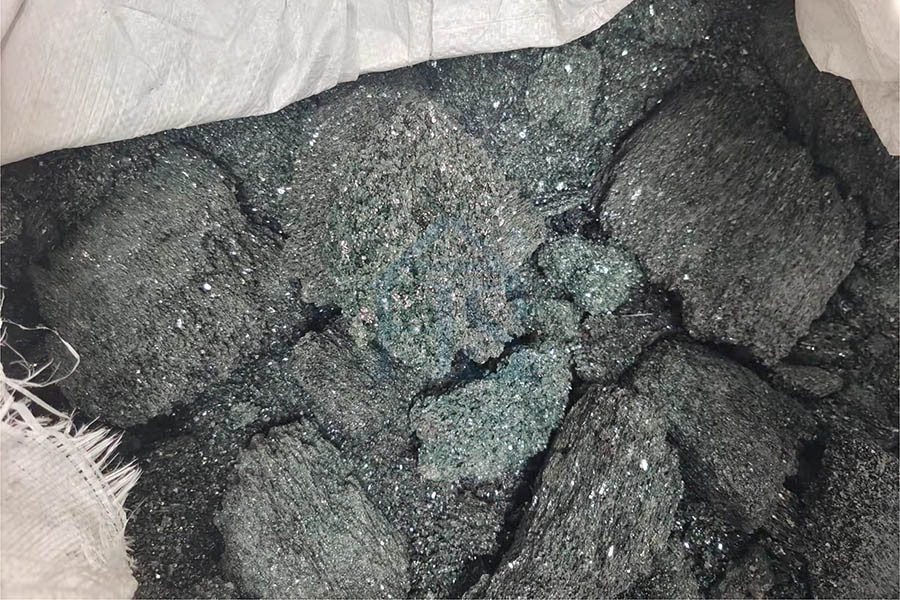
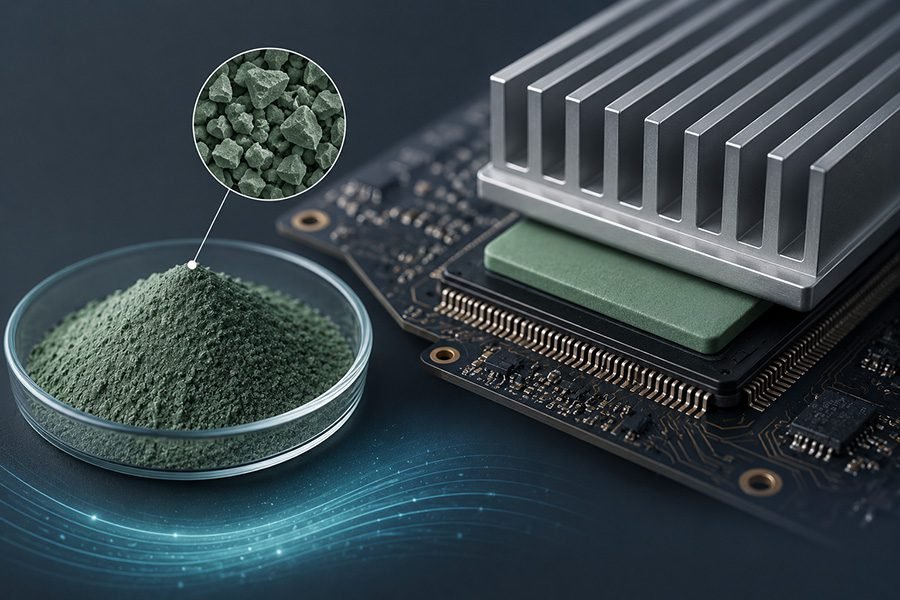
Most commercial TIMs rely on alumina, zinc oxide, or aluminum nitride as thermally conductive fillers. Each carries trade-offs in cost, compatibility, or ceiling conductivity. Green silicon carbide (GSiC) micro powder occupies a distinct performance tier: bulk thermal conductivity of 120–150 W/m·K (versus 20–30 W/m·K for alumina), near-zero electrical conductivity in its passivated form, and a Mohs hardness of 9.5 that resists particle deformation under compression cycling.
The crystalline purity of GSiC — typically ≥99.0% SiC with nitrogen and boron impurity levels below 200 ppm — limits lattice defect scattering that would otherwise degrade thermal transport at the grain level. Understanding the silicon carbide manufacturing process clarifies why green-grade material, synthesized at higher purity than black SiC, consistently delivers superior phonon mean free paths in dense filler matrices.
Partikelstørrelsesfordeling: The Variable Engineers Most Often Underspecify
Thermal conductivity in a filled polymer composite is not a linear function of filler loading. It depends critically on particle size distribution (PSD), because a multimodal PSD allows small particles to pack into voids between larger ones, raising effective filler volume fraction without increasing viscosity proportionally. For GSiC-filled TIMs, a bimodal blend combining a D50 of 10–15 µm with a secondary population at 1–3 µm consistently achieves packing densities above 68% — a threshold where percolation networks for phonon transport become continuous.
Single-modal fine powders at D50 ≤ 5 µm maximize surface area but create high-viscosity pastes that are difficult to dispense at the bondline thicknesses (50–150 µm) required in power electronics packaging. Conversely, coarse-only powders above D50 30 µm introduce surface roughness mismatches at the substrate interface. Specifying a tight D10/D90 ratio — preferably D90/D10 ≤ 5 for the primary fraction — is as important as specifying the median diameter itself.
Performance Comparison: GSiC Versus Common TIM Fillers
The table below compares key material parameters for fillers used in high-performance TIM formulations. Values represent bulk material properties; composite conductivity depends on loading fraction, matrix, and interface resistance.
| Filler Material | Bulk Thermal Conductivity (W/m·K) | Electrical Resistivity (Ω·cm) | Mohs Hardness | Typical D50 Range (µm) |
|---|---|---|---|---|
| Grønt siliciumcarbid | 120–150 | >10⁴ (surface-oxidized) | 9.5 | 1–45 |
| Aluminum Nitride (AlN) | 140–180 | >10¹³ | 7 | 1–30 |
| Aluminiumoxid (Al₂o₃) | 20–35 | >10¹⁴ | 9 | 0.3–50 |
| Zinc Oxide (ZnO) | 25–30 | Variable (semiconducting) | 4.5 | 0.1–5 |
| Boron Nitride (hBN) | 60–300 (anisotropic) | >10¹³ | 2 (basal plane) | 2–20 |
GSiC’s conductivity ceiling falls below AlN in bulk, but at equivalent cost-per-kilogram, GSiC typically delivers 2–3× the thermal performance of alumina at a fraction of AlN’s price. De density of silicon carbide (3.21 g/cm³) also matters for weight-sensitive aerospace and EV applications, where minimizing TIM mass without sacrificing conductivity is a real design constraint.
Surface Treatment Requirements for Polymer Matrix Compatibility
Untreated GSiC particles carry a native SiO₂ surface layer — typically 2–5 nm thick — that improves electrical isolation but creates a polar/nonpolar mismatch with silicone and epoxy matrices. Without coupling agent treatment, adhesion at the particle-matrix interface is weak, leading to delamination under thermal cycling (−40 °C to 150 °C, JEDEC JESD22-A104) and a measured increase in interfacial thermal resistance.
Silane coupling agents — specifically aminopropyltriethoxysilane (APTES) or glycidoxypropyltrimethoxysilane (GPTMS) — applied at 0.5–1.5 wt% relative to filler mass produce measurable improvements in both adhesion strength and composite thermal conductivity. Treated GSiC composites at 60 vol% loading in silicone matrices have demonstrated bulk conductivity values of 4.5–6.0 W/m·K, versus 2.8–3.5 W/m·K for untreated equivalents at the same loading.
Critical Specification Checklist for TIM-Grade GSiC Procurement
Engineers issuing purchase specifications for GSiC micro powder destined for TIM production should require documentation on the following parameters from any supplier:
- Chemical purity: SiC content ≥99.0%; free silicon ≤0.1%; free carbon ≤0.3%; total metallic impurities (Fe, Al, Ca) ≤500 ppm by ICP-OES
- Particle size distribution: D10, D50, D90 values per ISO 13320 (laser diffraction); maximum oversize fraction above D90 + 20% must be ≤0.1%
- Morphology: SEM confirmation of sub-angular to angular particles; avoid platelet-dominant shapes that increase anisotropy in dispensed TIM layers
- Surface chemistry: BET surface area (m²/g) and surface oxide content; specify if pre-silanization is required or supplied untreated for in-house coupling
- Lot-to-lot consistency: PSD coefficient of variation ≤5% across production batches; critical for automated dispensing lines where viscosity must stay within ±10% of target
- Moisture content: ≤0.1 wt% at delivery; excess moisture causes voiding during TIM cure and degrades long-term dielectric performance. Proper storage conditions for silicon carbide must be maintained through the supply chain.
Formulation Loading Strategies and Thermal Conductivity Targets
Achieving a composite TIM with bulk conductivity above 3 W/m·K requires filler volume fractions exceeding 50 vol% — a level that demands careful rheology management to maintain printability or dispensability. Bimodal GSiC blends (10–15 µm primary, 1–3 µm secondary at a 70:30 weight ratio) allow formulations to reach 58–62 vol% loading with viscosities under 50 Pa·s at a shear rate of 10 s⁻¹, which is compatible with stencil printing and needle dispensing equipment.
For phase-change TIMs and gap fillers where compliance at low pressure is required, GSiC loadings are typically capped at 40–50 vol% to preserve mechanical flexibility. In these formulations, a surface-treated GSiC with a narrower PSD (D90/D10 ≤ 3) is preferred because it reduces agglomeration risk during mixing and improves bondline thickness uniformity. Designers working with β-phase versus α-phase silicon carbide should note that most TIM-grade micro powders are predominantly α-phase (6H or 4H polytypes), which exhibit slightly higher anisotropy at the crystal level but perform comparably in isotropic composite matrices.
Ofte stillede spørgsmål
Q: What particle size of green silicon carbide micro powder is best for thermal interface materials?
EN: A bimodal distribution combining a D50 of 10–15 µm with a secondary fraction at 1–3 µm (blended at approximately 70:30 by weight) is optimal for most TIM applications. This combination achieves packing densities above 68 vol% while maintaining dispensable viscosities below 50 Pa·s at 10 s⁻¹ shear rate. Single-modal powders below D50 5 µm produce excessive viscosity; coarse-only powders above D50 30 µm reduce surface contact quality at the substrate interface.
Q: Is green silicon carbide electrically conductive — will it short-circuit components in a TIM?
EN: Bulk silicon carbide has electrical resistivity in the range of 10²–10⁴ Ω·cm, which is semiconducting. Imidlertid, green SiC micro powder develops a passivating SiO₂ surface layer (2–5 nm thick) during manufacturing and storage, raising effective resistivity to >10⁴ Ω·cm in powder form. In a silicone or epoxy matrix at 50–60 vol% loading, composite volume resistivity typically exceeds 10⁸ Ω·cm, which is acceptable for most power electronics packaging applications. Specifiers requiring higher isolation should evaluate post-surface-oxidation treatments or blending with AlN.
Q: What purity level of green SiC is required for TIM applications, and how is it verified?
EN: TIM-grade green silicon carbide should meet ≥99.0% SiC content with free silicon ≤0.1%, free carbon ≤0.3%, and total metallic impurities (Fe, Al, Ca) ≤500 ppm. Verification should be conducted by ICP-OES (inductively coupled plasma optical emission spectrometry) per a validated method traceable to certified reference materials. X-ray fluorescence (XRF) is acceptable for production-level screening but should not replace ICP-OES for qualification lots, as XRF sensitivity for trace metals below 100 ppm is insufficient for high-reliability electronics applications.
Q: How does green SiC compare to aluminum nitride as a TIM filler in terms of cost and performance?
EN: Aluminum nitride (AlN) has a higher bulk thermal conductivity ceiling (140–180 W/m·K vs. 120–150 W/m·K for GSiC) and superior electrical insulation (resistivity >10¹³ Ω·cm). Imidlertid, AlN is typically priced 4–8× higher per kilogram than GSiC of equivalent particle size and purity, and it is sensitive to hydrolysis in humid environments, requiring stricter moisture control during processing. For composite TIMs where the target bulk conductivity is 3–6 W/m·K, GSiC achieves equivalent application performance at significantly lower formulation cost, making it the preferred filler where electrical isolation requirements are met by matrix selection.
Q: What silane coupling agents are recommended for improving GSiC adhesion in silicone TIM matrices?
EN: Aminopropyltriethoxysilane (APTES) and glycidoxypropyltrimethoxysilane (GPTMS) are the most widely validated options. Treatment at 0.5–1.5 wt% relative to GSiC mass, applied in a dry or solution-phase process at 80–120 °C, produces a covalent Si–O–Si bond between the particle’s native oxide layer and the silane head group. In 60 vol% GSiC/silicone composites, treated samples consistently show bulk conductivity of 4.5–6.0 W/m·K versus 2.8–3.5 W/m·K for untreated equivalents, along with improved retention of thermal performance after 1,000 thermal cycles (−40 °C to 150 °C, JEDEC JESD22-A104).
Om Henan Superior Abrasives (HSA)
Henan Superior Abrasives (HSA) is a China-based global supplier of high-performance abrasive and advanced ceramic materials for industrial applications worldwide. Our core product range includes black silicon carbide, green silicon carbide, elektronisk siliciumcarbid (Sic), white fused alumina, brown fused alumina, Borkarbid, fused calcium aluminates, and SG abrasives.
Serving customers in 30+ lande, HSA supplies reliable materials for abrasives, ildfasteorier, Teknisk keramik, semiconductor applications, precision polishing, sandblæsning, metallurgy, and high-performance construction materials.
Get a Quote or Free Sample
Looking for a reliable supplier of premium abrasive and advanced ceramic materials? Contact our technical team today — we respond within 24 hours and can arrange free samples for qualified projects.
- 📧 E -mail: sales@superior-abrasives.com
- 💬 Whatsapp: +86-186-3863-8803