Black silicon carbide (Black SiC) has become one of the most trusted abrasive media in industrial steel surface preparation — combining exceptional hardness, sharp angular geometry, and cost-effectiveness in a single material. This article explores how Black SiC performs in blast cleaning operations, which international standards govern its use, and how to select the right grade for your application.
What Is Black Silicon Carbide?
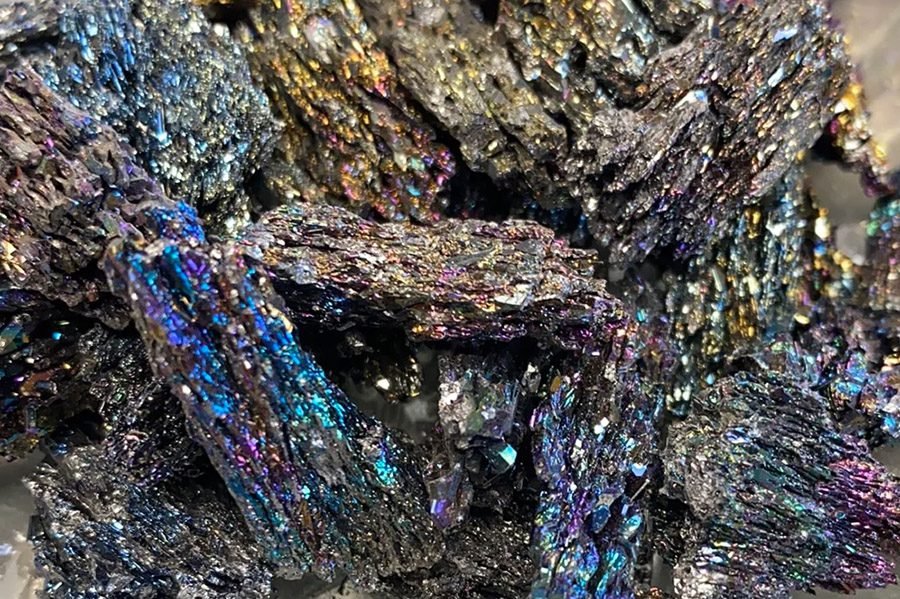
Black silicon carbide (chemical formula SiC) is produced by fusing high-purity silica sand and petroleum coke in an electric resistance furnace at temperatures exceeding 2,200 °C — a process known as the Acheson method. The resulting crystal is second in hardness only to diamond and cubic boron nitride, rating 9.1–9.5 on the Mohs scale. Its dark, lustrous color comes from residual iron and carbon impurities that reduce purity to typically 95–98% SiC (compared to 99%+ for Green SiC), but this makes Black SiC significantly more economical without compromising blasting performance.
The material fractures conchoidally under impact, constantly exposing fresh, razor-sharp cutting edges — a property critical to its effectiveness as a blasting abrasive. Where rounded abrasives like steel shot produce a peened, compressive profile, Black SiC generates a deeply angular, anchor-pattern surface profile that dramatically improves coating adhesion.
Why Black SiC Excels in Steel Blasting
Steel surface preparation is not simply about removing rust or mill scale — it is about engineering a specific surface profile and cleanliness level that ensures coating systems adhere correctly and perform over their intended service life. Black SiC delivers on multiple fronts:
1. Superior Cutting Aggressiveness
The angular, splintered morphology of Black SiC particles produces aggressive cutting action on steel. At equivalent blast pressures, Black SiC achieves deeper anchor patterns and faster cleaning rates than glass beads or aluminum oxide. This translates to shorter blast cycles and reduced energy costs per square meter of treated surface.
2. High Hardness with Controlled Friability
Black SiC is hard enough to cut through even heavily scaled or corroded steel but brittle enough to fracture rather than embed in the substrate. This self-sharpening behavior is particularly valuable when blasting carbon steel components destined for protective coatings — minimizing metallic contamination of the prepared surface.
3. Chemical Inertness
Unlike iron-based abrasives (steel grit, steel shot), Black SiC is chemically inert and introduces no iron contamination to the blasted surface. This matters greatly in applications where the substrate will be coated with zinc-rich primers or other corrosion-protective systems that are sensitive to iron contamination.
4. Recyclability and Cost Efficiency
Although Black SiC is more friable than steel abrasives, its hardness provides reasonable multi-cycle recyclability in closed-loop blast systems. Typical usage yields 3–6 recycles depending on blast pressure and equipment type, significantly reducing per-cycle media cost compared to single-use abrasives.
💡 Engineering InsightFor maximum surface profile depth (Rz 70–100 μm) on heavy structural steel, Black SiC in the F16–F36 grit range blasted at 90–110 PSI consistently outperforms steel grit GL40 in cycle time — while eliminating iron flash rusting risk in humid environments.
Key Industry Standards Governing Black SiC Blast Media
Specifying Black SiC for steel blasting requires compliance with internationally recognized standards that define particle size distribution, chemical composition, and surface cleanliness outcomes. Procurement engineers and coating inspectors rely on the following frameworks:
- FEPA F/P
The Federation of European Producers of Abrasives defines grit sizing standards (F8 through F1200 for bonded abrasives; P-grades for coated). FEPA F-grades are the global benchmark for coarse blast grit sizing of Black SiC, specifying d50 values and permissible fines content.
- ISO 11126-7
Specifies requirements for non-metallic blast-cleaning abrasives — including silicon carbide. Defines chemical composition, moisture content, water-soluble contaminants, and chloride levels. ISO 11127 provides the corresponding test methods for physical and chemical verification.
- SSPC-AB 1
The Steel Structures Painting Council’s Mineral and Slag Abrasive standard governs cleanliness and conductivity requirements for blast media used in steel surface preparation in North America. Black SiC used on infrastructure and marine projects in the U.S. market typically requires SSPC-AB 1 compliance.
- ISO 8501-1
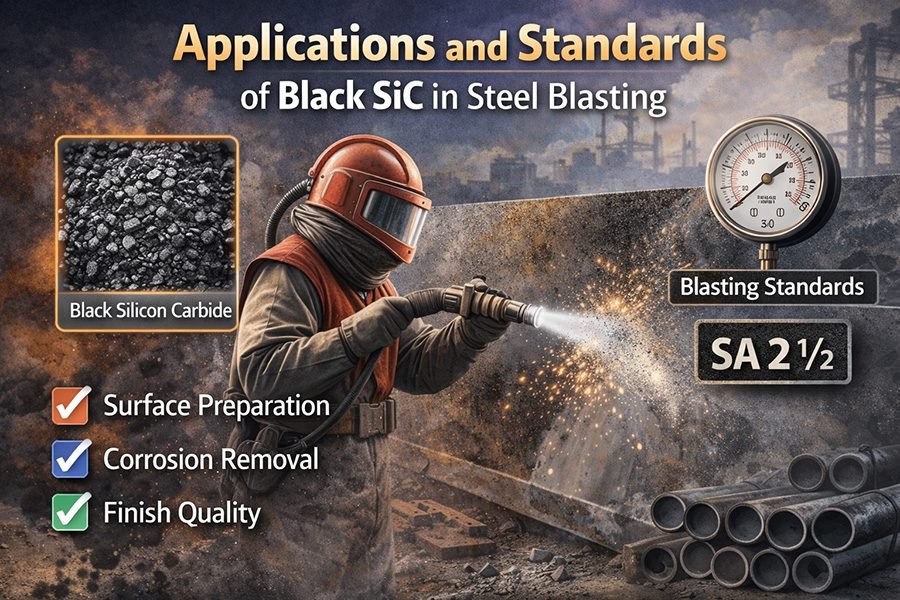
Defines rust grade and preparation grade of steel surfaces (Sa 1, Sa 2, Sa 2½, Sa 3). Black SiC is capable of achieving Sa 2½ (near white metal) and Sa 3 (white metal) finishes depending on blast parameters — required by most industrial protective coating specifications.
- SAE J444
Provides cast steel shot and grit specifications in North America. While primarily for metallic abrasives, SAE J444 particle size classification is often referenced as a cross-check baseline when specifying angular SiC grit for equivalent profile comparisons.
- GB/T 2480
China’s national standard for corundum and silicon carbide abrasive grain sizing. Governs domestic production quality for Black SiC exported from Chinese manufacturers and aligns closely with FEPA F-series in practical terms.
Application Scenarios and Grade Selection Guide
Selecting the correct Black SiC grit size is the single most important factor in achieving the target surface profile. The following table maps common steel blasting applications to recommended grit ranges and target cleanliness grades:
| Application | Recommended Grit | Target Profile (Rz) | Cleanliness Grade | Typical Blast Pressure |
|---|---|---|---|---|
| Heavy structural steel (bridges, offshore) | F16 – F24 | 75–100 μm | Sa 2½ / Sa 3 | 90–120 PSI |
| Pipeline & tank exterior | F24 – F36 | 50–75 μm | Sa 2½ | 80–110 PSI |
| Automotive & machinery frames | F36 – F60 | 30–55 μm | Sa 2 / Sa 2½ | 70–90 PSI |
| Stainless steel & light alloy parts | F80 – F120 | 15–30 μm | Sa 2 / Sa 2½ | 50–70 PSI |
| Precision components / thin sheet | F150 – F220 | 5–15 μm | Sa 2 | 40–60 PSI |
Black SiC vs. Other Blast Abrasives
Understanding where Black SiC fits in the broader abrasive landscape helps procurement professionals make cost-effective, specification-compliant choices:
| Abrasive | Hardness (Mohs) | Profile Type | Iron Contamination | Cost Index |
|---|---|---|---|---|
| Black SiC | 9.1–9.5 | Angular / Deep | None | Medium |
| Steel Grit (GL/GH) | 6.0–7.5 | Angular | High | Low (reusable) |
| Aluminum Oxide (Brown) | 8.5–9.0 | Angular | None | Medium-High |
| Glass Beads | 5.5–6.0 | Rounded / Peened | None | Low-Medium |
| Garnet | 7.5–8.5 | Sub-angular | None | Medium |
Black SiC occupies a unique position: it delivers the angularity and depth of steel grit without the iron contamination risk, and it cuts more aggressively than brown aluminum oxide at comparable particle sizes. For applications where chemical cleanliness matters — stainless steel equipment, marine coatings, or zinc-based primer systems — Black SiC is frequently the preferred specification.
Frequently Asked Questions
Looking for a reliable Black SiC supplier that meets international blasting standards?
Henan Superior Abrasives (HSA) manufactures FEPA-graded Black Silicon Carbide abrasives from F16 to F1200, with full ISO 11126-7 compliance documentation and third-party test reports available upon request. Whether you’re preparing structural steel for heavy-duty coatings, blasting pipeline exteriors, or finishing precision components, our technical team can help you identify the right grit size and purity grade for your specific application. We supply to clients in over 60 countries with consistent batch quality, flexible MOQ, and fast lead times. Contact us today to request a free sample or get a customized quote for your project.