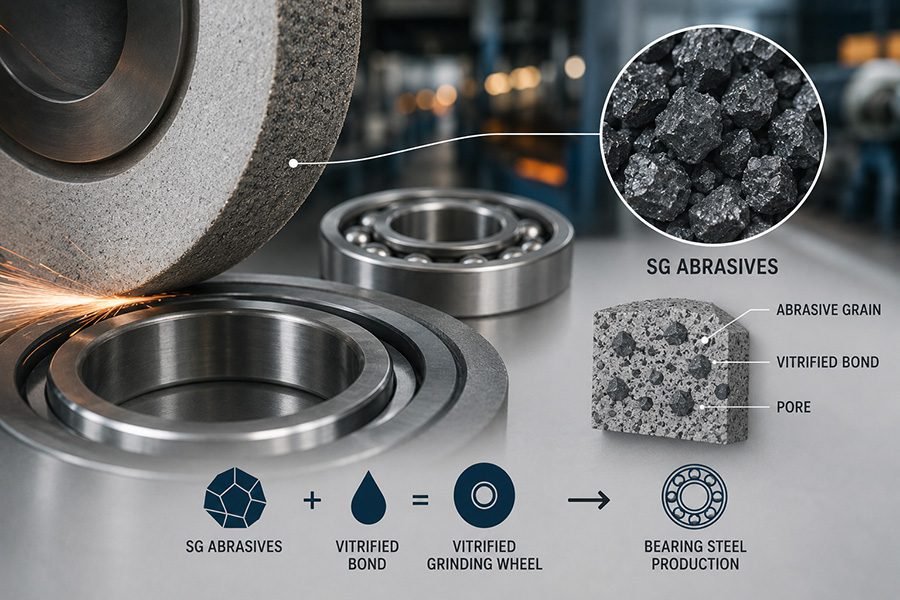
Określenie niewłaściwego ziarna ściernego do szlifowania stali łożyskowej nie tylko wydłuża czas cykli – stwarza ryzyko mikropęknięć podpowierzchniowych, które pod wpływem cyklicznego obciążenia prowadzą do przedwczesnego odpryskiwania. W masowej produkcji AISI 52100 i podobne stale hartowane na wskroś, utrzymanie chłodu, samoostrzące się cięcie przy zachowaniu tolerancji okrągłości poniżej mikrona określa żywotność procesu. W tym artykule szczegółowo opisano, jak działa zol-żel (SG) Materiały ścierne z ceramicznego tlenku glinu o spoiwie ceramicznym rozwiązują dokładnie problemy związane z awariami, jakie powodują konwencjonalne tarcze ze stopionego tlenku glinu.
Mechanika mikropęknięć i zachowanie samoostrzące
Ziarno ścierne SG zawdzięcza swoją wydajność nie samej twardości nasypowej, ale kontrolowanej strukturze podziarna powstałej w procesie spiekania zolowo-żelowego. Każde ziarno zawiera tysiące krystalitów o wielkości około 0,2–0,5 µm. Pod wpływem sił szlifujących, mikropęknięcia rozprzestrzeniają się wzdłuż granic krystalitów, zamiast powodować katastrofalne wyciąganie ziaren. Ta postępująca fragmentacja stale eksponuje ostrość, niezużyte krawędzie tnące – mechanizm zasadniczo nieobecny w standardzie stopiony tlenek glinu gdzie dominuje makrozłamanie.
W zastosowaniach ze stalą łożyskową, samoostrzenie bezpośrednio ogranicza dryft poboru mocy podczas dłuższych cykli mielenia. Stępienie koła wymusza kompensacyjny wzrost siły normalnej, co podnosi temperaturę strefy kontaktu powyżej progu austenityzacji. Konstrukcja mikrokrystaliczna SG utrzymuje stabilny reżim niskiej siły, zachowanie integralności powierzchni nawet przy agresywnym przekraczaniu wydajności usuwania naddatku 10 mm³/mm·s.
Właściwy dobór ziarna powinien uwzględniać klasę i strukturę koła. Dla kontekstu interakcji rodzaju ścierniwa z systemami spoiw, przejrzyj zasady szczegółowo opisane w naszym przewodniku na temat wybór idealnej ściernicy.
Zarządzanie temperaturą podczas szlifowania profili bieżni
Bieżnie wewnętrzne i zewnętrzne łożysk skupiają energię szlifowania w wąskim miejscu, zakrzywiona strefa kontaktu ograniczona ramionami. Bez odpowiedniego przewodzenia ciepła na styku ścierniwa ze stalą, lokalne gorące punkty przekraczają 800°C w ciągu mikrosekund – co wystarcza do wytworzenia niehartowanych białych warstw martenzytu o grubości 1–3 µm. Te ponownie utwardzone strefy działają jako miejsca inicjacji pęknięć.
Ziarna ścierne SG przyczyniają się do kontroli termicznej trzema jednoczesnymi ścieżkami:
- Niższa właściwa energia szlifowania (często 25–35% redukcji w porównaniu ze stopionym tlenkiem glinu w równoważnych warunkach) dzięki ostrzejszym krawędziom tnącym i zmniejszonemu tarciu.
- Wyższy zachowanie porowatości w wiązaniach zeszklonych; nieregularny kształt ziaren jest odporny na przedwczesne zagęszczenie, zachowując zdolność odprowadzania wiórów.
- Bardziej spójna wysokość występu piasku, który optymalizuje dostarczanie chłodziwa do łuku skrawania, zamiast odchylania od tępych wierzchołków.
Łącznie te czynniki utrzymują średnią temperaturę powierzchni poniżej krytycznego zakresu odpuszczania dla hartowanej stali łożyskowej, eliminacja przepaleń związanych z ponownym hartowaniem bez spowalniania szybkości podawania. Młyny, których celem jest wydłużenie żywotności ściernic, często oceniają alternatywne surowce ścierne; zapytania dot cena materiałów ściernych z węglika krzemu w Chinach odzwierciedlają równoległe zainteresowanie zarządzaniem przewodnością cieplną poprzez skład ziaren, chociaż tlenek glinu SG pozostaje pierwszym wyborem do precyzyjnego szlifowania metali żelaznych.
Preparat spoiwa ceramicznego do kotwienia ziaren SG
Materiał ścierny SG wymaga spoiwa zaprojektowanego specjalnie pod kątem mechaniki pękania mikrokrystalicznego. Tradycyjne spoiwo zeszklone opracowane na bazie topionego tlenku glinu albo przedwcześnie uwolni ziarna SG – powodując marnowanie materiału – albo chwyci zbyt agresywnie, negując przewagę kontrolowanego złamania. Idealny skład spoiwa równoważy dwa konkurencyjne wymagania:
- Chemia topników w wysokiej temperaturze który zwilża powierzchnię ziarna SG bez rozpuszczania struktury nanokrystalitu podczas wypalania.
- Kontrolowana porowatość po wypaleniu z połączonymi kanałami przekraczającymi 40–50% obj., umożliwiające odprowadzanie zanieczyszczeń podczas głębokich cięć ścieżek rolek łożyskowych.
- Rozszerzalność cieplna o dopasowanym module pomiędzy mostkami wiążącymi a ziarnami SG, zapobieganie tworzeniu się mikropęknięć podczas cykli termicznych w wyniku przerywanych sekwencji skrawania – biegu jałowego, powszechnych w zautomatyzowanych liniach łożyskowych.
Zaawansowane systemy zeszklone zawierają niskotopliwe kompozycje fryt i starannie dobrane substancje tworzące pory. The firing cycle must remain below the temperature at which SG grain crystallites begin to coalesce—typically under 1250°C—a parameter that limits bond maturity but preserves abrasive integrity.
Comparative Performance Metrics: SG vs. Fused Alumina in Bearing Steel
Quantifying the advantage of SG over white or brown fused alumina requires monitoring specific parameters under controlled cylindrical plunge grinding conditions on AISI 52100 (60–62 HRC). The table below synthesizes data from industrial trials conducted at a constant material removal rate of 8 mm³/mm·s with water-soluble coolant at 8 bar pressure.
| Parametr | SG Ceramic Alumina | Biały połączony tlenek glinu (WA) | Brown Soped Alumina (A) |
|---|---|---|---|
| Specific grinding energy (J/mm³) | 45–55 | 70–85 | 75–90 |
| G-ratio (volume ratio) | 80–120 | 15–25 | 20–30 |
| Surface roughness Ra (µm) | 0.15–0.25 | 0.30–0.45 | 0.35–0.50 |
| Stabilność zużycia energii (dryf % nad 100 strony) | <5% | 15–25% | 18–28% |
| Głębokość warstwy białej (µm) | Nie wykryto żadnego | 2–4 | 3–6 |
Dziesięciokrotna poprawa współczynnika G eliminuje częste zmiany kół, utrzymanie ciągłości produkcji na liniach łożyskowych pracujących w systemie zmianowym 24-godzinnym. Brak tworzenia się mierzalnej białej warstwy zapewnia zgodność ze specyfikacjami trwałości zmęczeniowej łożysk OEM bez wąskich gardeł związanych z inspekcją wytrawiania po szlifowaniu.
Kryteria doboru ziaren SG na podstawie geometrii elementów łożyska
Nie wszystkie powierzchnie nośne tolerują identyczne kombinacje wielkości ziarna i gatunku. Zwężane powierzchnie żeberek rolek, na przykład, występuje stan wejścia cienkiej krawędzi, w którym nadmierna głębokość wnikania piasku inicjuje wyłamanie krawędzi. Walce cylindryczne wymagają innej równowagi między wykończeniem powierzchni i usuwaniem naddatku.
For outer ring raceways with interrupted cut from lubrication holes, coarser SG grit (60–80 mesh) in a softer grade avoids loading without sacrificing form retention. Inner ring bores, where grinding occurs on a small-diameter wheel with high spindle speed, require finer grit (100–120 mesh) to limit individual grain penetration depth below 0.5 µm. Maintaining this depth prevents residual tensile stress reversal that distorts ring roundness after unclamping.
Procurement specifications should reference abrasive composition explicitly. While bearing steel grinding relies on ceramic alumina, other manufacturing steps sometimes require alternative media; A silicon carbide supplier in USA can address non-ferrous secondary operations within the same facility.
Integration with High-Performance Coolant Strategies
SG abrasive wheels in vitrified bonds respond predictably to optimized coolant delivery, but the synergy goes beyond simple flooding. The self-dressing action of SG grain maintains consistent surface porosity at the wheel periphery, allowing coolant to penetrate the grinding zone even as the wheel wears. Straight oil coolants, frequently specified for bearing steel to maximize lubricity, effectively wet SG grain surfaces without glazing, unlike their behavior with certain fused alumina formulations that trap swarf.
When paired with high-pressure through-coolant spindle delivery at 70–100 bar, SG vitrified wheels enable creep-feed grinding of ball screw grooves in integrated bearing assemblies—a process once deemed too thermally aggressive. The economic benefit accumulates from reduced cobalt-based bond system dependency, since vitrified bonds with SG grain significantly undercut the cost profile of resin-bonded CBN superabrasive alternatives in this hardness range.
For facilities exploring complementary raw material options in adjacent manufacturing cells, documentation on węglik boru na sprzedaż w Indiach I silica fume for silicon carbide is available through our technical resource library.
Często zadawane pytania
Q: What does SG stand for in SG abrasives, and how does it differ from conventional white fused alumina?
A: SG stands for Seeded Gel—a sol-gel-derived alpha-alumina grain nucleated with submicron seed particles. Unlike conventional white fused alumina (WFA) which fractures randomly, SG grains exhibit a microcrystalline structure that promotes controlled microfracture under grinding loads. This self-sharpening mechanism maintains grain sharpness and reduces specific grinding energy (NP., ~30% lower than WFA in many bearing steel operations).
Q: Why are SG abrasives particularly effective for grinding bearing steels such as 52100 or 100Cr6?
A: Bearing steels like 52100 (1.0% C, 1.5% Cr) have high hardness after heat treatment—typically 60–66 HRC—and generate intense frictional heat. SG grains, with their nano-scale crystallites (0.1–0.5 µm), enable controlled grain pullout at the submicron level, exposing fresh cutting edges continuously. This minimizes thermal damage (NP., grinding burn and white etching layer formation) while achieving surface finishes below Ra 0.2 µm.
Q: What bond system works best with SG abrasives in vitrified wheels for bearing rings?
A: Alkali-free borosilicate or high-strength lithium-aluminosilicate vitrified bonds are most effective, as they fire at 1100–1250°C and create a strong, porous matrix that retains SG grains without chemical attack. The bond content is typically optimized to 8–14 vol%; excessive bond reduces porosity (needed for coolant flow) and can cause glazing. For bearing raceway grinding, bond hardness grades around K–L are common.
Q: How does SG abrasive wheel life compare to conventional wheels in centerless grinding of bearing rollers?
A: In production data from precision bearing plants, SG vitrified wheels last 3–5 times longer than standard WFA wheels in centerless grinding of 100Cr6 rollers. Dressing intervals extend from every 100–150 parts to every 400–600 parts, while maintaining consistent roundness (NP., ≤ 1.5 µm) and reducing dressing diamond wear. Metal removal rates can increase by 20–40% without sacrificing surface integrity.
Q: Can SG wheels run dry or with minimal coolant on hardened bearing steel?
A: For bearing steel grinding, flood coolant is strongly recommended—even with SG wheels. SG abrasives reduce specific energy but still generate substantial heat at high MRR. In one test with 52100 steel, switching from WFA to SG reduced workpiece temperature rise by 15–20°C under identical coolant flow, but dry grinding still risked microstructural softening. Use a high-cetane, water-miscible oil at ≥15 L/min per wheel cm width.
O Henan Superior Aredives (HSA)
Henan Superior Aredives (HSA) jest chińskim producentem i globalnym dostawcą wysokowydajnych materiałów ściernych i zaawansowanych materiałów ceramicznych do zastosowań przemysłowych na całym świecie. Nasz podstawowy asortyment produktów obejmuje czarny węglik krzemu, zielony węglik krzemu, węglik krzemu klasy elektronicznej (Sic), biały stopiony tlenek glinu, brązowy stopiony tlenek glinu, Węglenie borowe, stopione gliniany wapnia, i materiały ścierne SG.
Obsługa klientów w 30+ kraje, HSA dostarcza niezawodne materiały do materiałów ściernych, refraktory, ceramika techniczna, zastosowania półprzewodników, precyzyjne polerowanie, piaskowanie, metalurgia, i wysokiej jakości materiały budowlane. Our products are manufactured under strict quality control standards to ensure consistent particle size distribution, czystość, and stable performance across demanding industrial applications.
Uzyskaj wycenę lub bezpłatną próbkę
Poszukujemy niezawodnego dostawcy najwyższej jakości materiałów ściernych i zaawansowanych materiałów ceramicznych? Skontaktuj się z naszym zespołem technicznym już dziś — odpowiemy w ciągu 24 godzin i może zorganizować bezpłatne próbki dla kwalifikujących się projektów.
- 📧 E-mail: sales@superior-abrasives.com
- 💬 WhatsApp: +86-186-3863-8803