W miarę zaostrzania się światowych przepisów dotyczących emisji w stosunku do normy Euro 6 do Chin VI, the humble Diesel Particulate Filter has become one of the most critical components in modern vehicle design. At its heart lies a single material that makes all of it possible: Krzemowy węglik (Sic) — a ceramic that combines extraordinary heat resistance, mechanical durability, and filtration efficiency in a way no other material can match.
What Is a Diesel Particulate Filter — and Why Does Material Matter?
A Diesel Particulate Filter is an exhaust aftertreatment device engineered to capture and oxidize carbonaceous soot particles produced during diesel combustion. Without a DPF, these fine particulates — many below 2.5 microns — enter the atmosphere and contribute to respiratory disease, smog, and regulatory non-compliance.
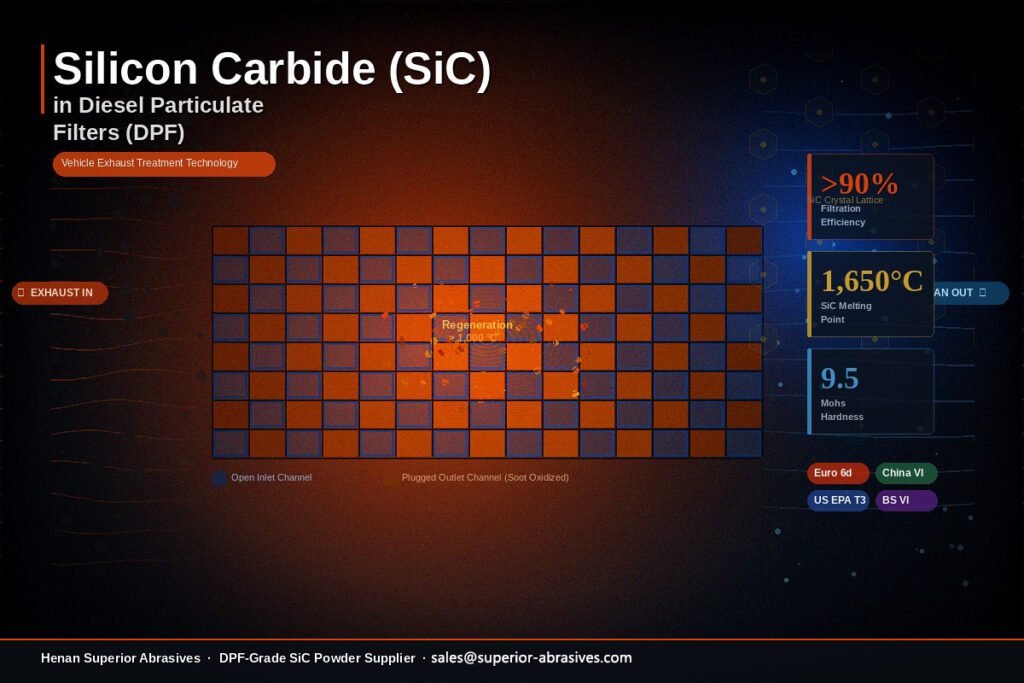
The DPF operates in an extreme environment: exhaust gas temperatures can routinely reach 600–900°C, and during active regeneration — the high-temperature burn-off cycle that clears accumulated soot — temperatures inside the filter can spike beyond 1,000°C. The substrate material must not only survive these conditions but maintain dimensional stability, filtration integrity, and low back-pressure cycle after cycle, for the life of the vehicle.
That is exactly why Silicon Carbide emerged — and why it now dominates the market for passenger car and light-duty DPF substrates globally.
The Material Science Behind SiC’s Dominance in DPF
Krzemowy węglik is a covalently bonded compound of silicon and carbon (Sic) that forms a crystalline lattice of exceptional rigidity. Its application in DPF substrates is not incidental — it is the result of its unique convergence of properties that are precisely matched to the demands of exhaust aftertreatment.
Właściwości termiczne: Surviving the Regeneration Cycle
The regeneration event is the single most thermally demanding moment in DPF operation. Accumulated soot is burned off at temperatures exceeding 550°C, and in uncontrolled regeneration events, localized “thermal runaway” can push temperatures well above 1,000°C. Most cordierite substrates — SiC’s main competitor — begin to soften and deform above 1,200°C.
- Melting point of ~1,650°C: SiC provides a substantial safety margin above the highest regeneration temperatures encountered in service.
- Thermal conductivity of 120–170 W/m·K: SiC dissipates heat rapidly and evenly across the substrate, preventing dangerous hot-spot formation.
- Low coefficient of thermal expansion (4.0 × 10⁻⁶/°C): The substrate expands and contracts predictably without cracking or delaminating over thousands of thermal cycles.
- High specific heat capacity: SiC absorbs and releases heat in a controlled manner, stabilizing temperatures during rapid load changes.
Mechanical Strength: Withstanding Road Vibration and Pressure
A DPF mounted beneath a vehicle is subject to constant mechanical vibration, exhaust pressure pulses, and mounting stress. SiC ceramics exhibit a flexural strength of 300–500 MPa, significantly higher than cordierite, allowing manufacturers to produce thinner-walled honeycomb structures without sacrificing structural integrity. Thinner walls mean lower back-pressure on the engine, which directly translates to fuel efficiency and power output.
Odporność chemiczna: Surviving the Exhaust Environment
Diesel exhaust contains sulfur compounds, hydrocarbons, nitrogen oxides, and water vapor — a chemically aggressive mixture at high temperatures. SiC’s outstanding oxidation resistance stems from a passive SiO₂ passivation layer that forms on the surface, protecting the bulk material from further oxidation. This self-protecting behavior is critical for long service life in the harsh under-hood environment.
Technical Note: The thermal conductivity advantage of SiC over cordierite (roughly 10–15× higher) is why SiC DPFs reach regeneration temperature faster and cool down more uniformly — a key factor in reducing thermal stress and extending substrate service life.
How SiC DPF Substrates Are Manufactured
The production of a SiC DPF substrate is a precision ceramic manufacturing process that begins with the quality of the raw SiC powder. Understanding this process helps buyers and engineers specify the correct material grade from the outset.
Step 1 — Raw Material Selection
High-purity alpha-SiC powder (≥99% SiC content) is selected as the base material. Particle size distribution is tightly controlled — typically D50 values in the 10–50 µm range — since particle size directly affects the porosity, permeability, and wall strength of the finished substrate.
Step 2 — Plasticization and Extrusion
SiC powder is blended with organic binders, pore-forming agents, and plasticizers, then extruded through a precision die to form the characteristic honeycomb channel structure. Cell density is typically 200–300 cells per square inch (cpsi) for automotive DPF applications.
Step 3 — Drying and Sintering
After extrusion and channel-end plugging (alternate channels are plugged to force exhaust through the porous walls), the green body is dried and then sintered at temperatures of 2,000–2,200°C in a controlled atmosphere. This step densifies the SiC skeleton, burns out the organic binders, and establishes the final pore structure.
Step 4 — Catalyst Washcoating (Optional)
For SCRF (Selective Catalytic Reduction Filter) applications, a catalyst washcoat containing platinum group metals (PGM) or base metal oxides is applied to the internal channel walls, converting NOₓ gases simultaneously with soot filtration.
SiC vs. Cordierite: DPF Substrate Material Comparison
| Nieruchomość | Krzemowy węglik (Sic) | Cordierite |
|---|---|---|
| Max Use Temperature | ~1,400°C continuous | ~1,200°C (softens above) |
| Thermal Conductivity | 120–170 W/m·K | 1.5–3.0 W/m·K |
| Coefficient of Thermal Expansion | 4.0 × 10⁻⁶/°C | 1.0–2.0 × 10⁻⁶/°C |
| Flexural Strength | 300–500 MPa | 150–200 MPa |
| Density | ~3.1 g/cm³ | ~2.1 g/cm³ |
| Primary DPF Application | Passenger cars, light trucks | Heavy-duty trucks, SCR-only |
| Regeneration Tolerance | Excellent | Umiarkowany |
| Relative Cost | Wyższy | Niżej |
Regulatory Drivers: Why SiC DPF Demand Is Accelerating
The shift toward stricter particulate emissions standards worldwide is the single most powerful driver of SiC DPF adoption. Each successive regulation imposes tighter limits on particle number (PN) and particle mass (PO POŁUDNIU), requiring higher-performance substrates.
Key Emissions Standards Requiring DPF Technology
- Euro 6d (Europa): Requires PN ≤ 6 × 10¹¹ particles/km for light-duty diesel vehicles — effectively mandating a high-efficiency DPF on every diesel car sold in Europe.
- China VI (Chiny): Directly equivalent to Euro 6d; implemented for light-duty vehicles from July 2020, and for heavy-duty vehicles from July 2021.
- US EPA Tier 3 / California LEV III: Stringent PM standards applied to all light-duty vehicles, driving DPF adoption even in gasoline particulate filter (GPF) applications where SiC is gaining share.
- BS VI (India): Leapfrogged from BS IV directly to BS VI in 2020, creating a massive overnight demand for DPF-equipped diesel powertrains across one of the world’s largest vehicle markets.
Market Insight: The global DPF market is projected to grow substantially through 2030 as emerging markets implement Euro 6-equivalent standards. SiC substrate demand is directly correlated — SiC DPF procurement cycles typically run 18–36 months from raw material specification to vehicle integration.
Specifying SiC for DPF Applications: What Buyers Must Know
For ceramic substrate manufacturers, catalyst coaters, and tier-1 automotive suppliers sourcing SiC powder for DPF production, material specification is not a commodity decision. The following parameters are critical:
Purity and Phase Composition
DPF-grade SiC should be alpha-phase (6H or 4H polytype) with a minimum purity of 98.5–99.5% SiC. Free silicon content must be minimized as it oxidizes preferentially and can disrupt sintering. Iron and other metallic impurities must be controlled to avoid catalytic activity that could alter regeneration behavior.
Particle Size Distribution (PSD)
The PSD of the input powder directly controls the pore size distribution of the sintered substrate, which in turn governs both filtration efficiency and pressure drop. Suppliers must provide full D10/D50/D90 data, not simply a median value. Bimodal distributions are sometimes specified to optimize the packing density of the green body before sintering.
Morphology and Surface Area
Platelet-shaped SiC particles are preferred for DPF applications as they pack with higher green density and produce stronger sintered necks compared to equiaxed morphologies. Specific surface area (BET) values of 1–5 m²/g are typical for DPF-grade powders.
Batch-to-Batch Consistency
Automotive supply chains demand extraordinary consistency. SiC powder lots must carry full certificates of analysis (CoA) with traceable calibration, and suppliers should be able to demonstrate statistical process control (SPC) data across production batches. A deviation in D90 tail values of even 5–10% can produce unacceptable variation in substrate back-pressure across a production run.
Często zadawane pytania
Q: Why is Silicon Carbide used in DPF instead of other ceramic materials?
SiC offers the optimal combination of thermal conductivity, high-temperature strength, and chemical resistance for DPF applications. Its thermal conductivity — roughly 50–100× higher than cordierite — allows faster, more uniform regeneration while minimizing dangerous thermal gradients. No other cost-viable ceramic material matches this combination of properties for passenger car DPF use cases.
Q: What is the difference between alpha-SiC and beta-SiC for DPF powder?
Alpha-SiC (sześciokątna struktura kryształu, 6H/4H polytypes) is the preferred form for DPF substrate manufacturing because it is thermodynamically stable above 2,000°C and sinters to higher density. Beta-SiC (sześcienny, 3C polytype) is less stable at sintering temperatures and can undergo a phase transformation during processing, which can introduce microstructural defects. DPF-grade SiC powder specifications typically call for alpha-SiC with a beta-SiC content below 5%.
Q: How does DPF regeneration work and how does SiC enable it?
As soot accumulates on the DPF walls, engine back-pressure increases. At a trigger threshold, the engine management system initiates regeneration — either passive (using exhaust heat from high-load operation) or active (injecting post-combustion fuel to raise exhaust temperature). SiC’s high thermal conductivity ensures the entire substrate reaches soot combustion temperature (~550–650°C) quickly and uniformly, preventing localized over-temperature events that can crack or melt inferior substrates.
Q: Can SiC DPFs be used for gasoline engines as well?
Tak. Gasoline Particulate Filters (GPFs) for gasoline direct injection (GDI) engines are increasingly required under Euro 6d and China VI regulations. SiC GPFs follow similar design principles to diesel DPFs, though the lower soot loading rates in GDI engines mean thinner walls and lower cell densities are often acceptable. SiC’s thermal stability remains a key advantage in GPF applications, where exhaust temperatures can briefly exceed those encountered in diesel operation.
Q: What SiC particle size is used to manufacture DPF substrates?
DPF substrate manufacturers typically use SiC powders with D50 values in the range of 10–50 µm for the main batch, often combined with a finer fraction (D50 of 1–5 µm) to fill inter-particle voids in the green body. The resulting sintered substrate has mean pore sizes of 10–20 µm — large enough to prevent excessive pressure drop while small enough to efficiently capture sub-micron soot particles.
Q: How do I qualify a new SiC powder supplier for DPF manufacturing?
A robust supplier qualification process should include: (1) full chemical analysis with ICP-OES for trace metals, (2) XRD phase analysis confirming alpha-SiC content and beta-SiC quantification, (3) laser diffraction PSD with D10/D50/D90 across a minimum of 10 consecutive production lots, (4) BET surface area and SEM morphology characterization, I (5) a pilot sintering trial comparing substrate porosity, MOR (modulus of rupture), and pore size distribution against your current qualified supplier. Request IATF 16949 certification evidence for automotive-grade supply chains.
Source High-Purity SiC Powder for DPF Manufacturing
Henan Superior Aredives (HSA) supplies FEPA- and ISO-certified Silicon Carbide powder to ceramic substrate manufacturers, catalyst coaters, and automotive tier-1 suppliers worldwide. Our DPF-grade SiC delivers the purity, PSD consistency, and phase control your production requires.
Alpha-SiC ≥99.0%, with full ICP-OES trace metal certification per batch.
SPC-monitored PSD with D10/D50/D90 CoA on every production lot.
Custom particle size ranges from D50 = 1 µm to 50 µm; bimodal blends available.
Serving 60+ countries with reliable lead times and dedicated technical support.