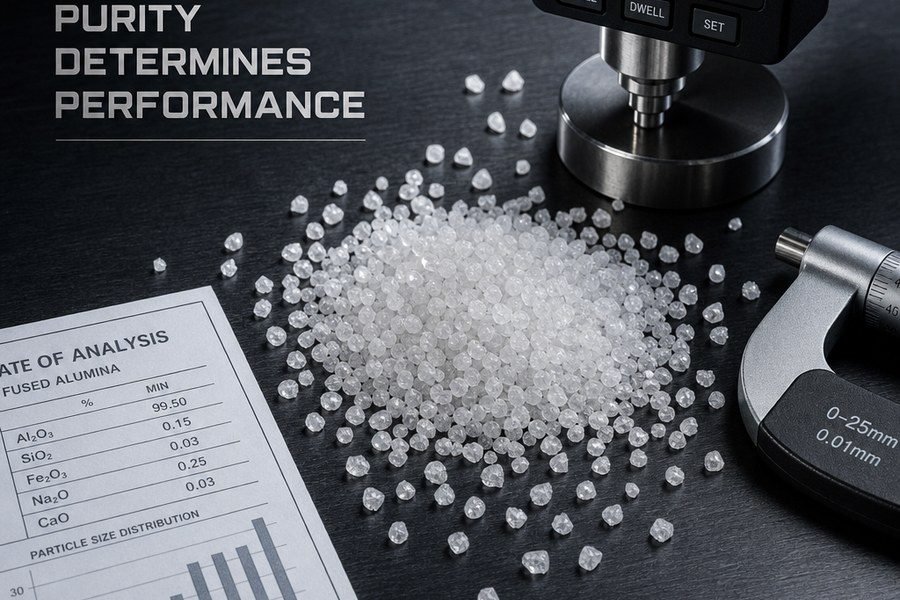
Et unøyaktig analysesertifikat for hvit smeltet alumina (WFA) gjør mer enn en feilaktig fremstilling av en forsendelse – det kan forårsake katastrofal feil i ildfast foring, inconsistent surface profiles in abrasive blasting, or a 15–20% drop in bonded wheel life. Engineers and procurement specialists who rely solely on a supplier’s bullet-point assurances risk installing media with hidden high-sodium content or residual un-fused alpha alumina, leading to spalling, premature wear, and costly production stoppages. This guide decodes the critical chemical and physical parameters you must verify on a COA to ensure the WFA meets your exact application requirements.
1. Understanding the Critical Role of Chemical Composition
Chemical purity separates premium white fused alumina from basic electro-fused material. A COA lists primary constituents and trace impurities, each exerting specific influence over refractory stability and abrasive cutting action. Al₂O₃ content directly governs hardness, while alkali oxides dictate high-temperature performance. Ignoring these values invites unpredictable thermal expansion and reduced bonding strength in vitrified wheels. For a broader overview of related materials, see our guide on white, black, and brown fused alumina.
Al₂O₃ on the COA represents total available aluminum oxide, but the specification you truly need is alpha alumina (α-Al₂O₃) phase content. A fusion process that runs too cool or proceeds too quickly leaves unconverted gamma alumina, a soft, hygroscopic phase that compromises grain toughness. A COA reporting 99.30% Al₂O₃ with only 92% alpha phase will perform worse in grinding hard steels than a 99.10% Al₂O₃ grain with 97% alpha phase. Always cross-reference the total Al₂O₃ with the alpha phase percentage; reputable producers explicitly list this value.
2. The Critical Impurity: Controlling Sodium Oxide (Na₂O)
Of all trace elements, sodium oxide demands the strictest scrutiny. Industrial alumina feedstock contains residual Na₂O from the Bayer refining process, and inadequate fusion fails to volatilize it. Entrapped sodium reacts with silicate bonds in refractory castables, forming a glassy phase that slashes hot modulus of rupture (HMOR) by up to 30% at 1,300°C. In abrasives, high Na₂O creates a weaker crystal lattice that dulls rapidly under pressure. To understand the broader applications of this material, explore the use of silicon carbide in similar demanding environments.
- Reacted sodium chemically binds within the alumina crystal after proper fusion, presenting lower risk.
- Unreacted sodium persists as free Na₂O, actively forming low-melting eutectics with silica in service.
- Top-tier WFA specifies Na₂O ≤ 0.30%, with premium grades achieving ≤ 0.10% through controlled, extended melting.
3. Quantifying Physical Integrity: Bulk Density and Grain Shape
A COA should report more than chemical data. Physical properties—particularly bulk density—reveal grain porosity and crystal solidity, parameters invisible to compositional analysis alone. A chemically pure grain riddled with internal voids behaves like a weaker material, absorbing bond and fracturing at low thresholds. Bulk density provides a direct proxy for this structural soundness.
Accurate assessment requires testing per ASTM C29 or ISO 5311 standards. Denser grains pack greater mass into the same volume, signifying a fully fused structure with minimal gas entrapment. When comparing two WFA lots of identical size distribution, the one with lower bulk density invariably contains more hollow grains and will yield lower stock removal rates. Always demand that the COA lists the specific standard used for the measurement. For a deeper dive into the fundamentals, read more about what fused alumina is.
| WFA Application | Critical COA Parameter | Risk of Non-Conformance |
|---|---|---|
| Refractory Castables | Na₂O ≤ 0.15% | Formation of beta-alumina; premature hot strength loss |
| Bonded Grinding Wheels | Bulkdensitet | Reduced grain retention; excessive dressing frequency |
| Blasting Media | Partikkelstørrelsesfordeling | Inconsistent surface profile; anchor pattern failure |
| Ceramic Foam Filters | α-Al₂O₃ Phase ≥ 95% | Hydration of gamma phase causing casting defects |
4. Decoding Particle Size Distribution: The FEPA Standard Nuances
Macrogrits typically follow FEPA F-designations (F12–F220), while microgrits adhere to the P-series (P240–P2500). A COA must specify not just the nominal grade but the allowed limits for coarse, median, and fine fractions. Overly wide distributions cause segregation in refractory mixes and produce scattered surface finishes in precision grinding. These values define the grain’s functional range, not just a label.
A true F46 specification requires a d50 (median size) between 310 og 370 µm, yet a cheaply processed batch might comply with F46 on the d3 oversize limit while carrying an excessively high volume of -45 µm fines. Those fines create a sludge problem in coolant systems and rob bond strength in abrasive products. Sophisticated buyers request the d10, d50, and d90 values on the COA to map the full distribution curve. A tight d90/d50 ratio signals sharp classification, translating to consistent material removal and predictable packing density in shaped refractories.
5. Validating Crystal Structure Through Loose Packing Density
Loose packing density goes beyond simple mass measurement to quantify how grain geometry and surface texture interact. Kantete, blocky grains from a properly fused, slow-cooled ingot achieve higher packing density than splintery or needle-like grains from a rushed process. This parameter directly correlates with thermal conductivity in refractory backup linings and with abrasive particle spacing in resin-bond wheels. For more on related materials, see our complete guide on advanced ceramics silicon carbide abrasives.
- Pour the WFA sample into a calibrated density cup without tapping or vibration per the referenced ISO/ASTM standard.
- Verify the measured value against the supplier’s specification—premium WFA typically yields 1.75–2.05 g/cm³ for F24–F80 grits.
- Cross-check the result against bulk density: a significant divergence indicates poor shape control or excessive fine contamination.
- Reject any lot whose packing density falls more than 5% below the contracted minimum, as this signals operational shortcuts in crushing and classifying.
6. Spotting COA Red Flags: Magnetic Material and Hidden Moisture
Even a COA displaying excellent chemistry and sizing can conceal a crucial defect: magnetic iron contamination. During the fusion process, the breakdown of graphite electrodes and reaction with iron-bearing bauxite or alumina generates ferrosilicon and magnetite particulates. Without thorough magnetic separation, these particles embed in the white fused alumina and later oxidize in a refractory lining, creating localized hot spots and spalling in service.
A value exceeding 0.05% magnetic material on the COA warrants immediate rejection for any ceramic or high-temperature application.
Moisture content in the final product often appears as an afterthought on the COA but matters greatly. WFA shipped in unlined containers from humid origins can absorb over 0.3% moisture, fremme kaking i bulkhåndteringssystemer og introdusere hydroksylioner i ildfaste blandinger. En robust COA vil rapportere fuktighet som en egen linjepost målt ved tap ved tørking, med en verdi under 0.10% nødvendig for pressklar pulverapplikasjoner. Aldri godta et COA som utelater disse tilsynelatende mindre parametrene - deres fravær signaliserer ofte en leverandør som ikke kontrollerer hele produksjonsprosessen fra fusjon til sluttemballasje. For ytterligere innsikt i materialegenskaper, lære om versatility of calcined alumina.
Ofte stilte spørsmål
Q: What Al₂O₃ percentage indicates true high-purity White Fused Alumina on a COA?
EN: For premium quality White Fused Alumina, the Certificate of Analysis (COA) should show an Al₂O₃ content of at least 99.5% by mass, with top-tier grades exceeding 99.7%. Anything below 99.0% typically indicates contamination from bauxite residues or incomplete electrofusion, which will degrade refractory performance.
Q: What maximum sodium oxide (Na₂O) level should I accept for optimal refractory-grade WFA?
EN: Na₂O-innholdet på en gyldig COA må være strengt ≤ 0.35% etter vekt. Nivåer over 0.40% indikerer dårlig vask eller utilstrekkelig elektrolyse, fører til keramisk oppblåsthet og redusert termisk sjokkmotstand i ovnsapplikasjoner. For WFA med slipemiddel, en grense på ≤ 0.40% er vanligvis akseptabelt.
Q: Hva er det kritiske magnetiske materialet (Fe203 + SiO2) terskel for å forhindre glasurfeil?
EN: For å unngå brannflekker og overflategroping i teknisk keramikk, det kombinerte Fe2O3- og SiO2-innholdet på COA bør ikke overstige 0.15% (ideelt sett <0.10%). The individual Fe₂O₃ value must stay below 0.05% for white-fired products; higher iron content creates unacceptable brown spotting at temperatures above 1500°C.
Q: What specific particle size distribution (PSD) tolerances must a COA show for consistent blasting media?
EN: For standard FEPA or ANSI grits (f.eks., F24 or #24), the COA must guarantee that at least 90% of the material passes through the designated nominal sieve and that no more than 8% remains on the next coarser sieve. The cumulative retained on the two coarsest sieves must be ≤ 15%, with fines (-63 microns for coarse grits) limited to < 2% to ensure consistent cutting speed.
Q: How do I verify true crystal density on a COA and why is it essential for sintering?
EN: High-density WFA should report a true density of ≥ 3.95 g/cm³ (often 3.96–3.99 g/cm³) when tested by helium pycnometry per ISO 5017. A reading below 3.90 g/cm³ signals trapped porosity or vitrification from leftover SiC, which directly reduces the sintering density of a finished refractory brick or ceramic part by up to 2–3%.
Om Henan Superior slipemidler (HSA)
Henan Superior slipemidler (HSA) er en Kina-basert produsent og global leverandør av høyytelses slipende og avanserte keramiske materialer for industrielle applikasjoner over hele verden. Kjerneproduktutvalget vårt inkluderer svart silisiumkarbid, grønn silisiumkarbid, elektronisk silisiumkarbid (Sic), hvit smeltet alumina, brunt smeltet alumina, Borkarbid, smeltede kalsiumaluminater, og SG-slipemidler.
Betjener kunder i 30+ land, HSA leverer pålitelige materialer for slipemidler, ildfaste stoffer, teknisk keramikk, halvlederapplikasjoner, presisjonspolering, sandblåsing, metallurgi, og høyytelses byggematerialer.
Få et tilbud eller gratis prøve
Ser etter en pålitelig leverandør av premium slipende og avanserte keramiske materialer? Kontakt vårt tekniske team i dag - vi svarer innen 24 timer og kan arrangere gratis prøver for kvalifiserte prosjekter.
- 📧 E -post: sales@superior-abrasives.com
- 💬 WhatsApp: +86-186-3863-8803