Krzemowy węglik (Sic) is widely used in abrasives, Materiały refrakcyjne, ceramika, metalurgia, surface treatment, and other industrial applications. Jednakże, buyers who are new to silicon carbide often encounter different product descriptions such as SiC Splits, silicon carbide macro grit, and micro powder.
What is the difference between them? What particle sizes do they represent? And which type should you choose for your application?
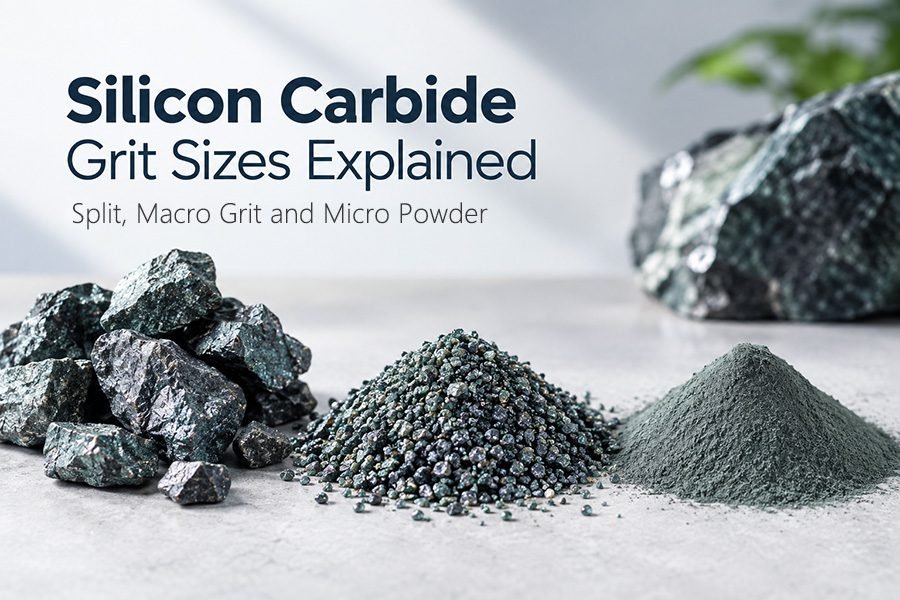
This guide explains the three main forms of silicon carbide by particle size: Split/segment material, macro grit, and micro powder.
Silicon Carbide Size Classification
Silicon carbide products can generally be classified according to their particle size:
| Product Type | Typical Particle Size | Common Specifications |
|---|---|---|
| Silicon Carbide Split | Approx. 0.5–12 mm | 0–1 mm, 1–3 mm, 3–5 mm, 5–8 mm |
| Silicon Carbide Macro Grit | Approx. 75–1700 μm | F12–F220 |
| Silicon Carbide Micro Powder | Usually below 63 μm | W63, W50, W40, W28, W20, W14, W10, W7, W5 |
The exact particle-size distribution depends on the applicable standard, screening process, and customer’s specification. Dlatego, a grade such as F120 or W20 should not be interpreted simply as one fixed particle diameter.
What Is Silicon Carbide Split or Segment?
Silicon carbide Split, sometimes called SiC Split, SiC segment, or coarse silicon carbide, refers to relatively large pieces of silicon carbide obtained after crushing and screening the SiC material.
Typical sizes include:
- 0–1 mm
- 1–3 mm
- 3–5 mm
- 5–8 mm
- 8–12 mm
Larger sizes may also be available for specific industrial applications.
Applications of Silicon Carbide Split
Coarse silicon carbide is commonly used in:
- Materiały refrakcyjne
- Steelmaking and metallurgy
- Foundry applications
- Furnace linings
- Ceramic production
- Abrasive raw materials
- Silicon carbide processing
For refractory and metallurgical applications, customers often purchase SiC according to a simple size range such as 1–3 mm or 3–5 mm, rather than an F-number.
What Is Silicon Carbide Macro Grit?
Silicon carbide macro grit, also known as SiC grit or abrasive grain, is a more precisely classified material produced by crushing, processing, and screening silicon carbide.
It is widely used in:
- Tarcze szlifierskie
- Cutting tools
- Abrasive papers
- Sandblasting
- Surface preparation
- Materiały refrakcyjne
- Ceramic applications
One of the most common grading systems is the F-grit system.
Common Silicon Carbide F Grit Sizes
| Piasek | Approximate Particle Size |
|---|---|
| F12 | ~1.7 mm |
| F16 | ~1.2 mm |
| F20 | ~850 μm |
| F24 | ~710 μm |
| F30 | ~600 μm |
| F36 | ~500 μm |
| F46 | ~355 μm |
| F54 | ~300 μm |
| F60 | ~250 μm |
| F80 | ~180 μm |
| F100 | ~150 μm |
| F120 | ~125 μm |
| F150 | ~106 μm |
| F180 | ~90 μm |
| F220 | ~75 μm |
These values are provided as a general reference. Actual particle-size distribution should always be confirmed according to the relevant standard and product specification.
Na przykład
If a customer asks for:
Zielony krzemowa węglika, 100–120 μm
the requested material is generally within the range of fine silicon carbide grain and is close to the F120 range.
Jednakże, 100–120 μm should not automatically be treated as exactly equivalent to F120. F-grit specifications are based on particle-size distribution requirements rather than a single particle diameter.
For international business, it is therefore important to confirm the customer’s required standard before quoting.
What Is Silicon Carbide Micro Powder?
Silicon carbide micro powder is a much finer form of SiC, generally used when a controlled fine particle size is required.
Micro powder is commonly specified using W grades, jak na przykład:
- W63
- W50
- W40
- W28
- W20
- W14
- W10
- W7
- W5
- W3.5
- W1.5
The number generally indicates the nominal or maximum particle-size classification under the applicable grading system.
Common Silicon Carbide Micro Powder Sizes
| Micro Powder Grade | Approximate Size Classification |
|---|---|
| W63 | <63 μm |
| W50 | <50 μm |
| W40 | <40 μm |
| W28 | <28 μm |
| W20 | <20 μm |
| W14 | <14 μm |
| W10 | <10 μm |
| W7 | <7 μm |
| W5 | <5 μm |
| W3.5 | <3.5 μm |
| W1.5 | <1.5 μm |
The actual distribution can vary according to the production process and applicable standard.
Applications of SiC Micro Powder
Silicon carbide micro powder is used in applications such as:
- Advanced ceramics
- Precision abrasives
- Polishing
- Ceramic coatings
- Electronic materials
- Refractory formulations
- Surface treatment
- Specialized grinding applications
Fine SiC powder is particularly useful when surface finish, particle uniformity, or fine-particle packing is important.
F Grit vs. W Micro Powder: What Is the Difference?
One common question from buyers is the difference between F-grit silicon carbide I W-grade silicon carbide micro powder.
The main difference is the particle-size range and grading system.
F Grys
F grades are commonly used for abrasive grains and relatively coarser particles.
Examples:
F24, F36, F46, F60, F80, F100, F120, F150
W Micro Powder
W grades are generally used for finer silicon carbide powders.
Examples:
W63, W50, W40, W28, W20, W14, W10, W7, W5
Dlatego, a simple rule of thumb is:
F grade → macro grit
W grade → micro powder
Jednakże, buyers should always specify the applicable standard and particle-size distribution when requesting a quotation.
Which Silicon Carbide Size Should You Choose?
The appropriate SiC particle size depends primarily on the application.
For refractory materials
Customers may prefer:
0–1 mm
1–3 mm
3–5 mm
5–8 mm
A combination of different particle sizes may also be used to optimize packing density.
For abrasive applications
Typical grades include:
F24, F36, F46, F60, F80, F100, F120
Coarser grades are generally selected for applications requiring more aggressive material removal, while finer grades are used where a finer surface finish is required.
For precision applications
Fine grades such as:
W20, W14, W10, W7, W5
may be considered when a smaller particle size is required.
The final selection should be based on the customer’s equipment, processing conditions, required surface finish, and technical specification.
Why Particle Size Distribution Matters
When purchasing silicon carbide, it is not enough to look only at the nominal grade.
Two products with similar nominal sizes can have different particle-size distributions.
Important parameters may include:
- Particle-size distribution
- Maximum particle size
- Minimum particle size
- SiC purity
- Darmowy węgiel
- Fe₂o₃
- Moisture
- Magnetic impurities
- Gęstość nasypowa
- Packing method
For industrial applications, buyers should request a Technical Data Sheet (TDS) I Certificate of Analysis (Certyfikat ważności) to verify the actual product specification.
How to Specify Silicon Carbide When Requesting a Quotation
To avoid misunderstandings, buyers should provide as much information as possible.
A good RFQ could look like this:
Produkt: Zielony krzemowa węglika
Czystość: ≥99% SiC
Rozmiar cząstek: 100–120 μm
Aplikacja: Ceramic production
Quantity: 20 Mt
Opakowanie: 25 torby kg
Destination: India
If the customer requires a specific grading system, it is better to state it explicitly:
Green SiC F120 according to the required standard
rather than simply saying:
120 μm SiC
This allows the supplier to confirm whether the requested material meets the customer’s particle-size distribution requirements.
Silicon Carbide Size Selection at a Glance
A simple way to understand the three categories is:
Split
mm range → 0–1 mm, 1–3 mm, 3–5 mm, 5–8 mm
↓
Grain / Piasek
tens to thousands of μm → F12–F220
↓
Mikro proszek
generally below 63 μm → W63–W1.5
The finer the required particle size, the more important particle-size distribution and classification become.
Wniosek
Silicon carbide is available in a wide range of particle sizes, from coarse millimeter-sized material to ultra-fine micro powder.
The three common categories are:
- Silicon carbide Split/segment: mainly mm-sized material
- Silicon carbide macro grit: commonly classified by F grades
- Silicon carbide micro powder: commonly classified by W grades
Choosing the correct size depends on the application rather than simply selecting the finest or highest grade available.
If you are sourcing green silicon carbide or czarny węglik krzemu, it is recommended to provide the required SiC purity, wielkość cząstek, grading standard, ilość, application, and packaging requirements when requesting a quotation. This allows the supplier to recommend the appropriate specification and provide a matching TDS and COA.