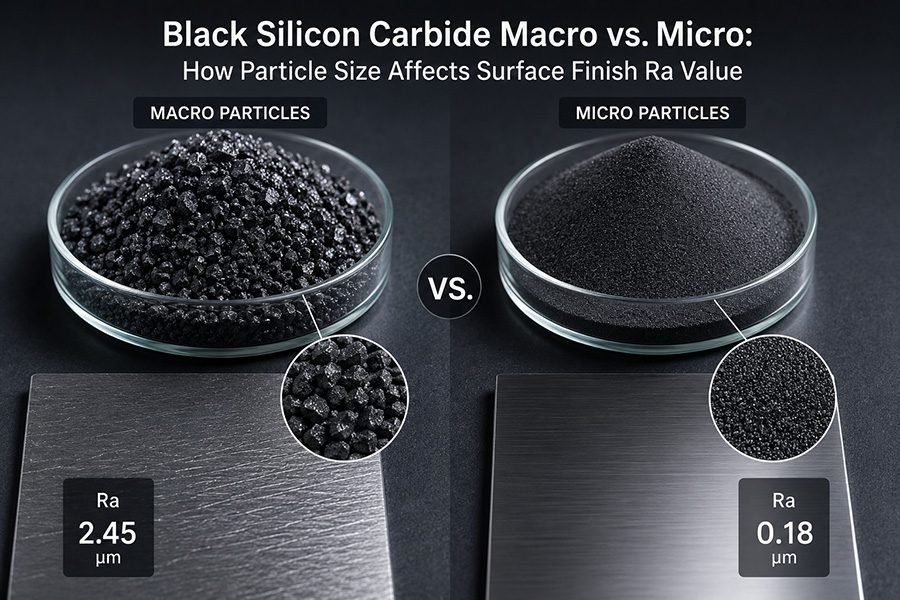
Specifying the wrong particle size range for black silicon carbide is not a minor calibration error — it is a root cause of chronic Ra non-conformance, rework loops, and scrapped components. A grinding or lapping operation optimized for a macro grit will produce a surface 8–15× rougher than the same substrate processed with the correct micro or sub-micro powder. Understanding how particle size distribution translates to measurable Ra outcomes lets engineers lock in surface finish at the process design stage rather than through iterative trial and rejection.
How Abrasive Particle Size Physically Generates Surface Roughness
Every abrasive grain engaged at a workpiece surface acts as a single-point indenter. The maximum groove depth it can generate scales approximately with the square root of the grain diameter multiplied by applied load and substrate hardness. For black silicon carbide — with a Mohs hardness of 9.1 and fracture toughness that encourages sharp sub-fracture edges — this relationship is particularly pronounced. Larger grains cut deeper, wider grooves; the statistical envelope of those grooves defines Ra.
Grain shape and size distribution width compound this effect. A broad distribution (high D90/D10 ratio) means outlier coarse particles establish peak-to-valley heights well above the median grain’s contribution, driving Ra upward unpredictably. Tight distributions, typical of precision-graded micro powders, constrain this variance and make Ra targets repeatable across production batches.
Macro Grit Range: Aggressive Stock Removal, Coarser Finish Baseline
Macro grits — generally FEPA F12 through F220 (roughly 1,680 µm down to 53 µm median diameter) — are the domain of rough grinding, heavy stock removal, and abrasive blasting. At these sizes, individual grain impressions are clearly visible under low-magnification inspection, and Ra values in single-pass operations typically range from 1.6 µm up to 25 µm or beyond, depending on grit number, bond system, and cutting speed.
For applications such as coarse silicon carbide grit in refractory industry preparations, macro grits are appropriate because dimensional tolerance matters more than optical smoothness. Imidlertid, using a macro grit where the downstream specification calls for Ra ≤ 0.8 µm creates a multi-stage finishing burden that erodes process economy. Selecting the coarsest grit that still reaches the target finish in one or two passes is the correct engineering approach.
Micro Grit Range: Controlled Finishing and Sub-Micron Ra Capability
Micro grits span FEPA F240 through F1200 and JIS/ISO micro powder grades from P240 down to sub-micron D50 sizes below 1 µm. In this regime, grain-workpiece contact transitions from macroscopic chip formation toward ductile-mode material removal on brittle substrates and toward plastic smearing on softer metals. The Ra values achievable compress sharply as grit number increases.
Precision optical lapping with F1000–F1200 black SiC slurries routinely achieves Ra values of 0.05–0.20 µm on glass and hardened steel. Even the transition zone around F400–F600 typically yields Ra in the 0.4–0.8 µm band — meeting many engineering surface finish classes without a subsequent superfinishing step. Operators who overlook common mistakes when using black silicon carbide in grinding wheels, such as mismatched bond hardness for micro-grit applications, frequently see Ra drift even when the correct grit is specified.
Particle Size vs. Ra Value: Reference Data Table
The table below maps FEPA grit designations to nominal median grain diameter and the practical Ra range achievable under controlled lapping or surface-grinding conditions on ferrous and non-ferrous substrates. Values assume a rigid or semi-rigid lap, moderate pressure (0.05–0.2 MPa), and water-based coolant/lubricant.
| FEPA karakter | Nominal Median Diameter (µm) | Typical Ra Range (µm) | Primary Application Context |
|---|---|---|---|
| F36 | ~530 | 12.5 - 25.0 | Fjerning av tungt lager, rough blasting |
| F80 | ~185 | 3.2 - 6.3 | Aggressive grinding, weld prep |
| F220 | ~58 | 1.6 - 3.2 | Intermediate grinding, deburring |
| F400 | ~17 | 0.8 - 1.6 | Finsliping, coated abrasive finishing |
| F600 | ~9.3 | 0.4 - 0.8 | Presisjonslapping, mold finishing |
| F1000 | ~4.5 | 0.10 - 0.25 | Optical lapping, halvledersubstrater |
| F1200 | ~3.0 | 0.05 - 0.12 | Super-finishing, precision ceramics |
Critical Variables That Modify the Grit-to-Ra Relationship
Particle size is the dominant variable, but not the only one. Engineers targeting a specific Ra value must account for the following factors, each of which can shift actual Ra by 0.2–2× relative to the grit-size baseline:
- Grain morphology: Kantete, blocky grains (characteristic of freshly crushed black SiC) cut more aggressively than rounded or pre-dulled particles, producing higher Ra at identical median diameter.
- Distribution sharpness: Narrow PSD (tight D10–D90 span) reduces Ra scatter; wide distributions increase peak roughness unpredictably.
- Substrate hardness: Harder materials (HRC 60+) resist lateral plastic deformation, yielding lower Ra than softer alloys at the same grit, because groove pile-up is suppressed.
- Lap or wheel bond: A hard bond retains grain geometry longer, maintaining consistent Ra; a soft bond releases dull grains faster but may introduce Ra variation during the transition interval.
- Coolant and lubrication: Aqueous coolants reduce heat-induced grain fracture, preserving sharpness and keeping Ra closer to theoretical minimums for the grit class.
Selecting the Right Grade: A Practical Decision Framework
Start from the final Ra specification and work backward. Identify the coarsest micro grit that can reach the target Ra in a single finishing pass — this minimizes process steps without sacrificing conformance. If stock removal is also required, use a macro grit for the roughing stage and plan a clear breakpoint where the transition to micro grit occurs, allowing sufficient dwell to erase macro-grit groove depth before measurement.
For applications where surface finish tolerance is exceptionally tight — such as mirror-quality telescope blanks, where silicon carbide for astronomy components demands sub-nanometer form error — sequential grading through at least three grit steps is standard practice, with each step removing the scratch depth of the previous grade. For structural ceramics used in high-impact applications, such as armor systems where silicon carbide is used for trauma plates of ballistic vests, surface finish requirements are governed by interlaminar bond quality and fracture mechanics rather than Ra alone, making grain selection a joint surface-finish and strength optimization problem.
Document the grit sequence, dwell time, and pressure in a controlled process sheet. Ra reproducibility across production lots depends as much on process discipline as on raw material consistency. Sourcing abrasive powder with certified PSD documentation — including D10, D50, and D90 values — is a non-negotiable foundation for any precision finishing operation.
Ofte stilte spørsmål
Q: What Ra value can I expect from F400 black silicon carbide under lapping conditions?
EN: Under controlled lapping with a rigid cast-iron lap, moderate pressure (0.05–0.15 MPa), and water-based lubricant, F400 black SiC (nominal D50 ~17 µm) typically produces Ra values in the 0.8–1.6 µm range on hardened steel and 0.6–1.2 µm on cemented carbide. Exact values depend on dwell time and substrate hardness; harder substrates trend toward the lower bound of this range.
Q: At what FEPA grit does the process transition from macro chip removal to micro ductile-mode finishing?
EN: The transition is substrate-dependent, but for most ceramics and hardened steels, ductile-regime behaviour begins to dominate at grain sizes below ~20–30 µm, corresponding roughly to FEPA F360–F400. Below this threshold, material is displaced plastically rather than fractured, groove morphology changes, and achievable Ra drops significantly with each grit increment.
Q: How does particle size distribution width affect Ra consistency batch-to-batch?
EN: A wide D90/D10 ratio — for example, D90/D10 greater than 3.0 — means the largest particles in the distribution can be 3× the median size. These outlier grains dominate groove depth and push Ra above the median-grain prediction. Precision-graded micro powders with D90/D10 ratios below 2.0 reduce batch-to-batch Ra variance to within ±15%, whereas broad-distribution powders can show variance exceeding ±40%.
Q: Can black silicon carbide micro powder achieve Ra values below 0.1 µm, or is white fused alumina preferred at that level?
EN: Black SiC micro powders at F1200 and sub-micron grades are capable of Ra below 0.1 µm on glass, silicon, and hard ceramics under optimized lapping conditions. White fused alumina is preferred for softer metals (aluminium alloys, kopper) where SiC’s higher hardness causes excessive subsurface damage. For hard substrates, SiC’s sharper cutting action often delivers lower Ra with less smearing than alumina at equivalent grit sizes.
Q: What certification or documentation should I request from a black SiC supplier to verify grit grade conformance?
EN: Request a Certificate of Analysis (CoA) that includes laser diffraction PSD data showing D10, D50, and D90 values conforming to FEPA 42-1:2022 or ISO 9286 tolerances for the specified grade. For micro powders finer than F400, additionally request SEM imagery confirming grain morphology and a chemical analysis showing SiC purity ≥98.5% with controlled free carbon and iron oxide content, as these impurities affect both cutting behaviour and Ra outcomes.
Om Henan Superior slipemidler (HSA)
Henan Superior slipemidler (HSA) is a China-based global supplier of high-performance abrasive and advanced ceramic materials for industrial applications worldwide. Kjerneproduktutvalget vårt inkluderer svart silisiumkarbid, grønn silisiumkarbid, elektronisk silisiumkarbid (Sic), hvit smeltet alumina, brunt smeltet alumina, Borkarbid, smeltede kalsiumaluminater, og SG-slipemidler.
Betjener kunder i 30+ land, HSA leverer pålitelige materialer for slipemidler, ildfaste stoffer, teknisk keramikk, halvlederapplikasjoner, presisjonspolering, sandblåsing, metallurgi, og høyytelses byggematerialer.
Få et tilbud eller gratis prøve
Ser etter en pålitelig leverandør av premium slipende og avanserte keramiske materialer? Kontakt vårt tekniske team i dag - vi svarer innen 24 timer og kan arrangere gratis prøver for kvalifiserte prosjekter.
- 📧 E -post: sales@superior-abrasives.com
- 💬 WhatsApp: +86-186-3863-8803