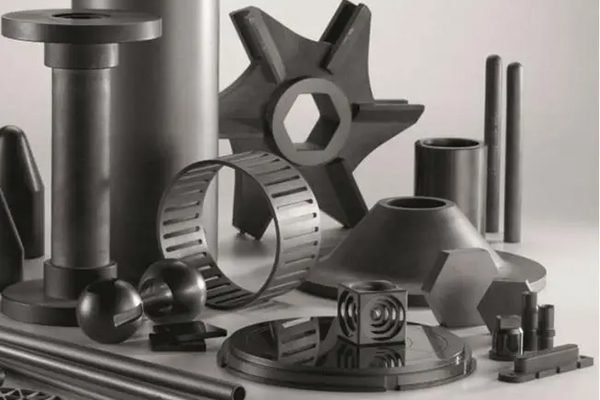
碳化硅 (碳化硅) 是一种独特的化合物,具有金属和非金属的特性. 它是一种半导体, 这意味着它介于金属之间 (导电的) 和绝缘体 (不导电).
Silicon carbide’s ability to conduct electricity is largely dependent on its temperature and the impurities present in the material. At low temperatures, silicon carbide behaves more like an insulator, resisting the flow of electricity. 然而, as the temperature increases, silicon carbide starts to behave more like a conductor, allowing electricity to pass through.
The electrical conductivity of silicon carbide can also be manipulated through a process called doping. This involves introducing impurities into the silicon carbide crystal structure, which can create more free charge carriers (electrons or holes) and thus increase the material’s conductivity. This is a common practice in the semiconductor industry to control the electrical properties of materials.
Silicon carbide’s semiconducting properties, along with its physical robustness and high thermal conductivity, make it an ideal material for many industrial applications. It’s used in high-power electronic devices such as diodes, transistors, 和晶闸管, where it can handle higher voltages and operate at higher temperatures than traditional silicon-based devices. It’s also used in high-frequency power devices, where its wide bandgap allows for devices that can operate at higher frequencies without losing efficiency.
而且, silicon carbide is used in the production of light-emitting diodes (发光二极管) 和早期收音机中的探测器. Its ability to withstand high temperatures and resist oxidation also makes it useful in harsh environments, such as in car brakes and clutches, and in the ceramic plates in bulletproof vests.
总之, while silicon carbide does not conduct electricity as well as metals, its semiconducting properties make it a versatile material in many industrial and electronic applications.