> 博客 > 白刚玉与. Tabular Alumina for Ultra-High Temperature Refractories

白刚玉与. Tabular Alumina for Ultra-High Temperature Refractories

为上述操作的耐火衬里选择错误的氧化铝颗粒 1600 °C 不会导致性能逐渐下降——它会导致结构过早失效. 剥落, 加速蠕变, 助熔剂渗透到开孔中直接导致窑炉意外停机和更换衬里成本,每个周期可达六位数. 工程师指定浇注料, 砖块, 或用于钢包的整体式, 水泥窑, 玻璃罐再生器必须尽早解决一个基本问题: 白刚玉 或者 板状刚玉?

每种材料是如何形成的——以及为什么这定义了它们的局限性

白刚玉 (世界足联) 通过在上面的电弧炉中电熔煅烧氧化铝而生产 2050 摄氏度, 随后进行控制冷却. 结果是高纯度的多晶 α-Al2O₃ 晶粒 (通常为 99.0–99.6% Al2O₃), 玻璃状断裂模式, 以及相对有棱角的, 块状形态. 其硬度 (莫氏 9) 和易碎性使其非常适合研磨和磨损, 但在难处理的情况下, 同样的脆性会在持续热循环下加速分解. 在比较这两个牌号之前了解完整的氧化铝系列, 什么是刚玉 提供了有用的技术基础.

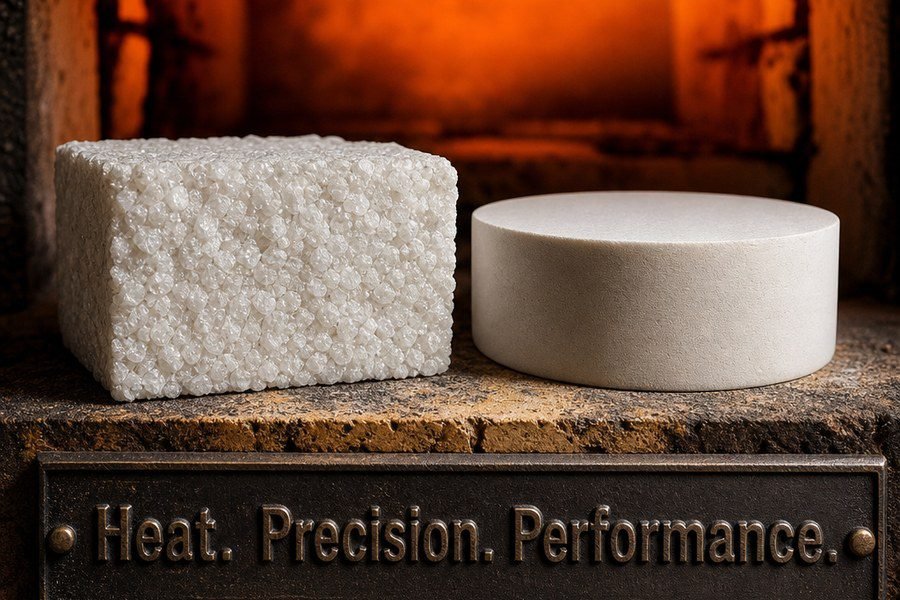
板状刚玉, 相比之下, 未熔合. 煅烧氧化铝在以下温度下烧结 1700 °C 和 1850 °C——低于熔点——并保持足够长的时间以控制晶粒生长成大, well-developed corundum crystals (50–500 微米). 该名称源自扫描电镜下可见的片状六角形片晶. This sintering process eliminates residual glass phase entirely and produces a near-theoretical-density grain (3.55–3.58 克/立方厘米) 具有卓越的尺寸稳定性.

关键特性比较: 数字出现分歧的地方

当根据超高温服务实际施加的条件制成表格时,两种材料之间的性能差距变得具体. 两种材料的 Al2O₃ 含量均高于 99%, 但在决定长期衬里完整性的微观结构和热性能方面存在很大分歧.

财产 白刚玉 板状氧化铝
Al2O₃含量 (%) 99.0 – 99.6 99.2 – 99.8
堆积密度 (克/立方厘米) 1.75 – 1.95 (粮食) 1.90 – 2.00 (粮食)
真密度 (克/立方厘米) 3.94 – 3.97 3.55 – 3.58 (烧结的)
Open porosity (%) 0 – 1 (fused grain) 2 – 5 (controlled pore structure)
Max service temp (摄氏度) 1750 – 1800 1800 – 1850+
抗热震性 缓和 高的
Creep resistance above 1600 摄氏度 缓和 优越的
Glassy phase content 低的 (residual) 没有任何

Creep resistance is particularly decisive in continuous service. WFA contains a residual vitreous phase at grain boundaries that begins to soften above approximately 1500 摄氏度, allowing grain boundary sliding under sustained load. Tabular alumina’s glass-free microstructure suppresses this mechanism, maintaining dimensional integrity at temperatures where WFA-based linings begin to deform.

Thermal Shock Behavior Under Cyclic Loading

Thermal shock resistance is not a single value — it depends on the thermal diffusivity, elastic modulus, and coefficient of thermal expansion (热膨胀系数) of the material, as well as the geometry and thickness of the installed lining. WFA’s CTE runs approximately 8.0 × 10⁻⁶/°C (25–1000 °C). Tabular alumina’s is slightly lower at 7.5–8.0 × 10⁻⁶/°C, but the more important factor is the grain structure.

Tabular alumina’s large, 有序的刚玉晶体和受控的孔隙率可以阻止微裂纹,而不是跨越晶界传播. 在出钢过程中经受快速热冷循环的钢包衬里, 这一特性可显着延长活动寿命——一些运营商报告称,与同等的 WFA 浇注料相比,活动寿命延长了 15-25%. WFA 在中等热循环环境中表现良好,但在每个循环 Delta-T 值超过 400–500 °C 的情况下不是首选.

Chemical Resistance to Slag and Flux Penetration

Both materials are classified as neutral to basic in slag chemistry terms. At high alumina purities, resistance to acidic slags (SiO₂-rich) and basic slags (氧化钙, MgO-rich) is broadly similar. The distinguishing variable is pore structure. WFA grains, being fully fused, present a near-zero internal porosity — which sounds advantageous until the castable or brick formulation introduces additional porosity through bonding phases and firing. Tabular alumina’s controlled internal porosity (2–5%) is intentional: it accommodates thermal expansion without generating macrocracks and does not significantly increase slag infiltration when properly bonded.

Applications involving highly aggressive fluxes — fluoride-containing glass melts, 例如, or iron oxide-saturated ladle slags — may also consider pairing alumina-based refractories with silicon carbide phases for enhanced oxidation and slag resistance. For a comparison of how other refractory-grade ceramics perform in aggressive environments, the analysis in Silicon Carbide Vs Boron Carbide provides relevant contrast on thermal and chemical stability mechanisms.

Application Matching: Which Grade Fits Which Installation

The choice is rarely absolute — it is context-dependent. The following framework covers the most common ultra-high-temperature refractory applications:

  • Steel ladle working linings and purging blocks: Tabular alumina is the standard specification where service temperatures exceed 1650 °C continuously. Its creep resistance and slag penetration barrier make it the lower-risk choice despite its higher unit cost.
  • Cement kiln burning zone bricks: WFA performs acceptably in brick formulations for zones below 1700 摄氏度; tabular alumina is preferred for outlet zones and cooler nose rings exposed to severe thermal shock and abrasion from clinker.
  • Glass tank regenerators (checker bricks): Tabular alumina’s glass-free microstructure resists alkali vapor attack at 1400–1600 °C better than WFA, where residual silica or glass phase accelerates alkali-induced degradation.
  • High-alumina castables for petrochemical furnaces: WFA is commonly used in the aggregate fraction for castables operating below 1500 摄氏度, providing a cost-effective balance of hardness and thermal stability. Tabular alumina replaces it where service exceeds that threshold.
  • Kiln furniture and setter plates (技术陶瓷): Tabular alumina dominates due to flatness retention under sustained load at elevated temperatures, critical for dimensional control in sintering of advanced ceramics and electronic components.

Cost Versus Performance: Making the Procurement Case

Tabular alumina commands a price premium of 20–40% over standard white fused alumina on a per-tonne basis, depending on grade, particle size distribution, and order volume. For procurement teams under budget pressure, that premium requires justification beyond material science. The business case centers on campaign life extension: if a tabular alumina lining lasts 15–25% longer than a WFA equivalent, the cost per heat or per production run often shifts decisively in favor of the more expensive grain.

For applications below 1600 °C or in environments with moderate thermal cycling, WFA remains the rational choice — its hardness, 纯度, and established supply chain make it a well-understood, cost-effective aggregate. The error is not choosing WFA for moderate-duty service; it is specifying it in place of tabular alumina for duty cycles it was not designed to sustain. Buyers evaluating sources for consistent purity and particle size across both grades should request certified test reports covering Al₂O₃ content, Fe₂O₃ and Na₂O impurity levels, and bulk density — the three variables that most directly predict in-service refractory performance.

经常问的问题

问: At what temperature does white fused alumina become unsuitable for refractory service?

A: White fused alumina remains structurally adequate up to approximately 1750–1800 °C in static conditions, but its residual glassy grain-boundary phase begins to soften above 1500 °C under sustained mechanical load. In applications involving continuous service above 1600 °C combined with mechanical stress — such as steel ladle walls during tapping — creep deformation becomes measurable, and tabular alumina is the recommended alternative.

问: What is the key microstructural difference between tabular alumina and white fused alumina?

A: Tabular alumina is produced by solid-state sintering at 1700–1850 °C, yielding large corundum crystals (50–500 微米) with zero glass phase and controlled open porosity of 2–5%. White fused alumina is produced by arc fusion above 2050 摄氏度, resulting in a fully dense polycrystalline grain (true density ~3.95 g/cm³) with a small residual vitreous phase at grain boundaries. The absence of glass phase in tabular alumina is the primary reason for its superior creep resistance and alkali resistance above 1500 摄氏度.

问: Can white fused alumina and tabular alumina be used together in the same castable formulation?

A: 是的. Blended formulations are common in high-alumina castables where cost optimization is required. A typical approach uses tabular alumina for the coarse aggregate fraction (6–20 mm) to provide creep resistance and thermal shock tolerance, while WFA fills the fine fraction (0–1 mm) at lower cost without significantly compromising overall performance. The specific blend ratio depends on the maximum service temperature, thermal cycling severity, and target cost per installed tonne.

问: How does alkali resistance compare between the two materials in glass furnace regenerators?

A: In glass tank regenerators exposed to alkali vapors (氧化钠, K₂O) at 1400–1600 °C, tabular alumina outperforms WFA. The residual silica and glassy phase in WFA reacts preferentially with alkali oxides, forming low-melting-point feldspar phases (例如, nepheline, NaAlSiO₄, melting point ~1526 °C) that accelerate dissolution of grain boundaries. Tabular alumina’s glass-free, high-purity corundum structure offers significantly lower reactivity and longer service life in this environment.

问: What purity specifications should procurement teams require for ultra-high-temperature refractory grades?

A: For service above 1600 摄氏度, specify a minimum Al₂O₃ content of 99.2% for both WFA and tabular alumina. Key impurity limits: Fe₂O₃ below 0.05%, Na₂O below 0.30% for WFA (Na₂O is the primary flux impurity introduced from the Bayer process), and SiO₂ below 0.10%. For tabular alumina, also confirm open porosity is within the 2–5% range — values above 5% indicate incomplete sintering and will reduce slag penetration resistance. All values should be supported by batch-specific XRF certificates.

关于河南高级磨料磨具 (高铁)

河南优之源磨料 (高铁) 是一家总部位于中国的全球工业应用高性能磨料和先进陶瓷材料供应商. 我们的核心产品系列包括黑碳化硅, 绿碳化硅, 电子级碳化硅 (碳化硅), 白刚玉, 棕刚玉, 碳化硼, 电熔铝酸钙, 和 SG 磨料.

服务客户于 30+ 国家, HSA 提供可靠的磨料材料, 耐火材料, 技术陶瓷, 半导体应用, 精密抛光, 喷砂, 冶金, 和高性能建筑材料.

获取报价或免费样品

寻找优质磨料和先进陶瓷材料的可靠供应商? 立即联系我们的技术团队——我们会在 24 小时并可为合格的项目安排免费样品.

相关文章

请求报价

所有提供的信息将被保密.
对我们的产品感兴趣? 请在下面的表格中发送您的询问: