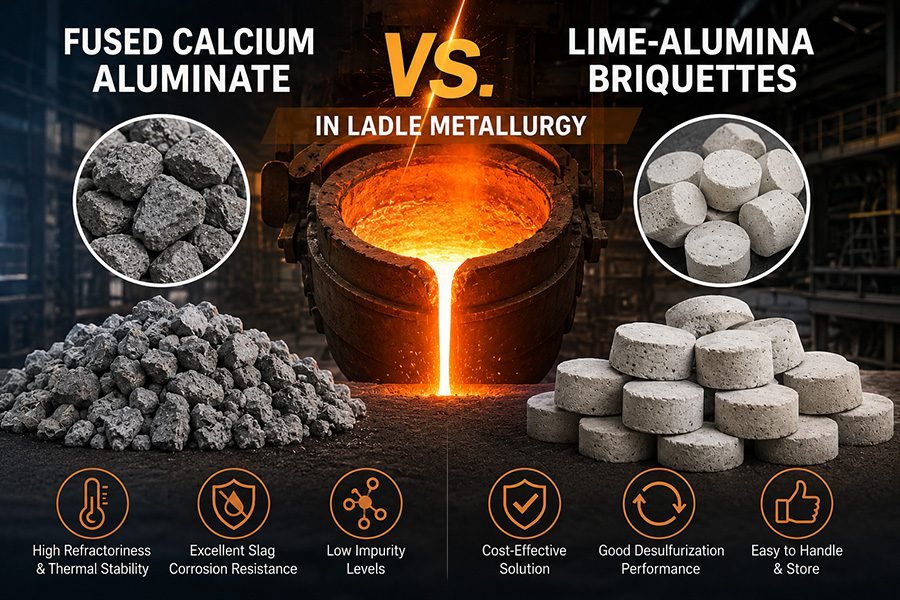
Вибір неправильного кондиціонера для шлаку при рафінуванні ковша не просто впливає на хімію — це безпосередньо впливає на час від крана до крана, швидкість зносу вогнетривів, і кінцеві популяції включення в затверділий ланцюг. Рослини-замінники вапняно-глиноземні брикети для плавлений алюмінат кальцію без урахування кінетики розчинення часто повідомляють про підвищені кластери Al₂O₃ у наднизькоуглецевих сортах і передчасну ерозію футеровки ковша, обидва вони несуть вимірні витрати на подальшому виробництві.
Як виготовляється кожен матеріал і чому це важливо
Плавлений алюмінат кальцію (FCA) виробляється шляхом спільного плавлення вапняку та глинозему в електродуговій печі при температурах, що перевищують 1700 ° C, дає однорідний, скляний або кристалічний злиток, який потім подрібнюють відповідно до специфікації. Процес плавлення виганяє всю вільну вологу та карбонатні фази, залишаючи стехіометрично стабільний продукт із фіксованим співвідношенням CaO/Al₂O₃ — найчастіше в CA (CaAl₂O₄) або CA₂ (CaAl₄O₇) мінералогічний етап.
Вапняно-глиноземні брикети, на противагу, являють собою холодно зв'язані агломерати кальцинованого вапна та дрібних частинок оксиду алюмінію, які утримуються разом із сполучною речовиною, такою як патока або силікат натрію. Сировина ніколи не досягає температури плавлення, тому кожна частинка зберігає свою чітку хімічну ідентичність. При додаванні до ковша, сполучна речовина згорає першою, брикет розпадається, і окремі оксидні фази розчиняються незалежно — двоетапна послідовність, яка за своєю суттю є повільнішою, ніж пряме розчинення попередньо прореагованої сполуки. Для застосувань, що вимагають високочистого флюсу оксиду алюмінію, розуміння що таке білий плавлений оксид алюмінію і те, як синтез змінює реакційну здатність оксиду, забезпечує корисний контекст для оцінки ефективності FCA.
Кінетика розчинення: Відмінність основного процесу
У ковшовому рафінуванні, шлак повинен досягти своєї цільової основності та текучості протягом визначеного вікна — зазвичай через 8–15 хвилин після початкового додавання флюсу на станціях, що працюють з LF (піч-ковш) або контури RH дегазатора. FCA швидко розчиняється, оскільки попередньо прореаговані фази алюмінату кальцію плавляться конгруентно або майже конгруентно в контакті з рідкою шлаковою ванною, не вивільняючи газоподібних побічних продуктів і не потребуючи додаткової теплової енергії для запуску реакції розкладання.
Брикети несуть залишковий CO₂, якщо випал вапна не завершений, і спалювання зв’язуючого створює турбулентність, яка може захопити атмосферний азот — критичний вектор дефектів у трубопроводах із низьким вмістом азоту та автомобільних листах. Повний переваги плавленого алюмінату кальцію над холодно з’єднаними альтернативами найбільш очевидні саме в цьому кінетичному вікні, де стабільна поведінка плавлення зменшує споживання електроенергії на НЧ-електроді та скорочує загальний час циклу нагрівання.
Порівняння властивостей: FCA проти. Вапняно-глиноземні брикети
| Параметр | Плавлений алюмінат кальцію | Вапняно-глиноземні брикети |
|---|---|---|
| Типовий вміст CaO (%) | 35–50 | 30–55 (змінна сумішшю) |
| Вміст Al₂O₃ (%) | 40–55 | 30–55 (змінна сумішшю) |
| Вільна волога (%) | <0.5 | 1–4 (сполучнозалежний) |
| Час розчинення при 1600 ° C (хв) | 3–8 | 10–20 |
| Ризик захоплення водню | Дуже низький | Від середнього до високого |
| Композиційна узгодженість (тепло до тепла) | Високий — фіксована мінералогія | Помірний — залежить від суміші |
| Типова вартість (США/т, колишній Китай) | 180–260 | 90–150 |
Різниця у вартості значно звужується після загального споживання та вторинних витрат — додаткового часу живлення НЧ, вогнетривкий ремонт, і ризик відмови — враховуються. Переробка рослини 800 кт/рік електротехнічної сталі зазвичай виявляє, що FCA знижує швидкість додавання флюсу на 15–25 % порівняно з еквівалентними брикетними добавками, оскільки менше матеріалу втрачається через передчасну реакцію або неповне розчинення перед стадією видалення шлаку.
Контроль включення та результати чистоти сталі
Включення глинозему (Al₂o₃) у рідкій сталі дуже шкідливі для тонкої смуги, катанка, і застосування підшипникової сталі. Механізм рафінування в обох системах ґрунтується на перенесенні розчиненого Al₂O₃ зі сталі в основну, рідкий шлак — але текучість шлаку залежить від досягнення правильної рідкої фракції системи CaO–Al₂O3–SiO₂ у межах вікна температури рафінування (1560–1620 °C).
Добавки FCA досягають складу шлаку в долині низької температури плавлення бінарної діаграми CaO–Al₂O₃ (приблизно 50-60 % Al₂o₃, рідина навколо 1400 ° C) набагато надійніше, ніж брикетні добавки, які вводять фази послідовно і можуть тимчасово створювати високоплавкі зони, багаті CaO, які перешкоджають поглинанню включень. Орієнтація на металургійні заводи загальний кисень нижче 15 ppm в класах підшипників (відповідно до ASTM A295 / ISO 683-17) постійно повідомляють про більш стабільні результати з FCA-кондиціонованими шлаками.
Сумісність з вогнетривами та термін служби ковша
Занадто багатий на СаО шлак розчиняє магнезій-вуглець (MgO–C) цегли агресивно; надто багатий на Al₂O₃ роз'їдає глиноземно-шпінельне покриття. Оскільки FCA забезпечує передбачуваність, попередньо встановлене співвідношення CaO/Al₂O₃, інженери з вогнетривких матеріалів можуть розробляти системи футеровки з відомим хімічним середовищем. З брикетами, фактичний склад шлаку в будь-який даний момент залежить від того, який компонент розчинився найшвидше — введення дисперсії, яка ускладнює моделювання зносу футеровки.
- Знос цегли MgO–C знижується при основності шлаку (CaO/SiO₂) залишається між 3.0 і 5.0 — діапазон добавок FCA зберігається більш стабільно, ніж брикети, при нагріванні з високим вмістом алюмінію.
- Утворення шпінелі на межі розділу шлак–цегла діє як жертовний бар’єр; FCA-кондиціоновані шлаки з помірною активністю Al₂O₃ створюють цей захисний шар, не розчиняючи його.
- Рослини, що використовують брикети в ультранизькому нагріванні кремнію (І < 0.005 %) доповідь 8–14 % менший термін служби ковша в середньому порівняно з графіками потоку на основі FCA, на основі оперативних даних кількох плавильних цехів EAF у Східній Азії.
Коли вапняно-глиноземні брикети залишаються прийнятним вибором
Брикети не є універсальними гіршими. У застосуваннях, де вміст водню в сталі не визначено чітко, тривалість циклу нагрівання є гнучкою, і цільова основность шлаку є відносно поблажливою — як, наприклад, у сортах арматури або конструкційних секцій — нижча вартість одиниці брикетів може переважити їхні кінетичні недоліки. Виробники з перемішуванням у відкритому ковші та без станції LF мають менш точний контроль над виділенням шлаку., зниження значення поведінки контрольованого розчинення FCA.
Додатково, деякі заклади використовують гібридний підхід: брикети для регулювання основності маси в кран-ковші, з подальшим додаванням FCA на LF для остаточного контролю складу та оптимізації текучості. Ця стратегія забезпечує економічну ефективність раннього додавання великих обсягів, зберігаючи при цьому точність у критичному вікні переробки. Команди із закупівель, які оцінюють загальні витрати на флюс, також можуть порівняти це з іншими еталонними показниками вогнетривких та абразивних товарів, щоб контекстуалізувати ціноутворення за одиницю в рамках своїх ширших витрат на сировину.
Часті запитання
Q: Яке співвідношення CaO/Al₂O₃ у плавленому алюмінаті кальцію є найкращим для кондиціонування ковшового шлаку?
А: Для більшості застосувань для рафінування ковшів, орієнтованих на марки підшипників або електротехнічної сталі з низьким вмістом оксидів, CA-фаза FCA (приблизно 35-40 % Цао, 50–55 % Al₂o₃) позиціонує кінцевий склад шлаку біля 1400 Мінімум рідини °C у подвійній системі CaO–Al₂O₃. Матеріал CA₂-фази (приблизно 22 % Цао, 72 % Al₂o₃) є кращим, коли сталь вже містить значний залишковий шлак із підвищеним вмістом SiO₂, оскільки більший вміст Al₂O₃ розбавляє основність менш агресивно.
Q: Чи збільшують вапняно-глиноземні брикети водень у сталі?
А: Так, вимірювано. Сполучні, такі як патока, вводять вуглець і гідроксильні групи; залишкової вологи в холоднозв'язаних брикетах (зазвичай 1–4 %) виділяє водень при температурі сталі. Було задокументовано тепло, що виробляється з додаванням брикетів у маршрутах EAF-LF, на рівні 3–5 ppm [Х] перед дегазацією порівняно з 1,5–2,5 ppm з додаванням FCA за еквівалентних умов перемішування. Для оцінок, що вимагають [Х] ≤ 2 ppm (трубопровідна сталь за API 5L PSL2), ця різниця може визначити, чи є цикл вакуумної дегазації обов'язковим.
Q: Як FCA впливає на термін служби вогнетривкості ковша порівняно з практикою виробництва брикетів?
А: Ключовою змінною є плинність і стабільність складу шлаку. Кондиціоновані FCA шлаки зберігають стабільніше співвідношення CaO/Al₂O₃ під час нагрівання, дозволяючи накладкам MgO–C утворювати стабільну шпінель (MgAl₂O₄) захисний шар. Польові дані з плавильних цехів EAF у Східній Азії показують 8–14 % довші кампанії з ковшами з графіками потоку на основі FCA порівняно з еквівалентними програмами брикетів у спеках, де вміст кремнію нижчий 0.01 %.
Q: Чи може FCA повністю замінити синтетичний шлак, або це часткова добавка?
А: FCA функціонує як основний синтетичний шлакоутворювач у багатьох операціях LF — він може становити повне додавання флюсу, коли цільова основность узгоджується з мінералогією FCA. Проте, у теплах з високим виносом FeO (вище 8 %) або при націлюванні на базовість вище 5.0, додаткове додавання вапна залишається необхідним, оскільки FCA сам по собі не може досягти достатньо високої активності CaO для швидкого зниження FeO. У тих випадках, FCA використовується як джерело Al2O3 та флюїдизатор, з вапном, що забезпечує додаткову основность.
Q: Який розмір частинок FCA є стандартним для додавання в ковш?
А: Промислова норма для пневматичного вприскування становить 0–1 мм або 0–3 мм (порошок/гранула); для подавача дроту або прямого додавання в ковш, 5– Звичайні грудки 50 мм. Дрібніші розміри розчиняються швидше, але збільшують втрату пилу під час роботи. ISO 11323 і ASTM C71 не визначають безпосередньо розмір частинок FCA; технічні специфікації окремих металургійних заводів зазвичай регулюють, більшість із зазначенням максимальної фракції –3 мм ≥ 85 % для ін'єкційного матеріалу.
Про Henan Superior Abrasives (HSA)
Henan Superior Abrasives (HSA) є китайським виробником і глобальним постачальником високоефективних абразивів і передових керамічних матеріалів для промислового застосування по всьому світу.. Наш основний асортимент продукції включає чорний карбід кремнію, зелений карбід кремнію, карбід кремнію електронного класу (SIC), білий плавлений оксид алюмінію, коричневий плавлений оксид алюмінію, карбід бору, плавлені алюмінати кальцію, і СГ абразиви.
Обслуговування клієнтів в 30+ країни, HSA постачає надійні матеріали для абразивів, рефракції, технічна кераміка, напівпровідникові програми, точне полірування, піскоструминна обробка, металургія, і високоякісні будівельні матеріали.
Отримайте цінову пропозицію або безкоштовний зразок
Шукаємо надійного постачальника преміальних абразивних та передових керамічних матеріалів? Зв’яжіться з нашою технічною командою сьогодні — ми відповімо протягом 24 годин і може організувати безкоштовні зразки для кваліфікованих проектів.
- 📧 Електронна пошта: sales@superior-abrasives.com
- 💬 WhatsApp: +86-186-3863-8803