Зайдите на любое прецизионное производственное предприятие, и вы обнаружите, что абразивное зерно работает тихо., важная работа. Формирует лопатки турбины., полирует оптические линзы, точит режущие инструменты, и обрабатывает поверхности, до которых другие процессы просто не могут добраться. И все же, несмотря на свою повсеместность, abrasive grain is often selected by habit rather than by informed choice — and that habit costs manufacturers in tool life, surface quality, and productivity.
This article takes a practical look at what abrasive grain is, how it works, and what separates a well-chosen grain from a poor one. Whether you are specifying a grinding wheel, a coated abrasive belt, or a loose lapping compound, understanding the fundamentals will help you make better decisions at every stage of your process.
What Is Abrasive Grain?
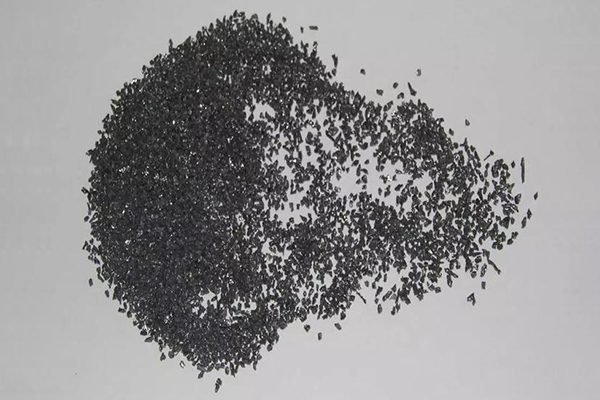
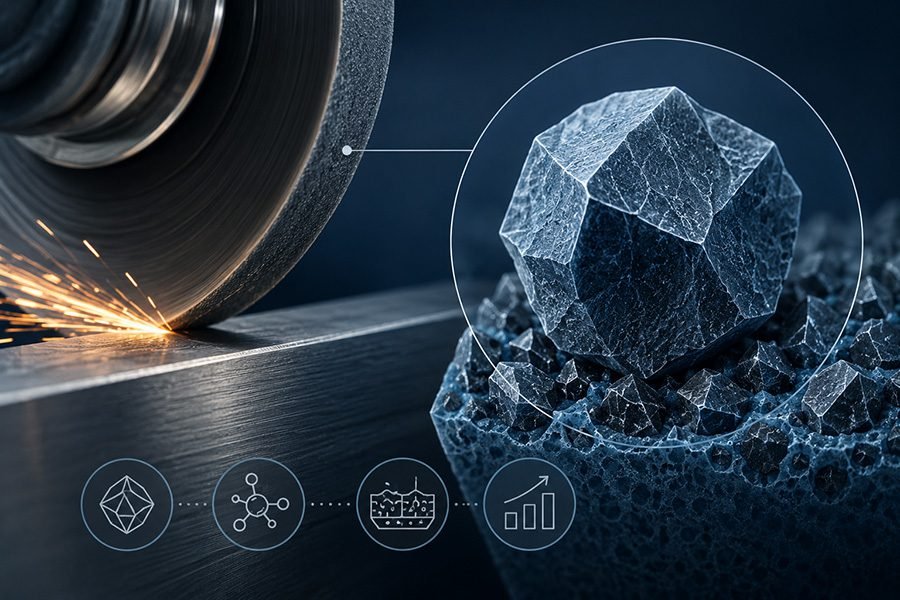
Abrasive grain refers to hard, angular particles used to cut, молоть, lap, hone, or polish a workpiece surface. The grain is the active cutting element in virtually every abrasive product — bonded into a wheel, coated onto a belt or disc, or suspended in a slurry.
The key physical characteristics that define an abrasive grain are:
- твердость — The grain must be harder than the material it is cutting. Hardness is measured on the Mohs scale or, more precisely, by Vickers or Knoop microhardness testing.
- Прочность — A grain that fractures too easily dulls quickly. One that is too tough stays sharp but may generate excessive heat. The ideal grain fractures in a controlled way, exposing fresh cutting edges.
- рыхлость — Related to toughness, friability describes how readily a grain self-sharpens under load. High-friability grains are preferred for precision grinding; low-friability grains suit heavy stock removal.
- Форма зерна — Blocky grains cut aggressively with high stock removal; platelike or splinter grains produce finer finishes.
- Распределение частиц по размерам — Tight size control (as defined by FEPA, ANSI, or JIS standards) ensures consistent surface finish and predictable wheel performance.
The Major Types of Abrasive Grain
Modern abrasive grain falls into two broad families: conventional abrasives and superabrasives.
Conventional abrasives include aluminum oxide (плавленый оксид алюминия), Карбид кремния, and their variants. They cover the vast majority of industrial grinding, взрывные работы, притирка, и полировальные приложения.
Карбид кремния (Карбид кремния) is one of the most important conventional abrasive grains. With a Mohs hardness of approximately 9.5 and a Knoop hardness around 2,500kg/mm², it is harder than aluminum oxide and cuts more aggressively. Two primary grades are used industrially:
- Черный карбид кремния — slightly lower purity (≥98% Карбид кремния), tougher, used for grinding cast iron, Цветные металлы, резина, камень, и огнеупорные материалы.
- Зеленый карбид кремния — higher purity (≥99% Карбид кремния), more friable, preferred for precision grinding of cemented carbides, керамика, стакан, and hard nonferrous alloys.
You can read a detailed comparison in Черный карбид кремния против. Зеленый карбид кремния.
Оксид алюминия grains — including brown fused alumina, белый плавленый глинозем, and pink alumina — are tougher but less hard than SiC. They excel on steel and ferrous alloys where their controlled fracture behavior extends wheel life.
Superabrasives — diamond and cubic boron nitride (CBN) — occupy a higher performance tier. Their cost is substantially greater, but in high-volume, tight-tolerance applications the economics often favor them.
How Abrasive Grain Size Is Specified
Размер зерна (also called grit size) defines the particle dimensions and directly controls the surface finish a process can achieve. Two major grading systems are in widespread use:
- FEPA F series — used for bonded abrasives (шлифовальные круги, точильные камни). Ranges from F12 (грубый) до F1200 (very fine).
- FEPA P series — used for coated abrasives (наждачная бумага, абразивные ленты). Ranges from P12 to P2500.
The two systems use different statistical definitions for the same nominal grit number, so F80 and P80 are not interchangeable. Понимание the difference between coated abrasives and bonded abrasives is essential before specifying grain size.
Как правило:
- Крупная крупа (F12–F60) используются для удаления тяжелых материалов и черновой обработки.
- Средняя крупа (Ф80–Ф220) ручка общего назначения для шлифовки и чистовой обработки.
- Мелкая и очень мелкая крупа (F240–F1200 и выше, в микронные диапазоны порошков) используются для прецизионной притирки, полировка, и поверхностная отделка.
Выбор подходящего абразивного зерна для вашего применения
Ни один тип зерна не превосходит все остальные в любой ситуации.. В процессе отбора следует учитывать:
- Материал заготовки — Hard, хрупкие материалы (керамика, стакан, карбид) предпочитаю острый, рыхлая режущая способность зеленого карбида кремния или алмаза. Tough steels benefit from aluminum oxide’s controlled fracture.
- Required surface finish — Tighter finish tolerances push you toward finer grains and higher-purity materials with tighter size distributions.
- Process type — Bonded abrasive processes (шлифовальные круги) behave differently from coated processes (ремни, диски) and free-abrasive processes (притирка, полировка). The grain’s interaction with the bond system matters as much as the grain itself.
- Thermal sensitivity — SiC conducts heat well, which can benefit temperature-sensitive workpieces. Однако, its reactivity with iron at high temperatures makes it unsuitable for grinding most steels.
- Cost and availability — Conventional grains offer excellent value for most applications. Superabrasives are justified only when the economics — tool life, cycle time, scrap rate — clearly support the premium.
For a structured decision framework, see How to Choose the Right Abrasive.
Grain Quality: What to Look For
Not all abrasive grain sold under the same grade designation is equal. Quality differences exist at every level of the supply chain. When evaluating a supplier or a lot of material, the following parameters matter:
- Химическая чистота — Higher SiC content means fewer soft inclusions that dull cutting edges prematurely.
- Grain shape consistency — A well-controlled process produces grains with consistent angularity. Irregular or overly rounded grains underperform.
- Size distribution tightness — Out-of-spec particles — oversized grains in particular — cause deep scratches and inconsistent finishes.
- Магнитный контент — Iron contamination from production equipment must be minimized, особенно для электронного, оптический, и полупроводниковые приложения.
- Свободный углерод и кремнезем — Excess free carbon or silica indicates process problems and degrades abrasive performance.
Авторитетные производители предоставляют сертификационные данные для каждой партии., включая ситовой анализ, химический состав, и магнитный контент. Понимание свойств абразивов из карбида кремния will help you interpret this data correctly.
Абразивное зерно в связке по сравнению с. Изделия с покрытием
The same grain behaves differently depending on how it is held and presented to the workpiece.
В bonded abrasive products (шлифовальные круги, сегменты, honing sticks), grain is locked in a vitrified, резиноид, or metal bond matrix. As grains dull, bond fracture releases them and exposes fresh grains — a self-sharpening mechanism. The grain’s toughness and the bond’s strength must be balanced for the wheel to dress properly rather than loading or glazing.
В coated abrasive products (наждачная бумага, абразивные ленты, диски), grain is adhered in a single layer to a flexible backing. The grain orientation, coating density (open vs. closed coat), and bond system all influence cut rate and finish. SiC-coated products excel on non-metallic substrates — stone, стакан, керамика, и пластмассы.
В loose abrasive processes (притирка, полировка, распиловка проволоки), grain suspended in a carrier fluid does the cutting. Particle size distribution and morphology are especially critical here, since there is no bond system to compensate for grain variability.
Часто задаваемые вопросы
Q1: What is the difference between abrasive grain and abrasive powder?
The terms are often used interchangeably, but technically “зерно” refers to particles in the macro grit range (typically F12–F220per FEPA), пока “пудра” или “микро порошок” refers to finer particles (F230and finer, down to sub-micron sizes). Macro grains are used in grinding wheels and blasting; micro powders are used for lapping, полировка, and precision finishing.
Q2: Is silicon carbide abrasive grain suitable for grinding steel?
В общем, no. SiC reacts chemically with iron at the elevated temperatures generated during grinding, causing rapid grain dulling. Aluminum oxide is the preferred grain for most steel grinding applications. Карбид кремния, однако, widely used for grinding cast iron, where the graphite in the microstructure acts as a lubricant.
Q3: How does grain size affect surface finish?
Coarser grains remove material faster but leave a rougher surface. Finer grains produce smoother surfaces but cut more slowly. For a given workpiece material, you typically start with a coarser grit for stock removal, then step through progressively finer grits to reach the required finish.
Q4: What does “friability” mean in practical terms?
Рыхлое зерно разрушается под режущими нагрузками, обнажая свежее зерно., острые края. Это желательно для прецизионного шлифования, поскольку оно обеспечивает низкие силы резания и предотвращает накопление тепла.. Менее рыхлое зерно дольше сохраняет форму, который подходит для агрессивного удаления припуска, но может привести к полировке, если зерно потускнеет без разрушения.
Q5: Как узнать, покупаю ли я качественное абразивное зерно??
Запросите сертификаты испытаний для конкретной партии, охватывающие ситовой анализ (распределение по размерам), химический состав, и магнитный контент. Сравните их с соответствующим документом FEPA., ANSI, or JIS standard. A reputable supplier should provide this documentation routinely and be able to trace material back to its production batch.
О компании Henan Superior Abrasives (HSA)
Henan Superior Abrasives is a China-based manufacturer and exporter of silicon carbide, плавленый оксид алюминия, and boron carbide abrasive materials. Founded with a focus on quality consistency and international standards compliance, HSA supplies macro grits, micro powders, and specialty grades to customers in abrasives manufacturing, огнеупоры, керамика, электроника, and metallurgy across more than 30 страны.
HSA’s products are produced in compliance with FEPA, ANSI, and JIS standards and are supported by full lot traceability and third-party quality certifications. The company’s technical team can assist with grain selection, size specification, and application troubleshooting.
Learn more at www.silicon-carbides.com or visit the HSA factory page.
Ready to Source High-Quality Abrasive Grain?
If you are evaluating silicon carbide or other abrasive grains for your manufacturing process, HSA offers competitive pricing, consistent quality, and responsive technical support.
Request a quote или contact our team to discuss your specifications.