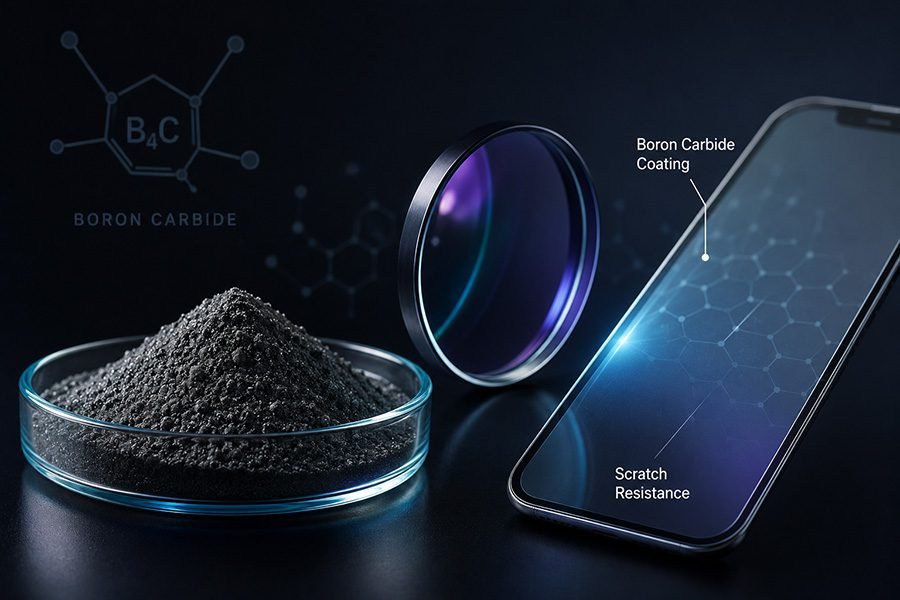
Display glass and precision optical elements routinely fail field acceptance tests when their protective layers cannot sustain a pencil hardness above 9H or a Vickers microhardness above 1,500 ВН. A single scratch event on an AR-coated lens or a ruggedized touch-panel surface can render a component commercially non-viable, triggering costly rework, warranty claims, or customer returns. карбид бора (Б₄С), with a Vickers hardness of 2,900–3,580 HV and a bulk hardness second only to diamond among industrial materials, is increasingly specified as an active phase in scratch-resistant thin-film and composite coating systems for both optics and consumer display substrates.
Why Conventional Hard Coatings Fall Short of Modern Display Demands
Diamond-like carbon (DLC) and titanium nitride (TiN) coatings dominated the optical hardcoat market for two decades, yet both carry inherent limitations. DLC films deposited above 2 µm frequently delaminate under thermal cycling because residual compressive stress exceeds 5 ГПа; TiN absorbs in the visible spectrum (yellowish tint), disqualifying it from anti-reflective stacks. Zirconia and alumina sol-gel coatings achieve only 1,200–1,800 HV, adequate for eyewear but insufficient for rugged handheld displays subjected to stylus or grit abrasion.
Engineers specifying protective layers for military optics, automotive HUD glass, or industrial touchscreens therefore face a hardness-transparency trade-off that neither legacy material resolves cleanly. Boron carbide fills this gap: its optical bandgap (~2.1 eV) allows near-transparency in the visible range when deposited in sub-stoichiometric or nanocomposite configurations, while its hardness remains well above the threshold for sustained stylus resistance.
твердость, Tribology, and Optical Properties of B₄C Coatings
The performance envelope of a boron carbide coating is defined by three interrelated parameters: nanoindentation hardness, coefficient of friction (CoF), and optical transmittance. Thin-film B₄C layers deposited by magnetron sputtering typically achieve 28–45 GPa hardness (ИСО 14577), with CoF values of 0.10–0.18 against steel under dry conditions — competitive with the best DLC grades without requiring hydrogen-rich plasma chemistry. Transmittance in the 400–700 nm window reaches 85–92% for films below 500 nm thickness, preserving the optical clarity required in display applications.
| Coating Material | Твердость по Виккерсу (ВН) | Dry CoF (vs. стали) | Visible Transmittance (%) | Typical Thickness (мкм) |
|---|---|---|---|---|
| карбид бора (Б₄С) | 2,900–3,580 | 0.10–0.18 | 85–92 | 0.2–2,0 |
| Diamond-Like Carbon (DLC) | 1,500–3,500 | 0.05–0.15 | 60–80 | 0.5–5.0 |
| Titanium Nitride (TiN) | 1,800–2,100 | 0.20–0.40 | <20 (absorbing) | 1.0–5.0 |
| глинозем (Al₂O₃) Sol-Gel | 1,200–1,800 | 0.25–0,45 | 90–96 | 1.0–8.0 |
| Zirconia (Zro₂) | 1,100–1,400 | 0.30–0,50 | 88–94 | 0.5–3.0 |
Deposition Routes: Selecting the Right Process for Your Substrate
Boron carbide coatings are applied commercially via three principal physical vapor deposition (ПВД) and chemical vapor deposition (ССЗ) routes, each with distinct process windows and substrate compatibility profiles. Understanding which technique aligns with your substrate geometry and throughput requirements is as important as the material selection itself.
- RF/DC Magnetron Sputtering: The dominant industrial route for flat optics and display glass. Operates at substrate temperatures of 150–300 °C, compatible with chemically strengthened glass (например, Corning Gorilla Glass). Achieves film uniformity of ±5% across 300 mm substrates. Deposition rates of 0.5–2.0 nm/s are typical with B₄C ceramic targets.
- Pulsed Laser Deposition (PLD): Preferred for R&D and specialty optics where stoichiometric control is critical. Produces near-bulk-density films but throughput is limited; substrate area rarely exceeds 100 mm diameter in production environments.
- Плазменное усиление сердечно-сосудистых заболеваний (PECVD): Uses boron-containing precursor gases (например, B₂H₆ + CH₄). Enables conformal coating of curved lenses and 3D geometries at substrate temperatures as low as 200 °С. Residual hydrogen content (1–5 at.%) must be controlled to avoid softening the B–C network.
- Ion Beam Assisted Deposition (IBAD): Combines sputtered B₄C flux with a simultaneous ion beam to enhance adhesion and reduce residual stress below 1 GPa — particularly valuable for multilayer antireflective-plus-hardcoat stack designs.
For high-volume display manufacturing, RF magnetron sputtering from sintered B₄C targets remains the most scalable option. Target purity directly governs film performance; a minimum of 99.0% B₄C with controlled free-carbon content below 0.3% is the accepted specification for optical-grade targets. The performance advantages of other advanced carbide abrasives help illustrate how impurity profiles in carbide materials translate to functional outcomes.
Adhesion Engineering: The Critical Interface Between Coating and Substrate
Hardness alone does not prevent coating failure. Scratch resistance at the system level is governed by the critical load (Lc) in a scratch adhesion test (ASTM C1624 / ИСО 20502), which quantifies the point at which cohesive or adhesive failure initiates. Bare boron carbide on soda-lime glass typically achieves Lc values of 8–12 N — insufficient for aggressive stylus applications. Insertion of a thin (<50 nm) interlayer of titanium, хром, or boron nitride raises Lc to 18–30 N by creating a graded modulus transition between the elastic glass substrate and the rigid carbide film.
Thermal expansion mismatch is the underlying driver of delamination under use-temperature cycling (от −40 °C до +85 °C in automotive applications per AEC-Q200). The coefficient of thermal expansion (CTE) of B₄C is 5–6 × 10⁻⁶/°C, compared to 8–9 × 10⁻⁶/°C for borosilicate glass. Multilayer designs that taper composition across the interface — from a metal or nitride bonding layer through a B-C-N graded zone into pure B₄C — are now standard practice in high-reliability optical coating specifications.
Particle Grade and Purity Specifications for Target and Slurry Feedstocks
Whether the application is sputter target fabrication or polishing a B₄C-reinforced hardcoat surface, the starting powder specification has direct downstream consequences. For target sintering, D50 particle sizes in the 0.5–3.0 µm range and purities ≥99.0% B₄C are standard. Coarser feedstocks (D50 10–25 µm) are appropriate for composite coating matrices or as lapping compounds during final surface finishing of the coated optic — a step required when PVD-deposited roughness (Ра) exceeds 0.5 nm for precision applications. The production processes governing carbide material quality share significant parallels with boron carbide manufacturing, particularly regarding Acheson furnace chemistry and post-synthesis milling.
Key purity parameters buyers should specify when procuring B₄C powder for optical-grade targets include: total boron content (theoretical 78.28 wt% B), free carbon ≤0.3 wt%, iron ≤0.05 wt%, and oxygen ≤0.5 wt%. Oxygen contamination is particularly damaging in sputtered films, introducing B₂O₃ phases that reduce hardness and increase optical absorption. Moisture-controlled packaging and inert-atmosphere storage are non-negotiable logistics requirements when sourcing sub-micron B₄C for this application.
Testing Protocols That Govern Specification Acceptance
Procurement engineers and quality labs use a layered test battery to validate scratch-resistant coatings before production release. No single test captures all failure modes, so the following suite is widely adopted across optical and display supply chains:
- Pencil Hardness Test (ИСО 15184): Baseline acceptance criterion; B₄C-coated optical glass typically rates 9H or higher. Simple, fast, but poorly correlated with real grit abrasion.
- Taber Abrasion (ASTM D1044): CS-10F wheels at 500 g load for 100 или 500 cycles; haze increase ΔH% must remain below 2–4% for display applications. B₄C composite coatings consistently outperform alumina hardcoats at identical film thickness.
- Nano-scratch / Microscratch (ИСО 20502): Progressive-load scratch from 0.1 к 50 N using a Rockwell C diamond stylus; reports Lc1 (onset of cracking) and Lc2 (delamination). This is the critical test for multilayer stack qualification.
- Steel Wool Rub (MIL-PRF-13830B, Annex D): Relevant for military optics; 40 back-and-forth strokes under 2.5 N load with 000-grade steel wool. Defines pass/fail for field-use ruggedization.
- Salt Fog / Humidity Cycling (MIL-C-675C): Ensures the hardcoat-substrate interface survives environmental exposure; B₄C films with adequate adhesion interlayers regularly pass 240-hour salt fog without delamination.
Correlation between lab test results and field durability remains an active area of standards development, particularly as flexible OLED display substrates introduce new substrate compliance variables that rigid-glass test protocols do not fully capture. Buyers sourcing B₄C for these emerging applications should request coating supplier data covering both rigid and flexible substrate test results before finalizing a grade specification. Comparable diligence in material qualification is well-established in industries that use FEPA-standard abrasive materials for precision applications, where documented particle size distribution and chemistry certification are prerequisites for acceptance.
Часто задаваемые вопросы
Вопрос: What purity grade of boron carbide is required for sputter targets used in optical hard coatings?
А: Optical-grade sputter targets require a minimum of 99.0% B₄C purity, with free carbon ≤0.3 wt%, iron ≤0.05 wt%, and oxygen ≤0.5 wt%. D50 particle size in the sintered target feedstock should fall within 0.5–3.0 µm to achieve dense, low-porosity targets with relative density ≥98% TD. Oxygen contamination above the stated limit introduces B₂O₃ phases in the deposited film, measurably reducing both hardness and visible-range transmittance.
Вопрос: How does boron carbide coating hardness compare to DLC and TiN on a standardised scale?
А: By nanoindentation (ИСО 14577), magnetron-sputtered B₄C films reach 28–45 GPa, overlapping with the upper range of hydrogen-free DLC (20–40 GPa) and significantly exceeding TiN (18–22 GPa). Крайне важно, B₄C maintains this hardness without the visible-spectrum absorption that disqualifies TiN from optical stacks. DLC films above 2 µm often develop residual compressive stress exceeding 5 ГПа, leading to delamination, a failure mode less pronounced in B₄C at equivalent thicknesses.
Вопрос: What adhesion interlayer is recommended between a boron carbide coating and chemically strengthened glass?
А: A thin (20–50 nm) layer of titanium, хром, or boron nitride improves the critical scratch load (Lc) from the typical bare-B₄C-on-glass value of 8–12 N to 18–30 N as measured by ASTM C1624. For demanding applications requiring thermal cycling down to −40 °C (automotive HUD per AEC-Q200), a graded B-C-N compositional interlayer is preferred because it bridges the CTE mismatch between B₄C (5–6 × 10⁻⁶/°C) and borosilicate glass (8–9 × 10⁻⁶/°C) more effectively than a single metallic bonding layer.
Вопрос: Which deposition method is best suited for high-volume display glass coating with boron carbide?
А: RF or DC magnetron sputtering from sintered B₄C ceramic targets is the industrial standard for flat display glass. It operates at substrate temperatures of 150–300 °C (compatible with chemically strengthened glass), achieves film uniformity of ±5% across 300 mm substrates, and delivers deposition rates of 0.5–2.0 nm/s. PECVD is preferred for curved or 3D substrates but introduces residual hydrogen (1–5 at.%) that must be minimised to preserve the B–C network hardness. PLD is restricted to R&D scales, typically below 100 mm substrate diameter.
Вопрос: What standard tests are used to qualify boron carbide scratch-resistant coatings for display applications?
А: The standard qualification battery includes: pencil hardness (ИСО 15184, target ≥9H), Taber abrasion (ASTM D1044, ΔHaze ≤2–4% after 500 cycles at 500 глин), nano-scratch progressive load (ИСО 20502, reporting Lc1 and Lc2), steel wool rub (MIL-PRF-13830B Annex D, 40 strokes at 2.5 N with 000-grade wool), and salt fog/humidity cycling (MIL-C-675C, 240 hours minimum). No single test is sufficient; procurement specifications for ruggedised optical or display components should require the full suite from coating suppliers.
О компании Henan Superior Abrasives (HSA)
Хэнань Улучшенные абразивы (HSA) является базирующимся в Китае мировым поставщиком высокопроизводительных абразивных и современных керамических материалов для промышленного применения по всему миру.. Наш основной ассортимент продукции включает черный карбид кремния., зеленый карбид кремния, карбид кремния электронного класса (Карбид кремния), белый плавленый глинозем, коричневый плавленый глинозем, карбид бора, плавленые алюминаты кальция, и абразивы SG.
Обслуживание клиентов в 30+ страны, HSA поставляет надежные материалы для абразивов, огнеупоры, техническая керамика, полупроводниковые приложения, прецизионная полировка, пескоструйная обработка, металлургия, и высокоэффективные строительные материалы.
Получите предложение или бесплатный образец
Ищем надежного поставщика абразивных и современных керамических материалов премиум-класса.? Свяжитесь с нашей технической командой сегодня — мы ответим в течение 24 часов и можем организовать бесплатные образцы для квалифицированных проектов.
- 📧 Эл. адрес: sales@superior-abrasives.com
- 💬 WhatsApp: +86-186-3863-8803