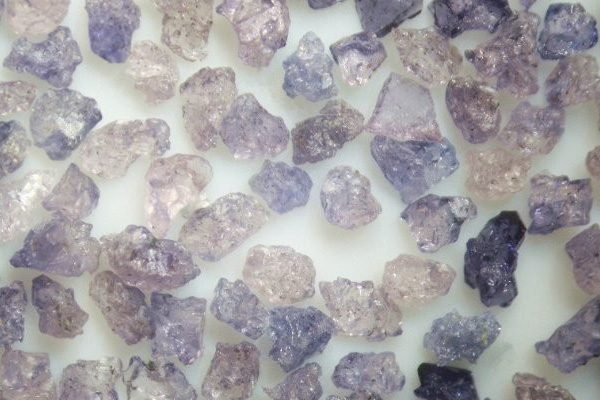
Monokrystaliczny tlenek glinu, często tzw “monokrystaliczny tlenek glinu” lub po prostu “szafir” w niektórych kontekstach, jest rodzajem tlenku glinu (Al₂o₃) który ma singiel, ciągła struktura krystaliczna. Inaczej jest w przypadku materiałów polikrystalicznych, which are made up of numerous small crystalline regions or grains with different orientations.
Monocrystalline alumina exhibits unique properties due to its singular crystal structure, w tym:
- Optical clarity: Monocrystalline alumina is transparent in its pure form and can transmit light over a wide range of wavelengths, from ultraviolet to infrared. This makes it useful for applications like sapphire windows and watch crystals.
- High hardness: Sapphire ranks 9 on the Mohs scale of mineral hardness, making it one of the hardest known materials, surpassed only by diamond.
- Stabilność termiczna: Monocrystalline alumina has a high melting point and maintains its strength at high temperatures.
- Chemical resistance: Sapphire is chemically inert and doesn’t react with most acids, bases, and other chemical agents.
- Electrical insulating properties: Monocrystalline alumina is an excellent electrical insulator.
Due to these properties, monocrystalline alumina finds application in various fields, w tym:
- Elektronika: Substrates for some semiconductor devices.
- Optics: Windows, lenses, and optical components, especially in harsh environments.
- Watch industry: Scratch-resistant watch faces.
- Medical: Surgical tools and endoscope optics.
The method commonly used to produce large single crystals of sapphire is known as the Kyropoulos method or other bulk crystal growth techniques.