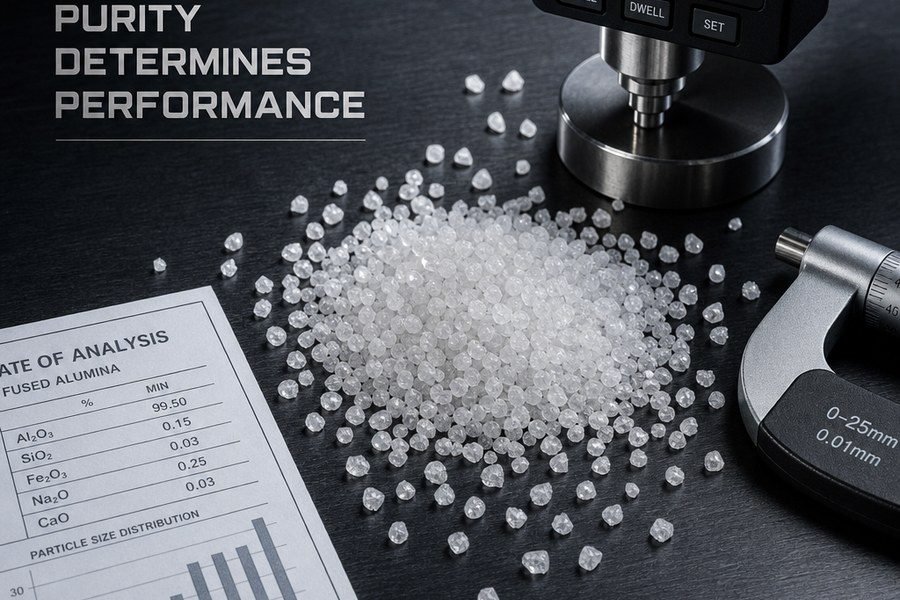
백색 용융 알루미나에 대한 부정확한 분석 인증서 (WFA) 선적을 허위로 표시하는 것 이상입니다. 이는 치명적인 내화 라이닝 파손을 일으킬 수 있습니다., inconsistent surface profiles in abrasive blasting, or a 15–20% drop in bonded wheel life. Engineers and procurement specialists who rely solely on a supplier’s bullet-point assurances risk installing media with hidden high-sodium content or residual un-fused alpha alumina, leading to spalling, premature wear, and costly production stoppages. This guide decodes the critical chemical and physical parameters you must verify on a COA to ensure the WFA meets your exact application requirements.
1. Understanding the Critical Role of Chemical Composition
화학적 순도를 통해 프리미엄 백색 용융 알루미나와 기본 전기 용융 재료를 분리합니다.. COA는 주요 성분을 나열하고 불순물을 추적합니다., 각각은 내화 안정성과 연마 절단 작용에 특정한 영향을 미칩니다.. Al₂O₃ 함량은 경도를 직접적으로 좌우합니다., 알칼리 산화물은 고온 성능을 결정합니다.. 이러한 값을 무시하면 예측할 수 없는 열 팽창이 발생하고 유리화 휠의 결합 강도가 감소합니다.. 관련 자료에 대한 더 넓은 개요를 보려면, 우리를 참조 화이트 가이드, 검은색, and brown fused alumina.
Al₂O₃ on the COA represents total available aluminum oxide, but the specification you truly need is alpha alumina (α-Al₂O₃) phase content. A fusion process that runs too cool or proceeds too quickly leaves unconverted gamma alumina, a soft, hygroscopic phase that compromises grain toughness. A COA reporting 99.30% Al₂O₃ with only 92% alpha phase will perform worse in grinding hard steels than a 99.10% Al₂O₃ grain with 97% alpha phase. Always cross-reference the total Al₂O₃ with the alpha phase percentage; reputable producers explicitly list this value.
2. The Critical Impurity: Controlling Sodium Oxide (Na2O)
Of all trace elements, sodium oxide demands the strictest scrutiny. Industrial alumina feedstock contains residual Na₂O from the Bayer refining process, and inadequate fusion fails to volatilize it. Entrapped sodium reacts with silicate bonds in refractory castables, forming a glassy phase that slashes hot modulus of rupture (HMOR) by up to 30% at 1,300°C. In abrasives, high Na₂O creates a weaker crystal lattice that dulls rapidly under pressure. To understand the broader applications of this material, explore the use of silicon carbide in similar demanding environments.
- Reacted sodium chemically binds within the alumina crystal after proper fusion, presenting lower risk.
- Unreacted sodium persists as free Na₂O, actively forming low-melting eutectics with silica in service.
- Top-tier WFA specifies Na₂O ≤ 0.30%, with premium grades achieving ≤ 0.10% through controlled, extended melting.
3. Quantifying Physical Integrity: Bulk Density and Grain Shape
A COA should report more than chemical data. Physical properties—particularly 부피 밀도—reveal grain porosity and crystal solidity, parameters invisible to compositional analysis alone. A chemically pure grain riddled with internal voids behaves like a weaker material, absorbing bond and fracturing at low thresholds. Bulk density provides a direct proxy for this structural soundness.
Accurate assessment requires testing per ASTM C29 or ISO 5311 standards. Denser grains pack greater mass into the same volume, signifying a fully fused structure with minimal gas entrapment. When comparing two WFA lots of identical size distribution, the one with lower bulk density invariably contains more hollow grains and will yield lower stock removal rates. Always demand that the COA lists the specific standard used for the measurement. For a deeper dive into the fundamentals, read more about what fused alumina is.
| WFA Application | Critical COA Parameter | Risk of Non-Conformance |
|---|---|---|
| 내화물 캐스터블 | Na2O ≤ 0.15% | 베타-알루미나의 형성; 조기 열간 강도 손실 |
| 보세 그라인딩 휠 | 부피 밀도 | 곡물 보유 감소; 과도한 드레싱 빈도 |
| 폭파 미디어 | 입자 크기 분포 | 일관되지 않은 표면 프로파일; 앵커 패턴 실패 |
| 세라믹 폼 필터 | α-Al2O₃ 상 ≥ 95% | 주조 결함을 일으키는 감마상의 수화 |
4. 입자 크기 분포 디코딩: FEPA 표준 뉘앙스
Macrogrits는 일반적으로 FEPA F 지정을 따릅니다. (F12~F220), 마이크로그릿이 P 시리즈에 부착되는 동안 (P240~P2500). A COA must specify not just the nominal grade but the allowed limits for coarse, median, and fine fractions. Overly wide distributions cause segregation in refractory mixes and produce scattered surface finishes in precision grinding. These values define the grain’s functional range, not just a label.
A true F46 specification requires a d50 (median size) between 310 그리고 370 μm, yet a cheaply processed batch might comply with F46 on the d3 oversize limit while carrying an excessively high volume of -45 µm fines. Those fines create a sludge problem in coolant systems and rob bond strength in abrasive products. Sophisticated buyers request the d10, d50, and d90 values on the COA to map the full distribution curve. A tight d90/d50 ratio signals sharp classification, translating to consistent material removal and predictable packing density in shaped refractories.
5. Validating Crystal Structure Through Loose Packing Density
Loose packing density goes beyond simple mass measurement to quantify how grain geometry and surface texture interact. 모난, blocky grains from a properly fused, slow-cooled ingot achieve higher packing density than splintery or needle-like grains from a rushed process. This parameter directly correlates with thermal conductivity in refractory backup linings and with abrasive particle spacing in resin-bond wheels. For more on related materials, see our complete guide on advanced ceramics silicon carbide abrasives.
- Pour the WFA sample into a calibrated density cup without tapping or vibration per the referenced ISO/ASTM standard.
- Verify the measured value against the supplier’s specification—premium WFA typically yields 1.75–2.05 g/cm³ for F24–F80 grits.
- Cross-check the result against bulk density: a significant divergence indicates poor shape control or excessive fine contamination.
- Reject any lot whose packing density falls more than 5% below the contracted minimum, as this signals operational shortcuts in crushing and classifying.
6. Spotting COA Red Flags: Magnetic Material and Hidden Moisture
Even a COA displaying excellent chemistry and sizing can conceal a crucial defect: magnetic iron contamination. During the fusion process, the breakdown of graphite electrodes and reaction with iron-bearing bauxite or alumina generates ferrosilicon and magnetite particulates. Without thorough magnetic separation, these particles embed in the white fused alumina and later oxidize in a refractory lining, creating localized hot spots and spalling in service.
A value exceeding 0.05% magnetic material on the COA warrants immediate rejection for any ceramic or high-temperature application.
Moisture content in the final product often appears as an afterthought on the COA but matters greatly. WFA shipped in unlined containers from humid origins can absorb over 0.3% moisture, promoting caking in bulk handling systems and introducing hydroxyl ions into refractory mixes. A robust COA will report moisture as a separate line item measured by loss on drying, with a value below 0.10% required for ready-to-press powder applications. Never accept a COA that omits these seemingly minor parameters—their absence frequently signals a supplier who does not control the full manufacturing process from fusion through final packaging. For additional insights into material properties, learn about the versatility of calcined alumina.
자주 묻는 질문
큐: What Al₂O₃ percentage indicates true high-purity White Fused Alumina on a COA?
ㅏ: For premium quality White Fused Alumina, the Certificate of Analysis (COA) should show an Al₂O₃ content of at least 99.5% by mass, with top-tier grades exceeding 99.7%. Anything below 99.0% typically indicates contamination from bauxite residues or incomplete electrofusion, which will degrade refractory performance.
큐: What maximum sodium oxide (Na2O) level should I accept for optimal refractory-grade WFA?
ㅏ: The Na₂O content on a valid COA must be strictly ≤ 0.35% 무게로. Levels above 0.40% indicate poor washing or insufficient electrolysis, leading to ceramic bloating and reduced thermal shock resistance in kiln applications. For abrasive-grade WFA, a limit of ≤ 0.40% is typically acceptable.
큐: What is the critical magnetic material (Fe₂O₃ + SiO2) threshold to prevent glaze defects?
ㅏ: To avoid firing stains and surface pitting in technical ceramics, the combined Fe₂O₃ and SiO₂ content on the COA should not exceed 0.15% (ideally <0.10%). The individual Fe₂O₃ value must stay below 0.05% for white-fired products; higher iron content creates unacceptable brown spotting at temperatures above 1500°C.
큐: What specific particle size distribution (PSD) tolerances must a COA show for consistent blasting media?
ㅏ: For standard FEPA or ANSI grits (예를 들어, F24 or #24), the COA must guarantee that at least 90% of the material passes through the designated nominal sieve and that no more than 8% remains on the next coarser sieve. The cumulative retained on the two coarsest sieves must be ≤ 15%, with fines (-63 microns for coarse grits) limited to < 2% 일관된 절단 속도를 보장하기 위해.
큐: COA에서 실제 결정 밀도를 확인하는 방법과 이것이 소결에 필수적인 이유는 무엇입니까??
ㅏ: 고밀도 WFA는 ≥의 실제 밀도를 보고해야 합니다. 3.95 g/cm³ (종종 3.96~3.99g/cm³) ISO에 따른 헬륨비중 측정으로 테스트했을 때 5017. 아래 읽기 3.90 g/cm3는 남은 SiC에서 갇힌 다공성 또는 유리화를 나타냅니다., 완성된 내화 벽돌 또는 세라믹 부품의 소결 밀도를 최대 2~3%까지 직접적으로 감소시킵니다..
허난 우수한 연마재 정보 (HSA)
허난 우수한 연마재 (HSA) is a China-based manufacturer and global supplier of high-performance abrasive and advanced ceramic materials for industrial applications worldwide. 당사의 핵심 제품 범위에는 흑색 실리콘 카바이드가 포함됩니다., 녹색 실리콘 카바이드, 전자 등급 실리콘 카바이드 (SiC), 백색 융합 알루미나, 갈색 융합 알루미나, 탄화붕소, 융합된 칼슘 알루미네이트, 및 SG 연마재.
고객에게 서비스 제공 30+ 국가, HSA는 신뢰할 수 있는 연마재 소재를 공급합니다., 내화 벽돌, 테크니컬 세라믹스, 반도체 응용, 정밀연마, 모래 분사, 야금, 및 고성능 건축자재.
견적 또는 무료 샘플 받기
프리미엄 연마재 및 고급 세라믹 소재를 공급하는 신뢰할 수 있는 공급업체를 찾고 있습니다.? 지금 기술팀에 문의하세요. 24 시간이며 자격을 갖춘 프로젝트에 대한 무료 샘플을 준비할 수 있습니다..
- 📧 이메일: sales@superior-abrasives.com
- 💬 왓츠앱: +86-186-3863-8803