Selecting the wrong alumina grain for a refractory lining operating above 1600 °C does not produce a gradual decline in performance — it produces premature structural failure. Spalling, accelerated creep, and flux penetration into open porosity translate directly into unplanned kiln downtime and relining costs that can reach six figures per campaign. Engineers specifying castables, bricks, or monolithics for steel ladles, cement kilns, and glass tank regenerators must resolve one fundamental question early: allumina fusa bianca O tabular alumina?
How Each Material Is Formed — and Why That Defines Their Limits
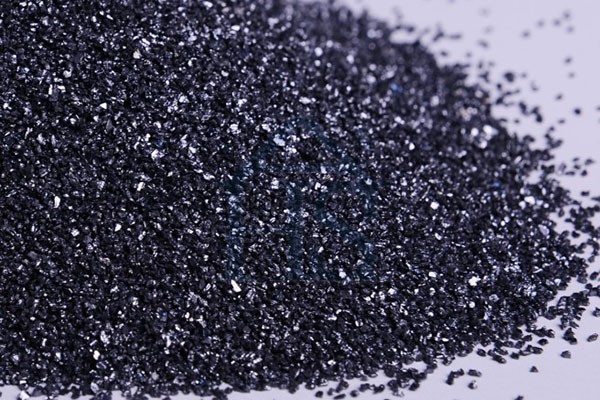
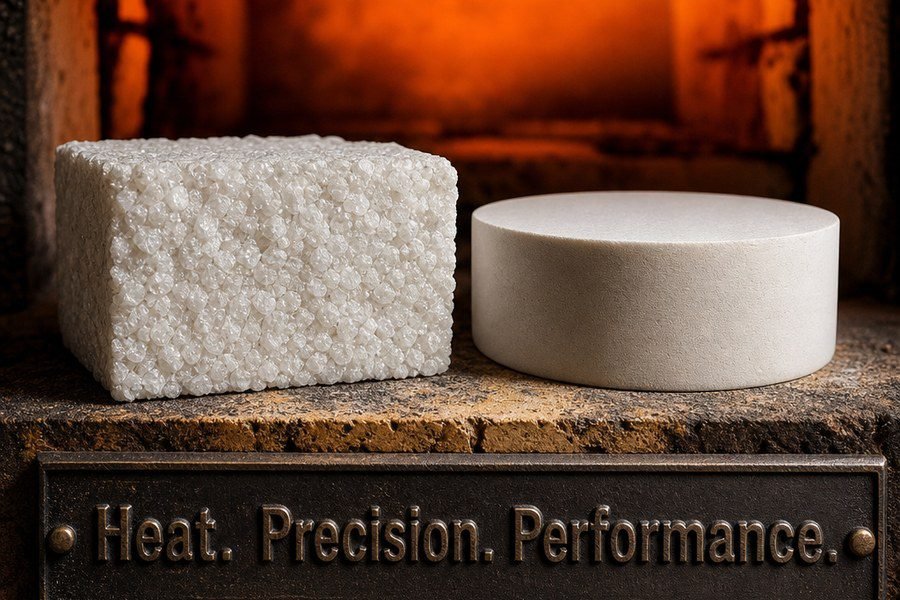
White fused alumina (WFA) is produced by electrofusing calcined alumina in an arc furnace above 2050 °C, followed by controlled cooling. The result is a polycrystalline alpha-Al₂O₃ grain with high purity (typically 99.0–99.6% Al₂O₃), a glassy fracture pattern, and a relatively angular, blocky morphology. Its hardness (Mohs 9) and friability make it excellent for grinding and abrasion, but in a refractory context, the same friability can accelerate breakdown under sustained thermal cycling. To understand the full alumina family before comparing these two grades, What Is Fused Alumina provides a useful technical foundation.
Tabular alumina, per contrasto, is not fused. Calcined alumina is sintered at temperatures between 1700 °C and 1850 °C — below the melting point — and held long enough for controlled grain growth into large, well-developed corundum crystals (50–500 µm). The name derives from the tablet-like hexagonal platelets visible under SEM. This sintering process eliminates residual glass phase entirely and produces a near-theoretical-density grain (3.55–3.58 g/cm³) with exceptional dimensional stability.
Critical Property Comparison: Where the Numbers Diverge
The performance gap between the two materials becomes concrete when tabulated against the conditions ultra-high-temperature service actually imposes. Both materials deliver Al₂O₃ content above 99%, but diverge sharply on microstructural and thermal properties that govern long-term lining integrity.
| Proprietà | Alumina bianca fusa | Tabular Alumina |
|---|---|---|
| Al₂O₃ content (%) | 99.0 - 99.6 | 99.2 - 99.8 |
| Densità apparente (g/cm³) | 1.75 - 1.95 (grain) | 1.90 - 2.00 (grain) |
| La vera densità (g/cm³) | 3.94 - 3.97 | 3.55 - 3.58 (sintered) |
| Open porosity (%) | 0 - 1 (fused grain) | 2 - 5 (controlled pore structure) |
| Max service temp (°C) | 1750 - 1800 | 1800 - 1850+ |
| Thermal shock resistance | Moderare | Alto |
| Creep resistance above 1600 °C | Moderare | Superior |
| Glassy phase content | Basso (residual) | Nessuno |
Creep resistance is particularly decisive in continuous service. WFA contains a residual vitreous phase at grain boundaries that begins to soften above approximately 1500 °C, allowing grain boundary sliding under sustained load. Tabular alumina’s glass-free microstructure suppresses this mechanism, maintaining dimensional integrity at temperatures where WFA-based linings begin to deform.
Thermal Shock Behavior Under Cyclic Loading
Thermal shock resistance is not a single value — it depends on the thermal diffusivity, elastic modulus, and coefficient of thermal expansion (CTE) of the material, as well as the geometry and thickness of the installed lining. WFA’s CTE runs approximately 8.0 × 10⁻⁶/°C (25–1000 °C). Tabular alumina’s is slightly lower at 7.5–8.0 × 10⁻⁶/°C, but the more important factor is the grain structure.
Tabular alumina’s large, well-ordered corundum crystals and controlled porosity allow micro-cracks to arrest rather than propagate across grain boundaries. In steel ladle linings subjected to rapid heat-cool cycles during tapping, this characteristic extends campaign life measurably — some operators report 15–25% longer campaigns compared with equivalent WFA-based castables. WFA performs adequately in moderate thermal cycling environments but is not the preferred choice where delta-T values exceed 400–500 °C per cycle.
Chemical Resistance to Slag and Flux Penetration
Both materials are classified as neutral to basic in slag chemistry terms. At high alumina purities, resistance to acidic slags (SiO₂-rich) and basic slags (Cao, MgO-rich) is broadly similar. The distinguishing variable is pore structure. WFA grains, being fully fused, present a near-zero internal porosity — which sounds advantageous until the castable or brick formulation introduces additional porosity through bonding phases and firing. Tabular alumina’s controlled internal porosity (2–5%) is intentional: it accommodates thermal expansion without generating macrocracks and does not significantly increase slag infiltration when properly bonded.
Applications involving highly aggressive fluxes — fluoride-containing glass melts, for instance, or iron oxide-saturated ladle slags — may also consider pairing alumina-based refractories with silicon carbide phases for enhanced oxidation and slag resistance. For a comparison of how other refractory-grade ceramics perform in aggressive environments, the analysis in Silicon Carbide Vs Boron Carbide provides relevant contrast on thermal and chemical stability mechanisms.
Application Matching: Which Grade Fits Which Installation
The choice is rarely absolute — it is context-dependent. The following framework covers the most common ultra-high-temperature refractory applications:
- Steel ladle working linings and purging blocks: Tabular alumina is the standard specification where service temperatures exceed 1650 °C continuously. Its creep resistance and slag penetration barrier make it the lower-risk choice despite its higher unit cost.
- Cement kiln burning zone bricks: WFA performs acceptably in brick formulations for zones below 1700 °C; tabular alumina is preferred for outlet zones and cooler nose rings exposed to severe thermal shock and abrasion from clinker.
- Glass tank regenerators (checker bricks): Tabular alumina’s glass-free microstructure resists alkali vapor attack at 1400–1600 °C better than WFA, where residual silica or glass phase accelerates alkali-induced degradation.
- High-alumina castables for petrochemical furnaces: WFA is commonly used in the aggregate fraction for castables operating below 1500 °C, providing a cost-effective balance of hardness and thermal stability. Tabular alumina replaces it where service exceeds that threshold.
- Kiln furniture and setter plates (ceramica tecnica): Tabular alumina dominates due to flatness retention under sustained load at elevated temperatures, critical for dimensional control in sintering of advanced ceramics and electronic components.
Cost Versus Performance: Making the Procurement Case
Tabular alumina commands a price premium of 20–40% over standard white fused alumina on a per-tonne basis, depending on grade, particle size distribution, and order volume. For procurement teams under budget pressure, that premium requires justification beyond material science. The business case centers on campaign life extension: if a tabular alumina lining lasts 15–25% longer than a WFA equivalent, the cost per heat or per production run often shifts decisively in favor of the more expensive grain.
For applications below 1600 °C or in environments with moderate thermal cycling, WFA remains the rational choice — its hardness, purity, and established supply chain make it a well-understood, cost-effective aggregate. The error is not choosing WFA for moderate-duty service; it is specifying it in place of tabular alumina for duty cycles it was not designed to sustain. Buyers evaluating sources for consistent purity and particle size across both grades should request certified test reports covering Al₂O₃ content, Fe₂O₃ and Na₂O impurity levels, and bulk density — the three variables that most directly predict in-service refractory performance.
Domande frequenti
Q: At what temperature does white fused alumina become unsuitable for refractory service?
UN: White fused alumina remains structurally adequate up to approximately 1750–1800 °C in static conditions, but its residual glassy grain-boundary phase begins to soften above 1500 °C under sustained mechanical load. In applications involving continuous service above 1600 °C combined with mechanical stress — such as steel ladle walls during tapping — creep deformation becomes measurable, and tabular alumina is the recommended alternative.
Q: What is the key microstructural difference between tabular alumina and white fused alumina?
UN: Tabular alumina is produced by solid-state sintering at 1700–1850 °C, yielding large corundum crystals (50–500 µm) with zero glass phase and controlled open porosity of 2–5%. White fused alumina is produced by arc fusion above 2050 °C, resulting in a fully dense polycrystalline grain (true density ~3.95 g/cm³) with a small residual vitreous phase at grain boundaries. The absence of glass phase in tabular alumina is the primary reason for its superior creep resistance and alkali resistance above 1500 °C.
Q: Can white fused alumina and tabular alumina be used together in the same castable formulation?
UN: SÌ. Blended formulations are common in high-alumina castables where cost optimization is required. A typical approach uses tabular alumina for the coarse aggregate fraction (6–20 mm) to provide creep resistance and thermal shock tolerance, while WFA fills the fine fraction (0–1 mm) at lower cost without significantly compromising overall performance. The specific blend ratio depends on the maximum service temperature, thermal cycling severity, and target cost per installed tonne.
Q: How does alkali resistance compare between the two materials in glass furnace regenerators?
UN: In glass tank regenerators exposed to alkali vapors (Na₂O, K₂O) at 1400–1600 °C, tabular alumina outperforms WFA. The residual silica and glassy phase in WFA reacts preferentially with alkali oxides, forming low-melting-point feldspar phases (PER ESEMPIO., nepheline, NaAlSiO₄, melting point ~1526 °C) that accelerate dissolution of grain boundaries. Tabular alumina’s glass-free, high-purity corundum structure offers significantly lower reactivity and longer service life in this environment.
Q: What purity specifications should procurement teams require for ultra-high-temperature refractory grades?
UN: For service above 1600 °C, specify a minimum Al₂O₃ content of 99.2% for both WFA and tabular alumina. Key impurity limits: Fe₂O₃ below 0.05%, Na₂O below 0.30% for WFA (Na₂O is the primary flux impurity introduced from the Bayer process), and SiO₂ below 0.10%. For tabular alumina, also confirm open porosity is within the 2–5% range — values above 5% indicate incomplete sintering and will reduce slag penetration resistance. All values should be supported by batch-specific XRF certificates.
Informazioni su Henan Superior Abrasives (HSA)
Henan Superior Abrasives (HSA) is a China-based global supplier of high-performance abrasive and advanced ceramic materials for industrial applications worldwide. La nostra gamma di prodotti principale comprende il carburo di silicio nero, Carburo di silicio verde, carburo di silicio di grado elettronico (Sic), allumina fusa bianca, allumina fusa marrone, Carburo di boro, alluminati di calcio fusi, e abrasivi SG.
Servire i clienti in 30+ Paesi, HSA fornisce materiali affidabili per abrasivi, Refrattari, ceramica tecnica, applicazioni dei semiconduttori, lucidatura di precisione, sabbiatura, metallurgia, e materiali da costruzione ad alte prestazioni.
Ottieni un preventivo o un campione gratuito
Alla ricerca di un fornitore affidabile di materiali ceramici avanzati e abrasivi di alta qualità? Contatta il nostro team tecnico oggi: rispondiamo entro 24 ore e può organizzare campioni gratuiti per progetti qualificati.
- 📧 E-mail: sales@superior-abrasives.com
- 💬 WhatsApp: +86-186-3863-8803