

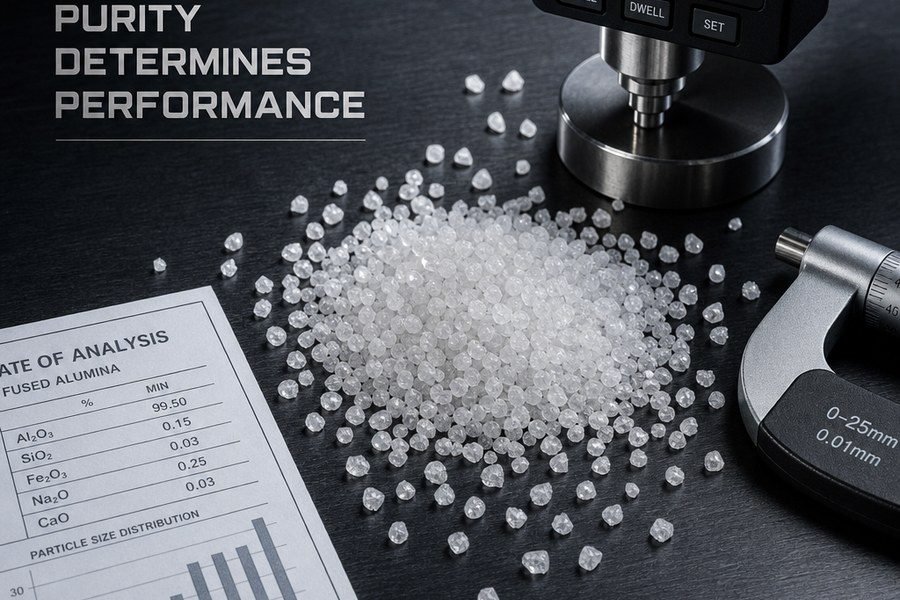
Un certificato di analisi impreciso per l'allumina fusa bianca (WFA) fa molto di più che travisare una spedizione: può causare danni catastrofici al rivestimento refrattario, inconsistent surface profiles in abrasive blasting, or a 15–20% drop in bonded wheel life. Engineers and procurement specialists who rely solely on a supplier’s bullet-point assurances risk installing media with hidden high-sodium content or residual un-fused alpha alumina, leading to spalling, premature wear, and costly production stoppages. This guide decodes the critical chemical and physical parameters you must verify on a COA to ensure the WFA meets your exact application requirements.
1. Understanding the Critical Role of Chemical Composition
Chemical purity separates premium white fused alumina from basic electro-fused material. A COA lists primary constituents and trace impurities, each exerting specific influence over refractory stability and abrasive cutting action. Al₂O₃ content directly governs hardness, while alkali oxides dictate high-temperature performance. Ignoring these values invites unpredictable thermal expansion and reduced bonding strength in vitrified wheels. For a broader overview of related materials, see our guide on white, nero, and brown fused alumina.
Al₂O₃ on the COA represents total available aluminum oxide, but the specification you truly need is alpha alumina (α-Al₂O₃) phase content. A fusion process that runs too cool or proceeds too quickly leaves unconverted gamma alumina, a soft, hygroscopic phase that compromises grain toughness. A COA reporting 99.30% Al₂O₃ with only 92% alpha phase will perform worse in grinding hard steels than a 99.10% Al₂O₃ grain with 97% alpha phase. Always cross-reference the total Al₂O₃ with the alpha phase percentage; reputable producers explicitly list this value.
2. The Critical Impurity: Controlling Sodium Oxide (Na₂O)
Of all trace elements, sodium oxide demands the strictest scrutiny. Industrial alumina feedstock contains residual Na₂O from the Bayer refining process, and inadequate fusion fails to volatilize it. Entrapped sodium reacts with silicate bonds in refractory castables, forming a glassy phase that slashes hot modulus of rupture (HMOR) by up to 30% at 1,300°C. In abrasives, high Na₂O creates a weaker crystal lattice that dulls rapidly under pressure. To understand the broader applications of this material, explore the use of silicon carbide in similar demanding environments.
- Reacted sodium chemically binds within the alumina crystal after proper fusion, presenting lower risk.
- Unreacted sodium persists as free Na₂O, actively forming low-melting eutectics with silica in service.
- Top-tier WFA specifies Na₂O ≤ 0.30%, with premium grades achieving ≤ 0.10% through controlled, extended melting.
3. Quantificazione dell'integrità fisica: Densità apparente e forma dei grani
Un COA dovrebbe riportare più che semplici dati chimici. Proprietà fisiche, in particolare densità apparente—rivelano la porosità dei grani e la solidità dei cristalli, parametri invisibili alla sola analisi compositiva. Un grano chimicamente puro crivellato di vuoti interni si comporta come un materiale più debole, assorbendo il legame e fratturandosi a soglie basse. La densità apparente fornisce un indicatore diretto di questa solidità strutturale.
Una valutazione accurata richiede test conformi a ASTM C29 o ISO 5311 standard. Denser grains pack greater mass into the same volume, signifying a fully fused structure with minimal gas entrapment. When comparing two WFA lots of identical size distribution, the one with lower bulk density invariably contains more hollow grains and will yield lower stock removal rates. Always demand that the COA lists the specific standard used for the measurement. For a deeper dive into the fundamentals, read more about what fused alumina is.
| WFA Application | Critical COA Parameter | Risk of Non-Conformance |
|---|---|---|
| Refractory Castables | Na₂O ≤ 0.15% | Formation of beta-alumina; premature hot strength loss |
| Bonded Grinding Wheels | Densità di massa | Reduced grain retention; excessive dressing frequency |
| Blasting Media | Particle Size Distribution | Inconsistent surface profile; anchor pattern failure |
| Ceramic Foam Filters | α-Al₂O₃ Phase ≥ 95% | Hydration of gamma phase causing casting defects |
4. Decoding Particle Size Distribution: The FEPA Standard Nuances
Macrogrits typically follow FEPA F-designations (F12–F220), while microgrits adhere to the P-series (P240–P2500). A COA must specify not just the nominal grade but the allowed limits for coarse, median, and fine fractions. Overly wide distributions cause segregation in refractory mixes and produce scattered surface finishes in precision grinding. These values define the grain’s functional range, not just a label.
A true F46 specification requires a d50 (median size) between 310 E 370 µm, yet a cheaply processed batch might comply with F46 on the d3 oversize limit while carrying an excessively high volume of -45 µm fines. Tali particelle fini creano un problema di fanghi nei sistemi di raffreddamento e riducono la forza di adesione nei prodotti abrasivi. Gli acquirenti sofisticati richiedono il d10, d50, e valori d90 sul COA per mappare l'intera curva di distribuzione. Un rapporto stretto d90/d50 segnala una classificazione precisa, traducendosi in una rimozione costante del materiale e in una densità di impaccamento prevedibile nei refrattari sagomati.
5. Convalida della struttura cristallina attraverso la densità di imballaggio allentata
Loose packing density goes beyond simple mass measurement to quantify how grain geometry and surface texture interact. Angolare, blocky grains from a properly fused, slow-cooled ingot achieve higher packing density than splintery or needle-like grains from a rushed process. This parameter directly correlates with thermal conductivity in refractory backup linings and with abrasive particle spacing in resin-bond wheels. For more on related materials, see our complete guide on advanced ceramics silicon carbide abrasives.
- Pour the WFA sample into a calibrated density cup without tapping or vibration per the referenced ISO/ASTM standard.
- Verify the measured value against the supplier’s specification—premium WFA typically yields 1.75–2.05 g/cm³ for F24–F80 grits.
- Cross-check the result against bulk density: a significant divergence indicates poor shape control or excessive fine contamination.
- Reject any lot whose packing density falls more than 5% below the contracted minimum, as this signals operational shortcuts in crushing and classifying.
6. Spotting COA Red Flags: Magnetic Material and Hidden Moisture
Even a COA displaying excellent chemistry and sizing can conceal a crucial defect: magnetic iron contamination. During the fusion process, the breakdown of graphite electrodes and reaction with iron-bearing bauxite or alumina generates ferrosilicon and magnetite particulates. Without thorough magnetic separation, these particles embed in the white fused alumina and later oxidize in a refractory lining, creating localized hot spots and spalling in service.
A value exceeding 0.05% magnetic material on the COA warrants immediate rejection for any ceramic or high-temperature application.
Moisture content in the final product often appears as an afterthought on the COA but matters greatly. WFA shipped in unlined containers from humid origins can absorb over 0.3% moisture, promoting caking in bulk handling systems and introducing hydroxyl ions into refractory mixes. A robust COA will report moisture as a separate line item measured by loss on drying, with a value below 0.10% required for ready-to-press powder applications. Never accept a COA that omits these seemingly minor parameters—their absence frequently signals a supplier who does not control the full manufacturing process from fusion through final packaging. For additional insights into material properties, learn about the versatilità dell’allumina calcinata.
Domande frequenti
Q: Quale percentuale di Al₂O₃ indica la vera allumina fusa bianca ad elevata purezza su un certificato di autenticità?
UN: Per allumina fusa bianca di alta qualità, il certificato di analisi (COA) dovrebbe mostrare un contenuto di Al₂O₃ di almeno 99.5% per massa, con voti di alto livello superiori 99.7%. Qualunque cosa qui sotto 99.0% tipicamente indica contaminazione da residui di bauxite o elettrofusione incompleta, che degraderà le prestazioni refrattarie.
Q: Quale massimo ossido di sodio (Na₂O) livello dovrei accettare per un WFA di grado refrattario ottimale?
UN: The Na₂O content on a valid COA must be strictly ≤ 0.35% by weight. Levels above 0.40% indicate poor washing or insufficient electrolysis, leading to ceramic bloating and reduced thermal shock resistance in kiln applications. For abrasive-grade WFA, a limit of ≤ 0.40% is typically acceptable.
Q: What is the critical magnetic material (Fe₂O₃ + SiO₂) threshold to prevent glaze defects?
UN: To avoid firing stains and surface pitting in technical ceramics, the combined Fe₂O₃ and SiO₂ content on the COA should not exceed 0.15% (ideally <0.10%). The individual Fe₂O₃ value must stay below 0.05% for white-fired products; higher iron content creates unacceptable brown spotting at temperatures above 1500°C.
Q: What specific particle size distribution (PSD) tolerances must a COA show for consistent blasting media?
UN: For standard FEPA or ANSI grits (PER ESEMPIO., F24 or #24), the COA must guarantee that at least 90% of the material passes through the designated nominal sieve and that no more than 8% remains on the next coarser sieve. The cumulative retained on the two coarsest sieves must be ≤ 15%, with fines (-63 micron per grane grosse) limitato a < 2% per garantire una velocità di taglio costante.
Q: Come posso verificare la vera densità dei cristalli su un COA e perché è essenziale per la sinterizzazione?
UN: La WFA ad alta densità dovrebbe riportare una densità effettiva pari a ≥ 3.95 g/cm³ (spesso 3,96–3,99 g/cm³) quando testato mediante picnometria ad elio secondo ISO 5017. Una lettura qui sotto 3.90 g/cm³ segnala la porosità o la vetrificazione intrappolata dal SiC residuo, che riduce direttamente la densità di sinterizzazione di un mattone refrattario finito o di una parte in ceramica fino al 2–3%.
Informazioni su Henan Superior Abrasives (HSA)
Henan Superior Abrasives (HSA) è un produttore e fornitore globale con sede in Cina di materiali ceramici avanzati e abrasivi ad alte prestazioni per applicazioni industriali in tutto il mondo. La nostra gamma di prodotti principale comprende il carburo di silicio nero, Carburo di silicio verde, carburo di silicio di grado elettronico (Sic), allumina fusa bianca, allumina fusa marrone, Carburo di boro, alluminati di calcio fusi, e abrasivi SG.
Servire i clienti in 30+ Paesi, HSA fornisce materiali affidabili per abrasivi, Refrattari, ceramica tecnica, applicazioni dei semiconduttori, lucidatura di precisione, sabbiatura, metallurgia, e materiali da costruzione ad alte prestazioni.
Ottieni un preventivo o un campione gratuito
Alla ricerca di un fornitore affidabile di materiali ceramici avanzati e abrasivi di alta qualità? Contatta il nostro team tecnico oggi: rispondiamo entro 24 ore e può organizzare campioni gratuiti per progetti qualificati.
- 📧 E-mail: sales@superior-abrasives.com
- 💬 WhatsApp: +86-186-3863-8803


