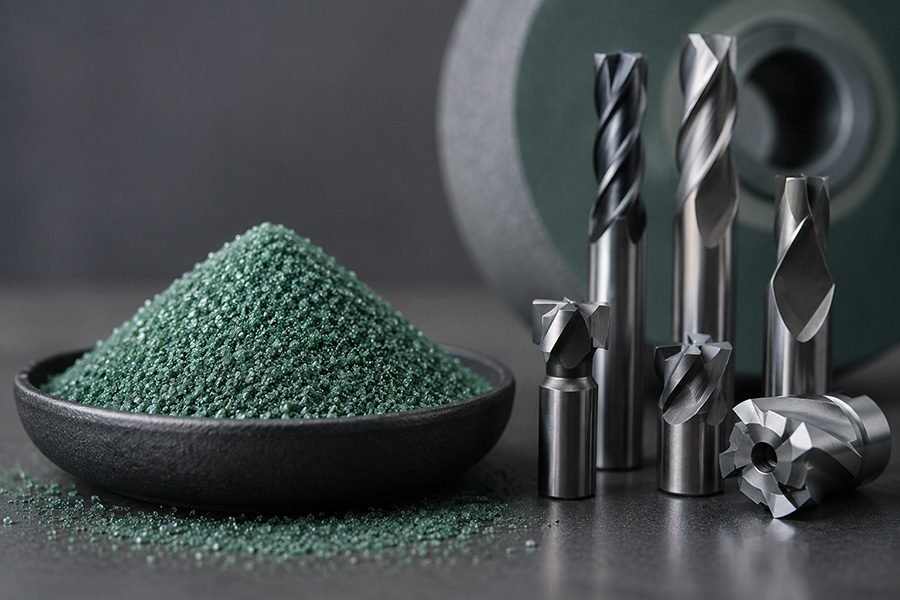
Grinding cemented carbide — the WC-Co family of cutting tool materials — with the wrong abrasive costs more than a rejected part. Thermal microcracking, cobalt binder smearing, and accelerated wheel glazing are recurring failure modes when abrasive selection ignores the material’s hardness-toughness duality. Carburo di silicio verde (GC) resolves these problems through specific physical and crystallographic properties that match the grinding demands of tungsten carbide composites. This guide explains the mechanisms behind that match and the parameters that govern reliable results.
Why Cemented Carbide Demands a Purpose-Matched Abrasive
Cemented carbide (WC-Co) sits at 1,400–1,800 HV depending on cobalt content and carbide grain size. Conventional brown or white fused alumina wheels — hardness approximately 2,000–2,100 HV — carry insufficient hardness margin against WC and wear rapidly, generating heat rather than cutting action. That heat drives cobalt binder phase transformation, introduces tensile residual stress, and can nucleate subsurface cracks that reduce tool life by 20–40% before the tool ever reaches the machine spindle.
Carburo di silicio, A 2,480 HV Vickers, maintains a genuine hardness advantage over WC grains throughout the wheel’s working life. IL green polytype (6H/4H crystal structure) is purer than black SiC — typically ≥99.0% SiC versus ≤98.5% for black — and its lower impurity burden produces sharper, more consistent fracture planes. That self-sharpening fracture behaviour is the core reason GC stays cutting rather than rubbing.
Crystal Structure and Fracture Mechanics: The Physical Basis for GC’s Performance
Green SiC forms during the Acheson furnace process in the highest-temperature core zone, where conditions favour closer-to-stoichiometric crystal growth and lower metallic impurity incorporation. The result is a material with a blocky, semi-friable fracture pattern that produces fresh cutting edges under grinding load without shattering to fines. SiC nero, per contrasto, is more friable and fractures to smaller debris, increasing wheel loading when grinding hard dense materials like WC-Co.
This controlled friability is quantified by the toughness index (TI) and friability index (FI) used in abrasive quality specification. GC typically shows a TI of 45–55 and an FI of 35–45 — values that place it between the aggressive cutting of black SiC and the toughness of fused alumina, making it optimal for precision grinding where form retention and surface finish matter simultaneously. For applications requiring very fine finishing, green silicon carbide micro powder grades extend this performance into sub-micron surface finish territory.
Grit Size Selection for WC-Co Grinding Operations
Grit selection in cemented carbide grinding involves balancing stock removal rate against surface integrity. Coarser grits cut faster but leave deeper surface damage layers that must be removed in subsequent passes; finer grits improve finish but increase thermal load per unit area if feed rates are not adjusted accordingly.
| Operation Type | Recommended Grit Range | Rugosità della superficie target (Ra) | Notes |
|---|---|---|---|
| Rough stock removal | 46–60 mesh | 0.8–1.6 µm | Higher coolant flow; monitor for cobalt smear |
| Rettifica semifinitura | 80–120 mesh | 0.4–0.8 µm | Transition pass; critical for stress relief |
| Finish / form grinding | 150–240 mesh | 0.1–0.4 µm | Wheel hardness grade H–J preferred |
| Lappatura di precisione / affinamento | F400–F1200 (micro powder) | <0.05 µm | Free-abrasive or resin-bonded lapping films |
Bond System Compatibility and Wheel Specification
GC abrasive is used in vitrified, resinoid, and metal-bond wheel constructions, each suited to different WC-Co grinding contexts. Vitrified bonds dominate precision cylindrical and surface grinding of carbide because the rigid bond structure holds form tolerance, allows effective dressing, and supports open-porosity designs that reduce chip loading. Resinoid bonds absorb vibration and suit interrupted-cut geometries. Metal bonds are preferred for profile grinding of complex carbide forms where wheel wear must be minimised over long runs.
Wheel hardness grade and structure number are as critical as abrasive type. For WC-Co with cobalt content below 10 wt%, a harder grade (I–K vitrified) resists premature breakdown. High-cobalt grades (above 15 wt%) are tougher and require a softer wheel (F–H) to avoid glazing caused by plastic deformation of the binder smearing over wheel pores. Structure numbers 8–10 (open) reduce heat buildup in both cases.
Thermal Management: Preventing Grinding Burns in Carbide Tools
Cemented carbide’s low thermal conductivity (20–85 W/m·K depending on Co content) concentrates heat at the grinding interface. Cobalt’s melting point of 1,495 °C sounds reassuring, but cobalt oxidises and phase-transforms at temperatures achievable in dry or poorly cooled grinding above 600 °C. The consequences — residual tensile stress and intergranular oxidation — reduce transverse rupture strength measurably.
Effective thermal management with GC wheels requires:
- Water-soluble synthetic coolant at minimum 10–15 L/min, directed ahead of the contact arc to pre-wet the workpiece
- Wheel speeds matched to bond type — vitrified GC wheels typically rated 35 m/s; exceeding this increases interface temperature regardless of coolant volume
- Dress frequency sufficient to keep grits sharp; dull GC grits rub rather than cut, converting mechanical energy to heat at efficiency losses exceeding 30%
- Workpiece traverse speed increased rather than reduced when surface temperature monitoring indicates thermal rise — counter-intuitive but effective at distributing heat over a larger area
- Spark-out passes of 2–3 without infeed to relieve elastic deflection and residual stress before measurement
GC vs. Diamond Abrasives for Carbide Grinding: A Practical Comparison
Diamond wheels outperform GC on hardest WC grades in terms of stock removal rate and wheel life, but the cost differential — diamond wheels typically run 8–15× the price of comparable GC wheels — shifts the economic calculation for many shops. GC remains the practical choice for roughing passes, for shops with mixed carbide and HSS workloads, and where wheel inventory flexibility matters. Diamond wheels impose a dressing challenge that GC vitrified wheels do not: rotary diamond dressing is standard for GC and adds no special tooling requirement.
The transition point is generally WC-Co grades with carbide grain size below 1 µm (submicron grades, hardness above 1,700 HV) processed at tight tolerance. At that intersection, diamond grinding economics improve. For standard ISO K and P application carbide grades at tolerances above ±0.01 mm, green SiC wheels remain cost-competitive and technically sufficient when properly specified. It is worth noting that the purity standards that define GC quality share common measurement methodology with semiconductor-grade SiC — as explored in the context of 6N high-purity α-form silicon carbide — illustrating how abrasive and electronic SiC quality ladders connect at the crystal chemistry level.
SiC nero, while harder than alumina, does not match GC’s purity or consistent friability for precision carbide grinding — a distinction relevant to buyers sourcing for multi-application environments, as illustrated in regional supply profiles such as black silicon carbide for sale in Thailand where both grades serve different industrial segments.
Domande frequenti
Q: What SiC purity level is required for grinding wheels used on cemented carbide?
UN: Green silicon carbide for bonded abrasive wheel manufacture should meet ≥99.0% SiC purity (FEPA or GB/T 2480 standard). Lower-purity black SiC (≤98.5% SiC) contains more iron and free carbon inclusions that reduce hardness consistency and introduce soft spots in the abrasive grain, accelerating uneven wheel wear on WC-Co workpieces.
Q: Can green SiC wheels be used dry when grinding tungsten carbide inserts?
UN: Dry grinding of WC-Co with GC wheels is not recommended for finish or semi-finish operations. Interface temperatures can exceed 600 °C within seconds, initiating cobalt oxidation and residual tensile stress that degrades transverse rupture strength. Short rough-grinding passes with immediate air blast can be tolerated, but water-soluble coolant at 10–15 L/min is the minimum specification for any sustained operation.
Q: What FEPA grit designation corresponds to the finish grinding of carbide cutting tools to Ra 0.2 µm?
UN: Achieving Ra 0.2 µm on WC-Co typically requires a FEPA F150 to F220 GC wheel in the grinding pass, followed optionally by a lapping step using F400–F600 micro powder. Wheel bond hardness grade J–K (vitrified) at structure number 8 is the standard specification for this surface finish range under conventional cylindrical grinding parameters.
Q: How does cobalt content in the carbide grade affect wheel selection?
UN: Higher cobalt content (above 15 wt% Co) increases workpiece toughness and ductility, which promotes cobalt smearing onto wheel pores — a primary cause of glazing. For these grades, a softer GC wheel (vitrified grade F–H) with open structure (number 9–11) is specified to ensure self-dressing action. Low-cobalt grades (below 6 wt% Co) are more brittle and abrasive to the wheel; a harder grade (I–K) with tighter structure (7–9) preserves form longer.
Q: What is the typical wheel speed for vitrified green SiC wheels on carbide grinding machines?
UN: Standard vitrified GC wheels for carbide grinding carry a maximum operating speed of 35 m/s (approximately 3,500–4,500 RPM depending on wheel diameter), per ISO 525 and ANSI B7.1 marking requirements. High-speed vitrified variants rated to 45–50 m/s are available but require wheel body reinforcement and machine guarding rated accordingly. Operating above the marked speed is a safety violation and invalidates the wheel’s burst-speed certification margin.
Informazioni su Henan Superior Abrasives (HSA)
Henan Superior Abrasives (HSA) è un fornitore globale con sede in Cina di materiali ceramici avanzati e abrasivi ad alte prestazioni per applicazioni industriali in tutto il mondo. La nostra gamma di prodotti principale comprende il carburo di silicio nero, Carburo di silicio verde, carburo di silicio di grado elettronico (Sic), allumina fusa bianca, allumina fusa marrone, Carburo di boro, alluminati di calcio fusi, e abrasivi SG.
Servire i clienti in 30+ Paesi, HSA fornisce materiali affidabili per abrasivi, Refrattari, ceramica tecnica, applicazioni dei semiconduttori, lucidatura di precisione, sabbiatura, metallurgia, e materiali da costruzione ad alte prestazioni.
Ottieni un preventivo o un campione gratuito
Alla ricerca di un fornitore affidabile di materiali ceramici avanzati e abrasivi di alta qualità? Contatta il nostro team tecnico oggi: rispondiamo entro 24 ore e può organizzare campioni gratuiti per progetti qualificati.
- 📧 E-mail: sales@superior-abrasives.com
- 💬 WhatsApp: +86-186-3863-8803