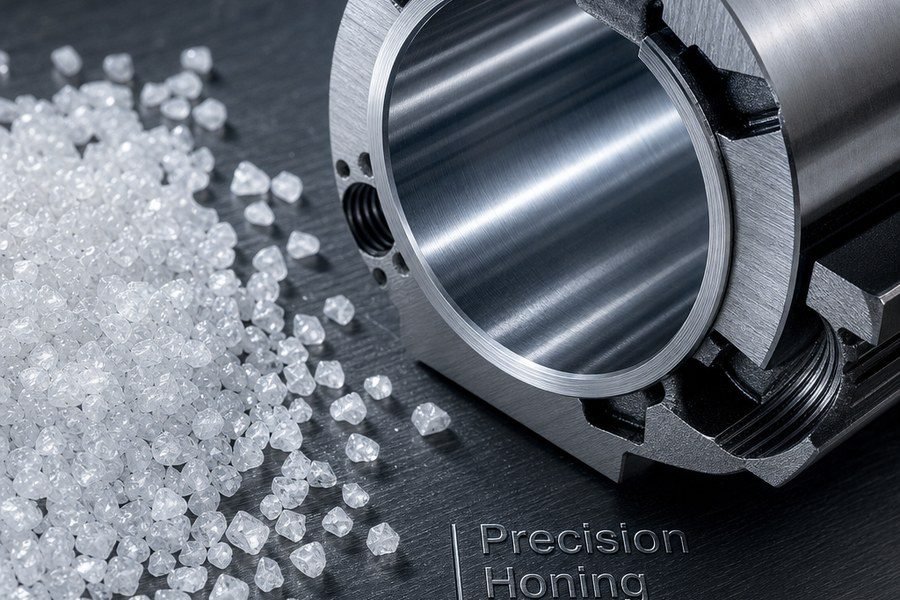
A hydraulic cylinder bore finished to the wrong surface roughness — even by 0.5 µm Ra — will accelerate seal wear, increase internal leakage, and shorten service life from thousands of operating hours to hundreds. In high-pressure hydraulic systems operating above 350 bar, the consequences scale fast: unplanned downtime, warranty claims, and in mobile equipment, catastrophic failure mid-operation. Selecting the correct abrasive for bore honing is not a secondary decision. It is an engineering constraint with direct cost implications.
Why Surface Finish Matters More Than Bore Diameter Tolerance
Engineers specifying hydraulic cylinders often focus on dimensional tolerances — bore roundness, cylindricity, and straightness — while treating surface finish as a downstream concern. In practice, the plateau honing finish on the bore wall governs seal contact behavior more than diameter alone. A plateau honed surface with a specific Rpk (reduced peak height) and Rvk (core valley depth) profile allows the seal to bed in quickly without excessive initial wear, while the valley structure retains lubrication film during steady-state operation.
Target surface parameters for most industrial hydraulic cylinders fall within Ra 0.2–0.8 µm and Rz 1.5–6.0 µm, with crosshatch angles typically between 30° and 60°. Achieving these values repeatedly across production runs demands an abrasive with consistent friability and sharp, blocky grain morphology — characteristics that define white fused alumina at its best.
What White Fused Alumina Offers That Other Abrasives Do Not
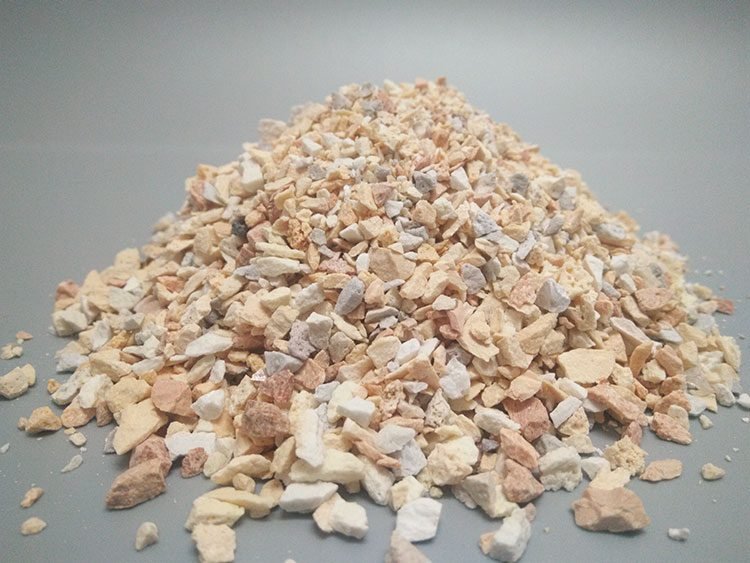
Alumina leburan putih (WFA) is produced by fusing high-purity Bayer-process alumina (typically ≥99.5% Al₂O₃) in an electric arc furnace and then crushing and classifying the resulting ingot. The absence of iron oxide and titanium oxide — impurities present in alumina leburan berwarna coklat — yields a grain that is harder, lebih gembur, and chemically inert. For honing applications, this translates to self-sharpening behavior: as the grain dulls under load, microfracture exposes fresh cutting edges rather than glazing over.
Compared with silicon carbide abrasives, WFA is less aggressive but leaves a more consistent surface profile on ferrous substrates. Understanding the fundamental differences between these material families — covered in depth in the guide on what is the difference between silicon carbide and alumina oxide — helps engineers match abrasive choice to substrate hardness and finish targets. For hardened steel bores in the 55–65 HRC range, WFA’s hardness of approximately 9 on the Mohs scale and its controlled fracture toughness make it the reference standard.
Grit Size Selection by Bore Finish Stage
Bore honing for hydraulic cylinders proceeds through two or three stages: rough honing (stock removal and geometry correction), finishing honing (surface profile development), and sometimes plateau honing (peak removal). Each stage demands a different grit range, and selecting outside that range forces compromises — either insufficient stock removal rate or a final surface too rough or too smooth for the target seal type.
| Honing Stage | Recommended WFA Grit (Memberi makan) | Target Ra (mikron) | Typical Material Removal Rate |
|---|---|---|---|
| Rough Honing | F46 – F80 | 1.6 - - 3.2 | 0.05 - - 0.20 mm/min |
| Finish Honing | F120 – F220 | 0.4 - - 0.8 | 0.005 - - 0.02 mm/min |
| Plateau Honing | F320 – F400 | 0.2 - - 0.4 | 0.001 - - 0.005 mm/min |
| Superfinishing Wash Pass | F600 – F800 | <0.2 | <0.001 mm/min |
Grit selection also interacts with honing stone bond hardness. Vitrified bond stones using WFA grains allow faster dressing recovery and tighter dimensional control than resin bond alternatives, making them the preferred choice for production-volume cylinder honing operations.
Critical WFA Material Specifications for Honing Stones
Not all white fused alumina is interchangeable. Honing stone manufacturers and end users specifying WFA for bore honing should evaluate material against a defined set of parameters. Inconsistent crystal size distribution, elevated Na₂O content, or poor grain shape uniformity will directly reduce stone life and finish consistency.
- Al₂O₃ purity: minimum 99.5% — lower purity increases thermal sensitivity and reduces hardness uniformity across grain population.
- Na₂O content: ≤0.30% — sodium compounds are hygroscopic and can cause vitrified bond stones to develop micro-porosity over time.
- Grain shape index: blocky to sub-blocky morphology preferred; elongated or platy grains fracture unpredictably under honing pressure and leave inconsistent surface profiles.
- Toughness index (per FEPA standard): 45–55 for finish-honing grades — balancing friability against rapid grain pullout under high contact pressure.
- Distribusi ukuran partikel: tight classification within ±5% of stated grit band to prevent coarse outlier grains generating deep scratches in an otherwise finished bore surface.
Hydraulic System Pressure Class and Abrasive Grade Matching
The operating pressure class of the hydraulic cylinder determines the seal geometry, material, and consequently the surface finish window the bore must hit. Low-pressure cylinders (hingga 100 bar) using polyurethane seals tolerate a wider Ra range, while high-pressure systems above 350 bar with PTFE or composite seals require the finish to be held within ±0.1 µm Ra to maintain acceptable leak rates across thermal cycling. At these tolerances, abrasive grade consistency becomes a supply chain issue, not just a process issue.
For reference, research on advanced alumina forms — including the discussion of spherical alumina Al₂O₃ powder morphologies — illustrates how grain shape at the micro-level directly governs surface interaction mechanics. The same principle applies to angular WFA grains in a honing stone: shape distribution is a controlled variable, not an incidental property.
Coolant Compatibility and Bore Contamination Risk
White fused alumina is chemically stable across the pH range of common water-soluble honing oils (pH 8.5–10.5) and exhibits no reaction with sulfurized or chlorinated cutting fluid additives used in some ferrous honing processes. This stability matters because grain-coolant incompatibility can cause accelerated chemical dissolution of the bond matrix in vitrified stones, increasing grain pullout rate and embedding loose abrasive particles into the bore surface — a contamination mode that compromises hydraulic fluid cleanliness downstream.
Bore cleanliness after honing is assessed against ISO 4406 fluid cleanliness codes in many hydraulic system specifications. Embedded abrasive particles that later release into the hydraulic circuit contribute directly to ISO particle count exceedances at the cleanliness codes that trigger servo valve or pump damage. Using a chemically stable, fully classified WFA grain with verified low free-silica content reduces this risk significantly compared with lower-purity alternatives.
Pertanyaan yang Sering Diajukan
Q: What Al₂O₃ purity grade of white fused alumina should be specified for hydraulic cylinder bore honing?
A: A minimum purity of 99.5% Al₂O₃ is the standard specification for precision honing applications. Grades below 99.0% introduce TiO₂ and Fe₂O₃ impurities that reduce hardness uniformity and increase grain-to-grain variability in cutting performance, leading to inconsistent Ra values across a production batch.
Q: Which FEPA grit size range produces a plateau honed finish suitable for high-pressure hydraulic seals?
A: For plateau honing targeting Ra 0.2–0.4 µm on hardened steel bores for systems operating above 200 bar, F320 to F400 WFA grit in a vitrified bond stone is the standard recommendation. The finish honing pass preceding it should use F120–F220 to establish the Rk core roughness profile before peak removal.
Q: Can white fused alumina honing stones be used on chrome-plated hydraulic cylinder bores?
A: Ya, with qualifications. Hard chrome (800–1000 HV) responds well to WFA honing using F220–F400 grit at reduced honing pressure (typically 0.3–0.8 MPa contact pressure versus 1.0–2.5 MPa for steel). Excessive pressure causes chrome layer microcracking. For thick EN plating or HVOF-coated bores, diamond or CBN stones are more appropriate than conventional WFA.
Q: What crosshatch angle is targeted during WFA finish honing of hydraulic cylinder bores?
A: The industry standard crosshatch angle for hydraulic cylinder bores is 30°–60° included angle (measured from the bore axis), with 45° being the most common target. This geometry provides the correct balance of lubrication retention in the valleys and axial seal support. Crosshatch angle is controlled through the ratio of honing tool rotation speed to stroking speed, not through abrasive selection alone.
Q: How does WFA grain toughness index affect honing stone life in production volume bore honing?
A: FEPA toughness index values of 45–55 are optimal for finish honing on hardened steel. Grains with toughness index above 60 resist fracture, leading to glazing and reduced cutting efficiency — the stone must be dressed more frequently, increasing cycle time. Grains below 40 fracture too rapidly, shortening overall stone life. Suppliers should provide certified toughness index data per batch, not per product grade alone.
Tentang Henan Superior Abrasives (HSA)
Henan Superior Abrasives (HSA) is a China-based global supplier of high-performance abrasive and advanced ceramic materials for industrial applications worldwide. Rangkaian produk inti kami meliputi silikon karbida hitam, silikon karbida hijau, silikon karbida kelas elektronik (Sic), alumina leburan putih, alumina leburan berwarna coklat, Boron Carbide, kalsium aluminat yang menyatu, dan abrasif SG.
Melayani pelanggan di 30+ negara, HSA memasok bahan abrasif yang andal, refraktori, keramik teknis, aplikasi semikonduktor, pemolesan presisi, peledakan pasir, metalurgi, dan bahan konstruksi berkinerja tinggi.
Dapatkan Penawaran atau Sampel Gratis
Mencari pemasok bahan keramik premium abrasif dan canggih yang dapat diandalkan? Hubungi tim teknis kami hari ini — kami meresponsnya dari dalam 24 jam dan dapat mengatur sampel gratis untuk proyek yang memenuhi syarat.
- 📧 E-mail: Sales@superior-abrasives.com
- 💬 Whatsapp: +86-186-3863-8803