

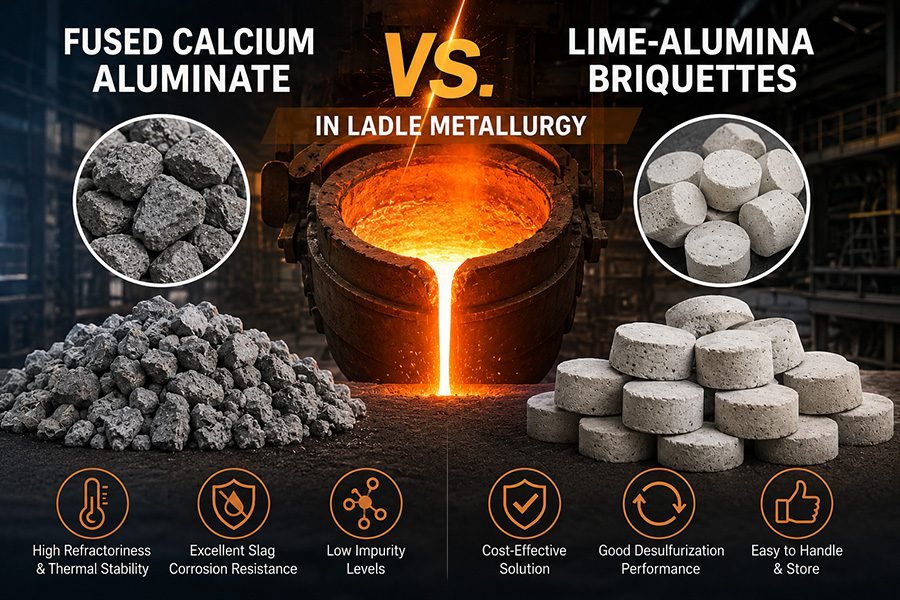
Choosing the wrong slag conditioner in ladle refining does not merely affect chemistry — it directly impacts tap-to-tap time, refractory wear rate, and final inclusion populations in the solidified strand. Plants that substitute lime-alumina briquettes for fused calcium aluminate without accounting for dissolution kinetics frequently report elevated Al₂O₃ clusters in ultra-low carbon grades and premature ladle lining erosion, both of which carry measurable downstream costs.
How Each Material Is Manufactured and Why It Matters
Fused calcium aluminate (FCA) is produced by co-melting limestone and alumina in an electric arc furnace at temperatures exceeding 1700 °C, yielding a homogeneous, glassy or crystalline ingot that is then crushed to specification. The fusion process drives off all free moisture and carbonate phases, leaving a stoichiometrically stable product with a fixed CaO/Al₂O₃ ratio — most commonly in the CA (CaAl₂O₄) or CA₂ (CaAl₄O₇) mineralogical phase.
Lime-alumina briquettes, by contrast, are cold-bonded agglomerates of calcined lime and alumina fines held together with a binder such as molasses or sodium silicate. The raw materials never reach fusion temperature, so each particle retains its distinct chemical identity. Upon addition to the ladle, the binder burns off first, the briquette disintegrates, and the individual oxide phases dissolve independently — a two-step sequence that is inherently slower than the direct dissolution of a pre-reacted compound. For applications requiring a high-purity alumina flux, understanding what white fused alumina is and how fusion changes oxide reactivity provides useful context for evaluating FCA performance.
Dissolution Kinetics: The Core Process Difference
Dalam pemurnian sendok, the slag must reach its target basicity and fluidity within a defined window — typically 8–15 minutes after the initial flux addition at stations operating with LF (ladle furnace) or RH degasser circuits. FCA dissolves rapidly because the pre-reacted calcium aluminate phases melt congruently or near-congruently in contact with the liquid slag bath, releasing no gaseous by-products and requiring no additional thermal energy to drive a decomposition reaction.
Briquettes carry residual CO₂ if lime calcination is incomplete, and the binder combustion generates turbulence that can entrap atmospheric nitrogen — a critical defect vector in low-nitrogen pipeline and automotive sheet grades. The full advantages of fused calcium aluminate over cold-bonded alternatives are most evident in precisely this kinetic window, where consistent melt-in behaviour reduces power consumption at the LF electrode and shortens overall heat cycle time.
Property Comparison: FCA vs. Lime-Alumina Briquettes
| Parameter | Kalsium Aluminat yang menyatu | Lime-Alumina Briquettes |
|---|---|---|
| Typical CaO content (%) | 35–50 | 30–55 (variable by blend) |
| Al₂O₃ content (%) | 40–55 | 30–55 (variable by blend) |
| Free moisture (%) | <0.5 | 1–4 (binder-dependent) |
| Dissolution time at 1600 °C (menit) | 3–8 | 10–20 |
| Hydrogen pickup risk | Very low | Moderate to high |
| Compositional consistency (heat-to-heat) | High — fixed mineralogy | Moderate — blend-dependent |
| Typical cost (USD/t, ex-China) | 180–260 | 90–150 |
The cost differential narrows significantly once total consumption rate and secondary costs — additional LF power time, refractory repair, and rejection risk — are factored in. A plant processing 800 kt/year of electrical steel commonly finds FCA reduces flux addition rates by 15–25 % compared with equivalent briquette additions, because less material is lost to premature reaction or incomplete dissolution before the slag skimming stage.
Inclusion Control and Steel Cleanliness Outcomes
Alumina inclusions (Al₂o₃) in liquid steel are highly detrimental in thin-strip, wire rod, and bearing steel applications. The refining mechanism in both systems relies on transferring dissolved Al₂O₃ from the steel into a basic, fluid slag — but slag fluidity depends on achieving the correct liquid fraction of the CaO–Al₂O₃–SiO₂ system within the refining temperature window (1560–1620 °C).
FCA additions achieve a slag composition in the low-melting-point valley of the CaO–Al₂O₃ binary diagram (approximately 50–60 % Al₂o₃, liquidus around 1400 °C) far more reliably than briquette additions, which introduce phases sequentially and can temporarily create high-melting CaO-rich zones that impede inclusion absorption. Steel mills targeting total oxygen below 15 ppm in bearing grades (per ASTM A295 / ISO 683-17) consistently report more stable results with FCA-conditioned slags.
Refractory Compatibility and Ladle Campaign Life
A slag that is too CaO-rich dissolves magnesia–carbon (MgO–C) bricks aggressively; one that is too Al₂O₃-rich corrodes alumina–spinel linings. Because FCA delivers a predictable, pre-set CaO/Al₂O₃ ratio, refractory engineers can design lining systems with a known chemical environment. With briquettes, the actual slag composition at any given moment depends on which component has dissolved fastest — introducing a variance that complicates lining wear modelling.
- MgO–C brick wear is reduced when slag basicity (CaO/SiO₂) stays between 3.0 Dan 5.0 — a range FCA additions maintain more consistently than briquettes in high-aluminium heats.
- Spinel formation at the slag–brick interface acts as a sacrificial barrier; FCA-conditioned slags with moderate Al₂O₃ activity promote this protective layer without dissolving it.
- Plants using briquettes in ultra-low silicon heats (Dan < 0.005 %) report 8–14 % shorter ladle campaign life on average compared with FCA-based flux schedules, based on operational data from multiple EAF melt shops in East Asia.
When Lime-Alumina Briquettes Remain a Viable Choice
Briquettes are not universally inferior. In applications where steel hydrogen content is not tightly specified, heat cycle time is flexible, and the slag basicity target is relatively forgiving — such as in rebar or structural section grades — the lower unit cost of briquettes can outweigh their kinetic disadvantages. Producers with open-top ladle stirring and no LF station have less precise control over slag evolution anyway, reducing the value of FCA’s controlled dissolution behaviour.
Selain itu, some facilities use a hybrid approach: briquettes for bulk basicity adjustment in the tap-ladle, diikuti dengan penambahan FCA pada LF untuk kontrol komposisi akhir dan optimalisasi fluiditas. Strategi ini menangkap efisiensi biaya dalam penambahan awal bervolume tinggi sambil menjaga presisi di masa kritis penyulingan. Tim pengadaan yang mengevaluasi total biaya fluks juga dapat membandingkannya dengan tolok ukur komoditas tahan api dan abrasif lainnya untuk mengontekstualisasikan harga per unit dalam belanja bahan baku mereka yang lebih luas..
Pertanyaan yang Sering Diajukan
Q: Berapa rasio CaO/Al₂O₃ dalam leburan kalsium aluminat yang terbaik untuk pengkondisian terak sendok?
A: Untuk sebagian besar aplikasi pemurnian sendok yang menargetkan bantalan oksida rendah atau baja listrik, FCA fase CA (sekitar 35–40 % Cao, 50–55 % Al₂o₃) menempatkan komposisi terak akhir di dekat 1400 °C cairan minimum dalam sistem biner CaO–Al₂O₃. bahan fase CA₂ (dengan kasar 22 % Cao, 72 % Al₂o₃) lebih disukai bila baja telah membawa sisa terak yang signifikan dengan SiO₂ yang tinggi, karena masukan Al₂O₃ yang lebih tinggi mengencerkan kebasaan dengan kurang agresif.
Q: Apakah briket kapur-alumina meningkatkan hidrogen dalam baja?
A: Ya, secara terukur. Pengikat seperti molase memperkenalkan gugus karbon dan hidroksil; sisa kelembaban dalam briket berikat dingin (biasanya 1–4 %) melepaskan hidrogen pada suhu baja. Panas yang dihasilkan dengan penambahan briket pada rute EAF-LF telah didokumentasikan sebesar 3–5 ppm [H] sebelum degassing versus 1,5–2,5 ppm dengan penambahan FCA dalam kondisi pengadukan yang setara. Untuk nilai yang membutuhkan [H] ≤ 2 ppm (baja pipa per API 5L PSL2), this difference can determine whether a vacuum degassing cycle is mandatory.
Q: How does FCA affect ladle refractory life compared with briquette-based slag practice?
A: The key variable is slag fluidity and composition stability. FCA-conditioned slags maintain a more consistent CaO/Al₂O₃ ratio throughout the heat, allowing MgO–C linings to develop a stable spinel (MgAl₂O₄) protective layer. Field data from EAF melt shops in East Asia shows 8–14 % longer ladle campaigns with FCA-based flux schedules compared with equivalent briquette programmes in heats where silicon content is below 0.01 %.
Q: Can FCA replace synthetic slag entirely, or is it a partial additive?
A: FCA functions as a primary synthetic slag former in many LF operations — it can constitute the full flux addition when target basicity aligns with FCA mineralogy. Namun, in heats with high carryover FeO (above 8 %) or when targeting basicity above 5.0, supplemental lime additions remain necessary because FCA alone cannot achieve high enough CaO activity to reduce FeO rapidly. In those cases, FCA is used as the Al₂O₃ source and fluidiser, with lime providing additional basicity.
Q: What particle size of FCA is standard for ladle addition?
A: The industry norm for pneumatic injection is 0–1 mm or 0–3 mm (powder/granule); for wire-feeder or direct ladle-top addition, 5–50 mm lumps are common. Finer sizes dissolve faster but increase dust loss during handling. ISO 11323 and ASTM C71 do not specify FCA particle size directly; individual steel plant technical specifications typically govern, with most specifying a maximum –3 mm fraction of ≥ 85 % for injection-grade material.
Tentang Henan Superior Abrasives (HSA)
Henan Superior Abrasives (HSA) adalah produsen dan pemasok global bahan keramik abrasif dan canggih berperforma tinggi yang berbasis di Tiongkok untuk aplikasi industri di seluruh dunia. Rangkaian produk inti kami meliputi silikon karbida hitam, silikon karbida hijau, silikon karbida kelas elektronik (Sic), alumina leburan putih, alumina leburan berwarna coklat, Boron Carbide, kalsium aluminat yang menyatu, dan abrasif SG.
Melayani pelanggan di 30+ negara, HSA memasok bahan abrasif yang andal, refraktori, keramik teknis, aplikasi semikonduktor, pemolesan presisi, peledakan pasir, metalurgi, dan bahan konstruksi berkinerja tinggi.
Dapatkan Penawaran atau Sampel Gratis
Mencari pemasok bahan keramik premium abrasif dan canggih yang dapat diandalkan? Hubungi tim teknis kami hari ini — kami meresponsnya dari dalam 24 jam dan dapat mengatur sampel gratis untuk proyek yang memenuhi syarat.
- 📧 E-mail: Sales@superior-abrasives.com
- 💬 Whatsapp: +86-186-3863-8803


