Die Wahl des falschen Schlackenkonditionierers beim Pfannenraffinieren wirkt sich nicht nur auf die Chemie aus, sondern wirkt sich auch direkt auf die Abstichzeit aus, Verschleißrate des feuerfesten Materials, und endgültige Einschlusspopulationen im verfestigten Strang. Pflanzen, die ersetzen Kalk-Tonerde-Briketts für geschmolzenes Calciumaluminat Ohne Berücksichtigung der Auflösungskinetik wird häufig von erhöhten Al₂O₃-Clustern in Qualitäten mit extrem niedrigem Kohlenstoffgehalt und vorzeitiger Erosion der Pfannenauskleidung berichtet, Beides ist mit messbaren nachgelagerten Kosten verbunden.
Wie jedes Material hergestellt wird und warum es wichtig ist
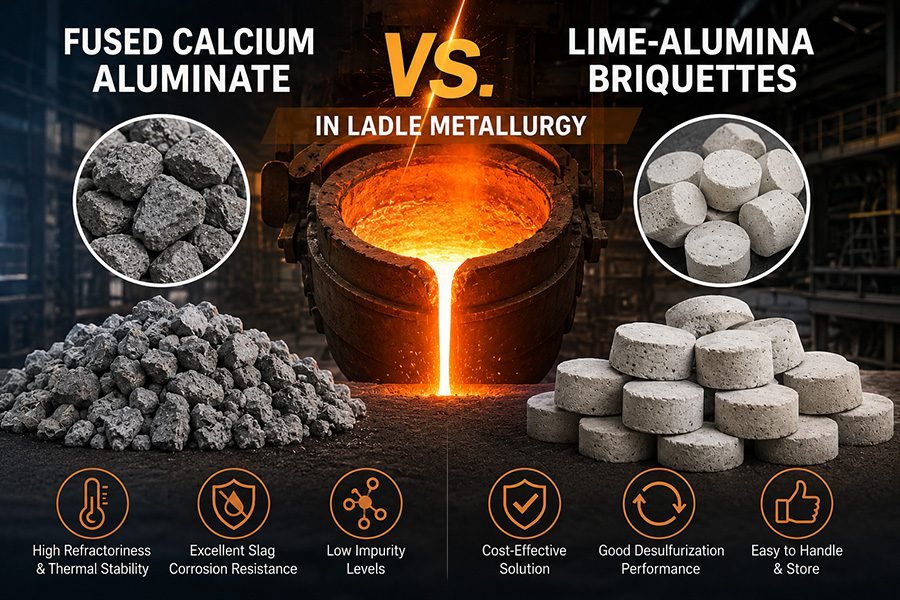
Geschmolzenes Calciumaluminat (FCA) wird durch gemeinsames Schmelzen von Kalkstein und Aluminiumoxid in einem Elektrolichtbogenofen bei Temperaturen über 20 °C hergestellt 1700 °C, ergibt ein homogenes Ergebnis, glasiger oder kristalliner Barren, der dann nach Spezifikation zerkleinert wird. Der Fusionsprozess vertreibt alle freien Feuchtigkeits- und Karbonatphasen, Hinterlässt ein stöchiometrisch stabiles Produkt mit einem festen CaO/Al₂O₃-Verhältnis – am häufigsten in der CA (CaAl₂O₄) oder CA₂ (CaAl₄O₇) mineralogische Phase.
Kalk-Aluminiumoxid-Briketts, im Gegensatz dazu, sind kaltgebundene Agglomerate aus kalziniertem Kalk und Aluminiumoxidfeinteilen, die mit einem Bindemittel wie Melasse oder Natriumsilikat zusammengehalten werden. Die Rohstoffe erreichen nie die Schmelztemperatur, so behält jedes Teilchen seine eindeutige chemische Identität. Beim Hinzufügen zur Kelle, zunächst verbrennt das Bindemittel, das Brikett zerfällt, und die einzelnen Oxidphasen lösen sich unabhängig voneinander auf – eine zweistufige Sequenz, die von Natur aus langsamer ist als die direkte Auflösung einer vorreagierten Verbindung. Für Anwendungen, die ein hochreines Aluminiumoxid-Flussmittel erfordern, Verständnis Was ist weißes geschmolzenes Aluminiumoxid? und wie die Fusion die Oxidreaktivität verändert, liefert einen nützlichen Kontext für die Bewertung der FCA-Leistung.
Auflösungskinetik: Der Kernprozessunterschied
In der Pfannenveredelung, Die Schlacke muss ihre angestrebte Basizität und Fließfähigkeit innerhalb eines definierten Fensters erreichen – typischerweise 8–15 Minuten nach der ersten Flussmittelzugabe an Stationen, die mit LF arbeiten (Pfannenofen) oder RH-Entgaserkreise. FCA löst sich schnell auf, da die vorreagierten Calciumaluminatphasen bei Kontakt mit dem flüssigen Schlackenbad kongruent oder nahezu kongruent schmelzen, Es werden keine gasförmigen Nebenprodukte freigesetzt und es ist keine zusätzliche Wärmeenergie erforderlich, um eine Zersetzungsreaktion voranzutreiben.
Bei unvollständiger Kalzinierung des Kalks enthalten Briketts Rest-CO₂, und die Bindemittelverbrennung erzeugt Turbulenzen, die Luftstickstoff einschließen können – ein kritischer Fehlervektor bei Pipeline- und Automobilblechqualitäten mit niedrigem Stickstoffgehalt. Das volle Vorteile von geschmolzenem Calciumaluminat gegenüber kaltgebundenen Alternativen sind genau in diesem kinetischen Fenster am deutlichsten, Dabei reduziert ein gleichmäßiges Einschmelzverhalten den Stromverbrauch an der LF-Elektrode und verkürzt die gesamte Heizzykluszeit.
Immobilienvergleich: FCA vs. Kalk-Aluminiumoxid-Briketts
| Parameter | Geschmolzenes Calciumaluminat | Kalk-Aluminiumoxid-Briketts |
|---|---|---|
| Typischer CaO-Gehalt (%) | 35–50 | 30–55 (variabel durch Mischung) |
| Al₂O₃-Gehalt (%) | 40–55 | 30–55 (variabel durch Mischung) |
| Kostenlose Feuchtigkeit (%) | <0.5 | 1–4 (Bindemittelabhängig) |
| Auflösungszeit bei 1600 °C (Mindest) | 3–8 | 10–20 |
| Gefahr der Wasserstoffaufnahme | Sehr niedrig | Mäßig bis hoch |
| Kompositionelle Konsistenz (Hitze-zu-Heizung) | Hoch – feste Mineralogie | Mäßig – mischungsabhängig |
| Typische Kosten (USD/t, Ex-China) | 180–260 | 90–150 |
Der Kostenunterschied verringert sich erheblich, wenn Gesamtverbrauchsrate und Sekundärkosten – zusätzliche NF-Leistungszeit – berücksichtigt werden, Reparatur von feuerfestem Material, und Ablehnungsrisiko – werden berücksichtigt. Eine Pflanzenverarbeitung 800 Bei Elektrostahl in kt/Jahr wird häufig festgestellt, dass FCA die Flusszugaberaten um 15–25 reduziert % im Vergleich zu gleichwertigen Brikettzusätzen, weil weniger Material durch vorzeitige Reaktion oder unvollständige Auflösung vor der Schlackenabschöpfungsstufe verloren geht.
Ergebnisse der Einschlusskontrolle und der Stahlreinheit
Aluminiumoxid-Einschlüsse (Al₂O₃) in flüssigem Stahl sind in dünnem Band äußerst schädlich, Walzdraht, und Wälzlagerstahlanwendungen. Der Raffinationsmechanismus in beiden Systemen beruht auf der Übertragung von gelöstem Al₂O₃ aus dem Stahl in eine basische Substanz, flüssige Schlacke – die Fließfähigkeit der Schlacke hängt jedoch davon ab, dass der richtige Flüssigkeitsanteil des CaO-Al₂O₃-SiO₂-Systems innerhalb des Raffinationstemperaturfensters erreicht wird (1560–1620 °C).
Durch FCA-Zusätze wird eine Schlackenzusammensetzung im Tiefschmelzpunkttal des CaO-Al₂O₃-Binärdiagramms erreicht (ca. 50–60 % Al₂O₃, Flüssigkeit herum 1400 °C) wesentlich zuverlässiger als Brikettzusätze, die nacheinander Phasen einführen und vorübergehend hochschmelzende CaO-reiche Zonen erzeugen können, die die Absorption von Einschlüssen behindern. Stahlwerke im Visier Gesamtsauerstoff unten 15 ppm in Lagerklassen (gemäß ASTM A295 / ISO 683-17) berichten durchweg über stabilere Ergebnisse mit FCA-konditionierten Schlacken.
Feuerfeste Kompatibilität und Pfannenlebensdauer
Eine zu CaO-reiche Schlacke löst Magnesia-Kohlenstoff auf (MgO–C) Ziegelsteine aggressiv; Eines, das zu Al₂O₃-reich ist, korrodiert Aluminiumoxid-Spinell-Auskleidungen. Weil FCA eine vorhersehbare Leistung liefert, voreingestelltes CaO/Al₂O₃-Verhältnis, Feuerfestingenieure können Auskleidungssysteme mit einer bekannten chemischen Umgebung entwerfen. Mit Briketts, Die tatsächliche Schlackenzusammensetzung zu einem bestimmten Zeitpunkt hängt davon ab, welche Komponente sich am schnellsten aufgelöst hat – was zu Abweichungen führt, die die Modellierung des Belagverschleißes erschweren.
- Verschleiß von MgO-C-Steinen wird reduziert, wenn die Basizität der Schlacke verringert wird (CaO/SiO₂) bleibt dazwischen 3.0 und 5.0 — Eine Reihe von FCA-Zusätzen bleibt in Hochaluminium-Heizungen gleichmäßiger erhalten als Briketts.
- Die Spinellbildung an der Schlacke-Ziegel-Grenzfläche fungiert als Opferbarriere; FCA-konditionierte Schlacken mit mäßiger Al₂O₃-Aktivität fördern diese Schutzschicht, ohne sie aufzulösen.
- Anlagen, die Briketts in extrem siliziumarmen Erhitzungen verwenden (Und < 0.005 %) Bericht 8–14 % Im Vergleich zu FCA-basierten Flussmittelplänen ist die Lebensdauer der Pfannen im Durchschnitt kürzer, basierend auf Betriebsdaten mehrerer EAF-Schmelzwerkstätten in Ostasien.
Wenn Kalk-Aluminiumoxid-Briketts eine gute Wahl bleiben
Briketts sind nicht überall minderwertig. Bei Anwendungen, bei denen der Wasserstoffgehalt von Stahl nicht genau spezifiziert ist, Die Heizzykluszeit ist flexibel, und das Basizitätsziel der Schlacke relativ nachsichtig ist – wie zum Beispiel bei Bewehrungsstäben oder Strukturprofilen – können die niedrigeren Stückkosten von Briketts deren kinetische Nachteile überwiegen. Hersteller mit offenem Pfannenrührwerk und ohne LF-Station haben ohnehin eine weniger präzise Kontrolle über die Schlackenentwicklung, Verringerung des Werts des kontrollierten Auflösungsverhaltens von FCA.
Zusätzlich, Einige Einrichtungen verwenden einen Hybridansatz: Briketts zur Massenbasizitätseinstellung in der Zapfpfanne, Anschließend erfolgt eine geringfügige Zugabe von FCA am LF zur endgültigen Kontrolle der Zusammensetzung und Optimierung der Fließfähigkeit. Diese Strategie ermöglicht Kosteneffizienz bei der großvolumigen frühen Zugabe und bewahrt gleichzeitig die Präzision im kritischen Raffinationsfenster. Beschaffungsteams, die die gesamten Flussmittelkosten bewerten, können diese auch mit anderen Benchmarks für feuerfeste und abrasive Rohstoffe vergleichen, um die Preise pro Einheit im Rahmen ihrer umfassenderen Rohstoffausgaben zu kontextualisieren.
Häufig gestellte Fragen
Q: Welches CaO/Al₂O₃-Verhältnis in geschmolzenem Calciumaluminat ist für die Pfannenschlackenkonditionierung am besten geeignet??
EIN: Für die meisten Pfannenraffinierungsanwendungen, die auf oxidarme Stahlsorten oder Elektrostahlsorten abzielen, ein CA-Phase-FCA (ca. 35–40 % CaO, 50–55 % Al₂O₃) positioniert die endgültige Schlackenzusammensetzung in der Nähe des 1400 °C Flüssigkeitsminimum im CaO-Al₂O₃-Binärsystem. CA₂-Phasenmaterial (rund 22 % CaO, 72 % Al₂O₃) wird bevorzugt, wenn der Stahl bereits erhebliche Schlackenverschleppungen mit erhöhtem SiO₂ aufweist, da der höhere Al₂O₃-Eintrag die Basizität weniger stark verdünnt.
Q: Erhöhen Kalk-Aluminiumoxid-Briketts den Wasserstoffgehalt im Stahl??
EIN: Ja, messbar. Bindemittel wie Melasse führen Kohlenstoff- und Hydroxylgruppen ein; Restfeuchte in kaltgebundenen Briketts (typischerweise 1–4 %) setzt bei Stahltemperaturen Wasserstoff frei. Die mit Brikettzusätzen in EAF-LF-Strecken erzeugten Schmelzen wurden mit 3–5 ppm dokumentiert [H] vor der Entgasung im Vergleich zu 1,5–2,5 ppm mit FCA-Zugaben unter äquivalenten Rührbedingungen. Für Noten, die es erfordern [H] ≤ 2 ppm (Pipelinestähle gemäß API 5L PSL2), Dieser Unterschied kann bestimmen, ob ein Vakuumentgasungszyklus obligatorisch ist.
Q: Wie wirkt sich FCA im Vergleich zur Praxis mit Schlacke auf Brikettbasis auf die Lebensdauer von feuerfestem Pfannenmaterial aus??
EIN: Die Schlüsselvariablen sind die Fließfähigkeit der Schlacke und die Stabilität der Zusammensetzung. FCA-konditionierte Schlacken behalten während der gesamten Hitze ein gleichmäßigeres CaO/Al₂O₃-Verhältnis bei, Dadurch können MgO-C-Auskleidungen einen stabilen Spinell entwickeln (MgAl₂O₄) Schutzschicht. Felddaten aus EAF-Schmelzwerken in Ostasien zeigen 8–14 % längere Pfannenkampagnen mit FCA-basierten Flussmittelplänen im Vergleich zu gleichwertigen Brikettprogrammen in Schmelzen, in denen der Siliziumgehalt darunter liegt 0.01 %.
Q: Kann FCA synthetische Schlacke vollständig ersetzen?, oder ist es ein teilweiser Zusatz?
EIN: FCA fungiert in vielen LF-Vorgängen als primärer synthetischer Schlackenbildner – es kann die vollständige Flussmittelzugabe darstellen, wenn die Zielbasizität mit der FCA-Mineralogie übereinstimmt. Jedoch, in Schmelzen mit hoher FeO-Verschleppung (über 8 %) oder wenn oben auf die Basizität abzielt 5.0, Zusätzliche Kalkzusätze bleiben notwendig, da FCA allein keine ausreichend hohe CaO-Aktivität erreichen kann, um FeO schnell zu reduzieren. In diesen Fällen, FCA wird als Al₂O₃-Quelle und Fluidisator verwendet, mit Kalk, der für zusätzliche Basizität sorgt.
Q: Welche Partikelgröße von FCA ist standardmäßig für die Pfannenzugabe vorgesehen??
EIN: Die Industrienorm für die pneumatische Injektion beträgt 0–1 mm oder 0–3 mm (Pulver/Granulat); für Drahtvorschub oder direkte Zugabe in die Pfanne, 5–50-mm-Klumpen sind häufig. Feinere Größen lösen sich schneller auf, erhöhen aber den Staubverlust bei der Handhabung. ISO 11323 und ASTM C71 geben die FCA-Partikelgröße nicht direkt an; In der Regel sind die technischen Spezifikationen einzelner Stahlwerke maßgeblich, wobei die meisten einen maximalen Bruchteil von –3 mm von ≥ angeben 85 % für Spritzgussmaterial.
Über Henan Superior Abrasives (HSA)
Henan überlegene Schleifmittel (HSA) ist ein in China ansässiger Hersteller und globaler Lieferant von Hochleistungsschleif- und Hochleistungskeramikmaterialien für industrielle Anwendungen weltweit. Zu unserem Kernsortiment gehört schwarzes Siliziumkarbid, grünes Siliziumcarbid, Siliziumkarbid in elektronischer Qualität (SiC), weißes geschmolzenes Aluminiumoxid, braunes geschmolzenes Aluminiumoxid, Borcarbid, geschmolzene Calciumaluminate, und SG-Schleifmittel.
Kunden bedienen in 30+ Länder, HSA liefert zuverlässige Materialien für Schleifmittel, Feuerfest, Technische Keramik, Halbleiteranwendungen, Präzisionspolieren, Sandstrahlen, Metallurgie, und leistungsstarke Baumaterialien.
Holen Sie sich ein Angebot oder ein kostenloses Muster
Auf der Suche nach einem zuverlässigen Lieferanten hochwertiger Schleif- und Hochleistungskeramikmaterialien? Kontaktieren Sie noch heute unser technisches Team – wir antworten innerhalb kürzester Zeit 24 Stunden und können kostenlose Muster für qualifizierte Projekte arrangieren.
- 📧 Email: sales@superior-abrasives.com
- 💬 Whatsapp: +86-186-3863-8803