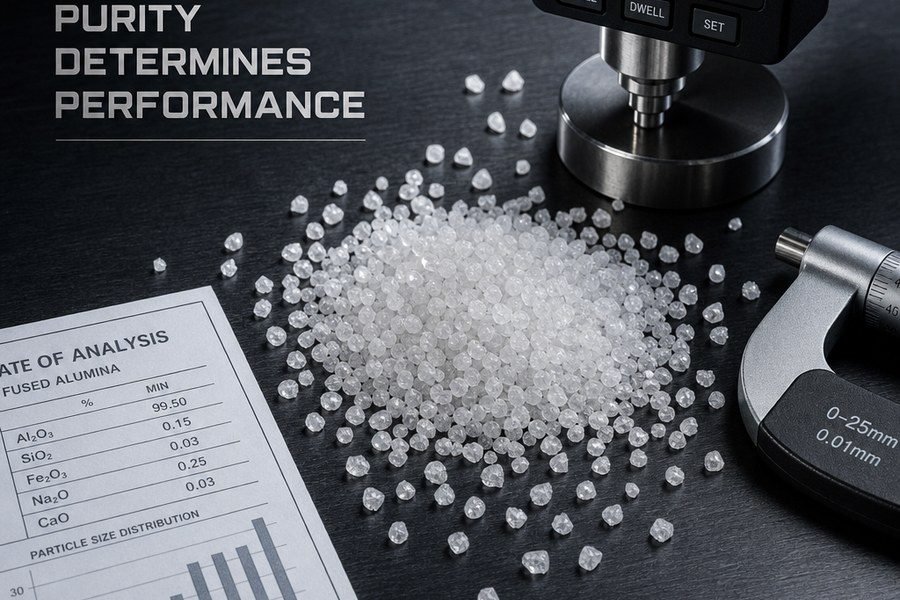
Неточний сертифікат аналізу білого плавленого оксиду алюмінію (WFA) робить більше, ніж спотворює інформацію про вантаж — це може спричинити катастрофічну поломку вогнетривкої футеровки, inconsistent surface profiles in abrasive blasting, or a 15–20% drop in bonded wheel life. Engineers and procurement specialists who rely solely on a supplier’s bullet-point assurances risk installing media with hidden high-sodium content or residual un-fused alpha alumina, leading to spalling, premature wear, and costly production stoppages. This guide decodes the critical chemical and physical parameters you must verify on a COA to ensure the WFA meets your exact application requirements.
1. Understanding the Critical Role of Chemical Composition
Хімічна чистота відокремлює білий плавлений глинозем преміум-класу від основного електроплавленого матеріалу. Сертифікат придатності містить перелік основних компонентів і слідових домішок, кожен з яких справляє певний вплив на вогнетривку стабільність і абразивну дію. Вміст Al₂O₃ безпосередньо визначає твердість, в той час як лужні оксиди диктують високотемпературні характеристики. Ігнорування цих значень призводить до непередбачуваного теплового розширення та зниження міцності зчеплення в оскловатих колесах. Для ширшого огляду супутніх матеріалів, побачити наш керівництво на білому, чорний, і коричневий плавлений оксид алюмінію.
Al₂O₃ on the COA represents total available aluminum oxide, but the specification you truly need is alpha alumina (α-Al₂O3) phase content. A fusion process that runs too cool or proceeds too quickly leaves unconverted gamma alumina, a soft, hygroscopic phase that compromises grain toughness. A COA reporting 99.30% Al₂O₃ with only 92% alpha phase will perform worse in grinding hard steels than a 99.10% Al₂O₃ grain with 97% alpha phase. Always cross-reference the total Al₂O₃ with the alpha phase percentage; авторитетні виробники чітко вказують це значення.
2. Критична домішка: Контроль оксиду натрію (Na₂O)
З усіх мікроелементів, оксид натрію вимагає найсуворішої перевірки. Промислова глиноземна сировина містить залишковий Na₂O від процесу рафінування Bayer, а неадекватне злиття не випаровує його. Захоплений натрій реагує з силікатними зв'язками у вогнетривких плитах, утворюючи склоподібну фазу, яка знижує гарячий модуль розриву (HMOR) до 30% при 1300°C. В абразивах, high Na₂O creates a weaker crystal lattice that dulls rapidly under pressure. To understand the broader applications of this material, explore the use of silicon carbide in similar demanding environments.
- Reacted sodium chemically binds within the alumina crystal after proper fusion, presenting lower risk.
- Unreacted sodium persists as free Na₂O, actively forming low-melting eutectics with silica in service.
- Top-tier WFA specifies Na₂O ≤ 0.30%, with premium grades achieving ≤ 0.10% through controlled, extended melting.
3. Кількісна оцінка фізичної цілісності: Насипна щільність і форма зерна
Сертифікат автентичності повинен повідомляти більше, ніж хімічні дані. Особливо фізичні властивості насипна щільність— виявити пористість зерен і твердість кристалів, параметри, невидимі лише для композиційного аналізу. Хімічно чисте зерно, пронизане внутрішніми пустотами, поводиться як більш слабкий матеріал, поглинаючий зв’язок і розрив при низьких порогах. Насипна щільність є прямим показником міцності конструкції.
Точна оцінка вимагає тестування відповідно до ASTM C29 або ISO 5311 стандарти. Denser grains pack greater mass into the same volume, signifying a fully fused structure with minimal gas entrapment. When comparing two WFA lots of identical size distribution, the one with lower bulk density invariably contains more hollow grains and will yield lower stock removal rates. Always demand that the COA lists the specific standard used for the measurement. For a deeper dive into the fundamentals, read more about what fused alumina is.
| WFA Application | Critical COA Parameter | Risk of Non-Conformance |
|---|---|---|
| Refractory Castables | Na₂O ≤ 0.15% | Formation of beta-alumina; premature hot strength loss |
| Bonded Grinding Wheels | Насипна щільність | Reduced grain retention; excessive dressing frequency |
| Blasting Media | Гранулометричний склад | Inconsistent surface profile; anchor pattern failure |
| Ceramic Foam Filters | α-Al₂O₃ Phase ≥ 95% | Hydration of gamma phase causing casting defects |
4. Decoding Particle Size Distribution: The FEPA Standard Nuances
Macrogrits typically follow FEPA F-designations (F12–F220), while microgrits adhere to the P-series (P240–P2500). A COA must specify not just the nominal grade but the allowed limits for coarse, median, and fine fractions. Overly wide distributions cause segregation in refractory mixes and produce scattered surface finishes in precision grinding. These values define the grain’s functional range, not just a label.
A true F46 specification requires a d50 (median size) between 310 і 370 мкм, yet a cheaply processed batch might comply with F46 on the d3 oversize limit while carrying an excessively high volume of -45 µm fines. Ці дрібні фракції створюють проблему утворення осаду в системах охолоджуючої рідини та погіршують міцність зв’язку в абразивних продуктах. Досвідчені покупці вимагають d10, d50, і значення d90 на сертифікаті автентичності, щоб відобразити повну криву розподілу. Жорстке співвідношення d90/d50 свідчить про чітку класифікацію, що забезпечує послідовне видалення матеріалу та передбачувану щільність упаковки у фасонних вогнетривах.
5. Перевірка кристалічної структури через нещільну упаковку
Щільність вільної упаковки виходить за рамки простого вимірювання маси для кількісного визначення взаємодії геометрії зерна та текстури поверхні. Кутова, блокові зерна з правильно сплавленого, повільно охолоджені злитки досягають вищої щільності упаковки, ніж осколкові або голчасті зерна, отримані при швидкому процесі. Цей параметр безпосередньо корелює з теплопровідністю вогнетривкої опорної футеровки та з відстанню абразивних частинок у смоляних кругах.. Докладніше про супутні матеріали, перегляньте наш повний посібник передові керамічні абразиви з карбіду кремнію.
- Pour the WFA sample into a calibrated density cup without tapping or vibration per the referenced ISO/ASTM standard.
- Verify the measured value against the supplier’s specification—premium WFA typically yields 1.75–2.05 g/cm³ for F24–F80 grits.
- Cross-check the result against bulk density: a significant divergence indicates poor shape control or excessive fine contamination.
- Reject any lot whose packing density falls more than 5% below the contracted minimum, оскільки це сигналізує про скорочення операцій у дробленні та класифікації.
6. Виявлення червоних прапорців COA: Магнітний матеріал і прихована волога
Навіть Сертифікат автентичності, який демонструє чудовий хімічний склад і розмір, може приховати важливий дефект: забруднення магнітним чавуном. Під час процесу злиття, руйнування графітових електродів і реакція із залізовмісними бокситами або глиноземом утворює частинки феросиліцію та магнетиту. Без ретельної магнітної сепарації, ці частинки вбудовуються в білий плавлений оксид алюмінію і пізніше окислюються у вогнетривкій футерівці, створення локальних гарячих точок і відколів під час обслуговування.
Перевищення значення 0.05% магнітний матеріал на сертифікаті автентичності гарантує негайну відмову для будь-якого керамічного або високотемпературного застосування.
Вміст вологи в кінцевому продукті часто з’являється в сертифікації автентичності як запізніла думка, але має велике значення. WFA, доставлені в контейнерах без підкладки, з вологого походження можуть поглинути 0.3% вологи, promoting caking in bulk handling systems and introducing hydroxyl ions into refractory mixes. A robust COA will report moisture as a separate line item measured by loss on drying, with a value below 0.10% required for ready-to-press powder applications. Never accept a COA that omits these seemingly minor parameters—their absence frequently signals a supplier who does not control the full manufacturing process from fusion through final packaging. For additional insights into material properties, learn about the versatility of calcined alumina.
Часті запитання
Q: What Al₂O₃ percentage indicates true high-purity White Fused Alumina on a COA?
А: For premium quality White Fused Alumina, the Certificate of Analysis (COA) should show an Al₂O₃ content of at least 99.5% by mass, with top-tier grades exceeding 99.7%. Anything below 99.0% typically indicates contamination from bauxite residues or incomplete electrofusion, which will degrade refractory performance.
Q: What maximum sodium oxide (Na₂O) level should I accept for optimal refractory-grade WFA?
А: The Na₂O content on a valid COA must be strictly ≤ 0.35% за вагою. Levels above 0.40% indicate poor washing or insufficient electrolysis, leading to ceramic bloating and reduced thermal shock resistance in kiln applications. For abrasive-grade WFA, a limit of ≤ 0.40% is typically acceptable.
Q: What is the critical magnetic material (Fe₂O₃ + SiO₂) threshold to prevent glaze defects?
А: To avoid firing stains and surface pitting in technical ceramics, the combined Fe₂O₃ and SiO₂ content on the COA should not exceed 0.15% (ideally <0.10%). The individual Fe₂O₃ value must stay below 0.05% for white-fired products; higher iron content creates unacceptable brown spotting at temperatures above 1500°C.
Q: What specific particle size distribution (PSD) tolerances must a COA show for consistent blasting media?
А: For standard FEPA or ANSI grits (напр., F24 or #24), the COA must guarantee that at least 90% of the material passes through the designated nominal sieve and that no more than 8% remains on the next coarser sieve. The cumulative retained on the two coarsest sieves must be ≤ 15%, with fines (-63 microns for coarse grits) limited to < 2% to ensure consistent cutting speed.
Q: How do I verify true crystal density on a COA and why is it essential for sintering?
А: High-density WFA should report a true density of ≥ 3.95 g/cm³ (often 3.96–3.99 g/cm³) when tested by helium pycnometry per ISO 5017. A reading below 3.90 g/cm³ signals trapped porosity or vitrification from leftover SiC, which directly reduces the sintering density of a finished refractory brick or ceramic part by up to 2–3%.
Про Henan Superior Abrasives (HSA)
Henan Superior Abrasives (HSA) є китайським виробником і глобальним постачальником високоефективних абразивів і передових керамічних матеріалів для промислового застосування по всьому світу.. Наш основний асортимент продукції включає чорний карбід кремнію, зелений карбід кремнію, карбід кремнію електронного класу (SIC), білий плавлений оксид алюмінію, коричневий плавлений оксид алюмінію, карбід бору, плавлені алюмінати кальцію, і СГ абразиви.
Обслуговування клієнтів в 30+ країни, HSA постачає надійні матеріали для абразивів, рефракції, технічна кераміка, напівпровідникові програми, точне полірування, піскоструминна обробка, металургія, і високоякісні будівельні матеріали.
Отримайте цінову пропозицію або безкоштовний зразок
Шукаємо надійного постачальника преміальних абразивних та передових керамічних матеріалів? Зв’яжіться з нашою технічною командою сьогодні — ми відповімо протягом 24 годин і може організувати безкоштовні зразки для кваліфікованих проектів.
- 📧 Електронна пошта: sales@superior-abrasives.com
- 💬 WhatsApp: +86-186-3863-8803