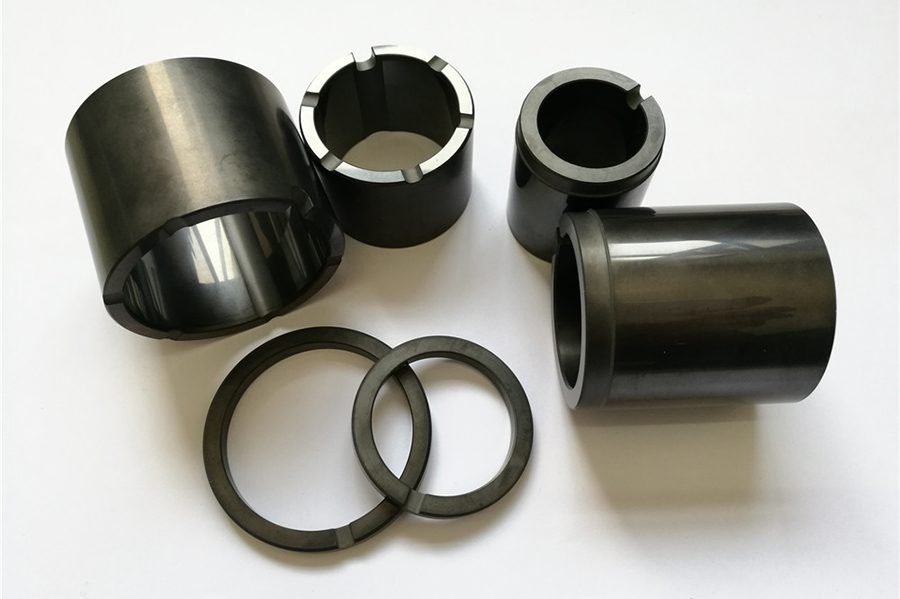
Carbură de siliciu (Sic) pudra is widely used for non-pressure sintering processes, which involves the densification of powder particles without the application of external pressure. Non-pressure sintering of SiC is commonly employed in the production of various ceramic components, such as high-temperature structural materials, piese rezistente la uzura, and electronic devices.
The non-pressure sintering of SiC powder typically involves the following steps:
Powder preparation
SiC powder is obtained through various synthesis methods, such as the Acheson process or chemical vapor deposition (CVD). The powder is carefully characterized in terms of particle size, purity, and other properties to ensure suitable sintering behavior.
Powder processing
The SiC powder is mixed with sintering aids or additives, such as boron, carbon, or aluminum compounds, which facilitate densification and enhance the final properties of the sintered material. The powder mixture is then shaped into the desired form, often using techniques like dry pressing or slip casting.
Pre-sintering
The shaped SiC compact is heated to a moderate temperature (typically around 1000-1200°C) in an inert or reducing atmosphere. This step removes any remaining organic binders or solvents and provides initial particle bonding.
Sinterizarea
The pre-sintered compact is then heated to higher temperatures, typically ranging from 1800°C to 2200°C, depending on the desired properties and microstructure. The high temperatures promote solid-state diffusion and densification of the SiC particles, resulting in a dense and strong ceramic material.
Post-processing
After sintering, the SiC component may undergo further processing steps, such as machining, măcinare, or surface treatment, depending on the intended application.
Non-pressure sintering of SiC powder offers several advantages, including the ability to produce complex shapes, high-purity materials, and good dimensional control. Cu toate acestea, it also presents challenges, such as the need for high sintering temperatures, the potential for grain growth and microstructural coarsening, and the management of sintering additives to achieve desired properties.
The selection of SiC powder characteristics, sintering additives, and processing parameters is crucial to obtain high-quality, dense SiC ceramics with the desired mechanical, termic, and electrical properties for specific applications.