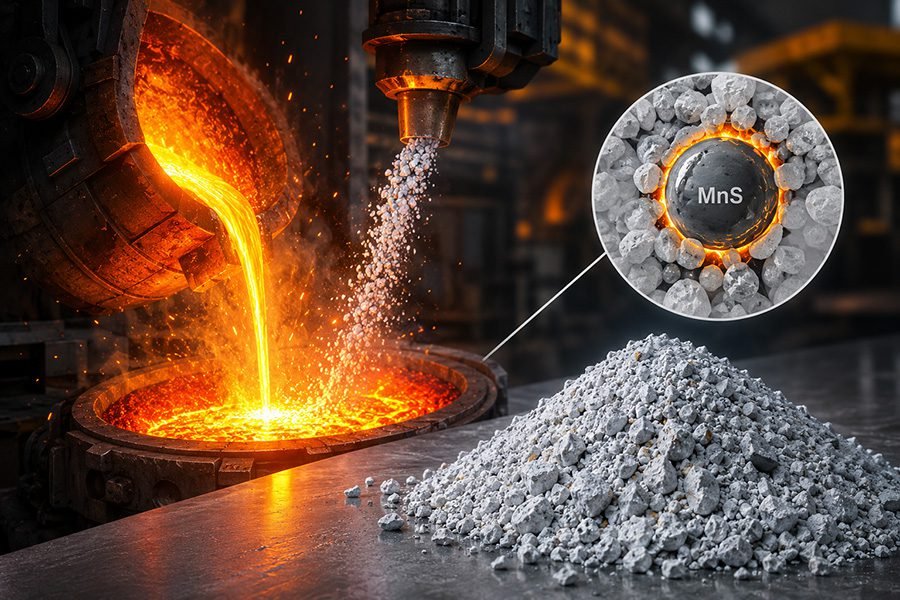
Manganese sulfide inclusions are a persistent structural liability in steel. Elongated Type II MnS stringers formed during solidification act as stress concentrators, degrading impact toughness, fatigue life, and transverse ductility in finished plate, bar, and tube products. When downstream customers reject heats over Charpy values or ultrasonic inspection results, the cost reaches far beyond the rejected tonnage — it encompasses reprocessing, delivery delays, and reputational risk with tier-1 OEM accounts. Fused calcium aluminate offers a well-established metallurgical pathway to arrest that failure mode before it starts.
Why MnS Inclusions Form and Why Morphology Determines the Damage
During solidification of medium- to high-sulfur steels, manganese and sulfur partition strongly to the liquid phase ahead of the solidification front. As the liquidus temperature drops, MnS precipitates within interdendritic channels, forming the characteristic elongated stringer morphology that persists through hot rolling. These stringers align parallel to the rolling direction, creating anisotropic mechanical properties — acceptable longitudinal toughness alongside severely reduced transverse or through-thickness performance.
The aspect ratio of the inclusion, not simply its volume fraction, governs the severity of mechanical degradation. A globular inclusion with an aspect ratio below 3:1 is substantially less harmful than an elongated stringer exceeding 10:1, even at identical sulfur contents. Calcium treatment changes the thermodynamic stability of the inclusion phase itself, converting MnS into calcium-modified sulfide (CaS or CaS–MnS solid solution) that nucleates as near-spherical particles with far lower aspect ratios.
The Thermodynamic Mechanism of Calcium-Based Sulfide Modification
Calcium has a substantially lower sulfide capacity temperature than manganese. When dissolved calcium activity in the steel melt reaches a threshold — typically 15–25 ppm total Ca, depending on sulfur level — CaS becomes the thermodynamically preferred sulfide phase over MnS. Nucleation shifts from interdendritic channels to earlier in the solidification sequence, producing dispersed, globular particles rather than continuous network stringers.
Fused calcium aluminate serves as the delivery vehicle for this reaction. Unlike calcium silicide or pure CaO additions, fused calcium aluminate fluxes (typically C12A7 or CA phases: 12CaO·7Al₂O₃ or CaO·Al₂O₃) dissolve rapidly into liquid steel slag, buffer calcium release into the metal, and simultaneously improve ladle slag fluidity for consistent inclusion absorption. The aluminate matrix also suppresses the formation of solid CaO agglomerates that would otherwise cause nozzle clogging — a critical process benefit in continuous casting operations.
Key Compositional and Physical Specifications for Ladle Metallurgy Applications
Not all calcium aluminate products perform equivalently. Phase composition, basicity, and particle geometry each affect reaction kinetics and process consistency. The table below summarizes the critical specification parameters buyers should evaluate:
| Parameter | Typical Specification Range | Process Relevance |
|---|---|---|
| CaO content | 35–55 wt% | Governs calcium delivery potential; C12A7 phase peaks near 48% CaO |
| Al₂O₃ content | 35–50 wt% | Controls slag basicity and alumina absorption capacity |
| SiO₂ content | <5 wt% (preferred <3%) | Higher SiO₂ reduces calcium activity; risks Si reversion into melt |
| Fe₂O₃ + MgO (combined) | <3 wt% | Impurity oxides dilute flux effectiveness; Fe₂O₃ contributes oxygen load |
| Particle size (granular) | 1–10 mm or as-specified | Affects dissolution rate; fine particles dissolve faster but may be entrained |
| Moisture (max) | <0.5 wt% | Hydration generates H₂ and CaO; causes hydrogen pickup and clogging risk |
When evaluating suppliers, request XRD phase analysis to confirm the dominant crystalline phase (C12A7 vs. CA vs. C3A), not just bulk chemistry. The same CaO/Al₂O₃ ratio can yield meaningfully different dissolution kinetics depending on the proportion of glass phase versus crystalline phase in the fused product. Begrip how to choose the right fused alumina product for your application provides a useful framework for applying similar selectivity criteria to calcium aluminate grades.
Dosing Strategy and Process Integration at the Ladle Furnace
Optimal calcium modification requires both adequate dissolved calcium in the steel and sufficient slag conditioning to absorb released alumina inclusions. Under-dosing leaves residual Type II MnS; over-dosing generates excessive CaS that can cluster and form new macro-inclusions. Typical addition rates range from 3–8 kg of fused calcium aluminate per tonne of steel, adjusted for sulfur load, aluminum content, and target cleanliness specification.
Additions are most effective when made after aluminum deoxidation is complete and before final argon stirring. This sequencing ensures that residual Al₂O₃ clusters have already been partially floated, that calcium encounters a well-deoxidized melt, and that the final soft-stirring cycle disperses modified inclusions uniformly before casting. Ladle slag basicity (CaO/SiO₂) should be maintained above 2.5 to prevent re-oxidation and SiO₂-driven calcium depletion from the slag back into the metal.
Inclusion Assessment: Connecting Material Input to Measurable Steel Quality
The effectiveness of calcium aluminate treatment is quantified through standardized inclusion rating methods. ASTM E45 (Method A chart series) and ISO 4967 both provide morphological and size-based ratings for sulfide-type inclusions. A well-executed calcium treatment should shift the inclusion population from Type II elongated sulfides (ASTM E45 thin series rating >1.5) to globular Type I or modified sulfide particles rated below 1.0.
- SEM/EDS mapping: Confirms conversion from pure MnS to CaS–MnS solid solutions; Ca:Mn molar ratio in inclusions should exceed 0.5 for effective modification.
- Ultrasonic inspection (UT) pass rates: Properly modified heats show a measurable reduction in UT rejections for plate and heavy bar — typically 30–60% fewer indications compared to unmodified heats at equivalent sulfur levels.
- Charpy impact testing (transverse orientation): Modified heats at 0.015–0.025% S routinely achieve transverse CVN values within 15% of longitudinal values, compared to 40–60% degradation in unmodified material.
- Optical microscopy inclusion ratings at 100× magnification across multiple fields per ASTM E45 remain the industry standard for production quality records.
Sourcing Criteria and Common Supply-Chain Failure Points
Fused calcium aluminate is an intermediate product that sits between commodity flux and specialty chemical — which means quality consistency varies significantly between suppliers. The most common failure points are moisture ingress during transit (CaO is hygroscopic and rapidly hydrates to Ca(OH)₂, reducing active CaO content and creating hydrogen risk), inconsistent phase ratios between production batches, and excessive fines generation from inadequate packaging.
Reliable procurement specifications should require sealed moisture-proof bags or supersacks with desiccant, COA with XRF chemistry and LOI per batch, and particle size distribution with maximum fines content below 5% bij gewicht. For buyers sourcing calcium-bearing fluxes alongside other refractory and abrasive inputs — such as brown fused alumina for refractory castables — consolidating supply from a vertically integrated manufacturer simplifies QC auditing and logistics. The dynamics of specialty oxide sourcing from China are also worth reviewing; an overview of the global market for silicon carbide illustrates how raw material supply concentration affects pricing and availability across adjacent advanced material categories.
Storage conditions matter as much as initial product quality. Fused calcium aluminate should be stored in dry, covered areas with stacking height limits that prevent bag rupture and fines generation. Shelf life under sealed, dry conditions exceeds 12 months; open or damaged packaging should be tested for moisture and active CaO before use, particularly in humid climates.
Veelgestelde vragen
Q: What calcium content in steel is required to fully modify MnS inclusions?
EEN: Effective sulfide modification generally requires dissolved calcium activity of 15–25 ppm in the steel melt, with the precise threshold depending on sulfur content. Bij 0.020% S, a Ca:S molar ratio of approximately 0.7–1.0 is typically cited in process metallurgy literature as the target range. Below this ratio, incomplete modification leaves residual elongated MnS; above a Ca:S ratio of ~1.5, excess CaS clustering becomes the dominant defect risk.
Q: How does fused calcium aluminate differ from calcium silicide wire for MnS modification?
EEN: Calcium silicide (CaSi) cored wire injects calcium directly into the steel melt for rapid, targeted treatment, while fused calcium aluminate is added as a slag conditioner that releases calcium into the metal indirectly via slag–metal equilibrium. CaSi wire delivers higher instantaneous calcium yields but also higher vapor losses; calcium aluminate provides slower, more stable calcium transfer with the added benefit of slag fluidity improvement and alumina absorption. Most clean-steel practices use both: calcium aluminate for slag conditioning and refining, followed by CaSi or CaFe wire for final melt treatment.
Q: Which phase in fused calcium aluminate — C12A7 or CA — dissolves faster in ladle slag?
EEN: C12A7 (12CaO·7Al₂O₃, also called mayenite) dissolves significantly faster than CA (CaO·Al₂O₃) in typical ladle slag at 1550–1620°C. C12A7 has a melting point of approximately 1415°C and a lower viscosity melt, enabling rapid integration into slag within 3–5 minutes of addition. CA melts at approximately 1605°C and dissolves more slowly, making it preferable when a sustained, staged calcium release profile is desired over longer treatment cycles. Suppliers should declare the dominant phase by XRD rather than relying solely on bulk chemistry.
Q: What ASTM or ISO standard is used to verify MnS modification in production steel?
EEN: ASTM E45 (Standard Test Methods for Determining the Inclusion Content of Steel) and its European equivalent ISO 4967 are the primary standards used. Under ASTM E45 Method A, sulfide inclusions are rated as Type A (thin or heavy series) across multiple fields at 100× magnification. Effective calcium treatment is generally considered achieved when Type A thin-series ratings remain at or below 1.0 across the heat. SEM/EDS is used as a supplementary method to confirm the Ca:Mn ratio in individual inclusion particles when tighter cleanliness specifications — such as those for API 5L X65/X70 pipe or bearing steel — are required.
Q: Can fused calcium aluminate be used in electric arc furnace (EAF) steelmaking as well as BOF routes?
EEN: Ja. Fused calcium aluminate is process-agnostic and is used in ladle metallurgy furnace (LMF) treatment regardless of the primary steelmaking route — EAF, BOF, or induction furnace. In EAF-based mini-mills producing structural and engineering steels with moderate sulfur targets (0.010–0.025% S), calcium aluminate additions during LMF refining follow the same dosing logic: 3–8 kg/t adjusted for initial slag composition and target cleanliness. The key constraint in EAF routes is often higher initial slag FeO content, which must be reduced below 3–5% before calcium-bearing additions are made to prevent rapid oxidation losses.
Over Henan Superior Schuurmiddelen (HSA)
Henan Superior Schuurmiddelen (HSA) is a China-based global supplier of high-performance abrasive and advanced ceramic materials for industrial applications worldwide. Ons kernproductassortiment omvat zwart siliciumcarbide, groen siliciumcarbide, siliciumcarbide van elektronische kwaliteit (SiC), wit gesmolten aluminiumoxide, bruin gesmolten aluminiumoxide, boorcarbide, gefuseerde calciumaluminaten, en SG-schuurmiddelen.
Klanten binnen bedienen 30+ landen, HSA levert betrouwbare materialen voor schuurmiddelen, vuurvaste materialen, technische keramiek, semiconductor applications, precision polishing, zandstralen, metallurgie, and high-performance construction materials.
Get a Quote or Free Sample
Looking for a reliable supplier of premium abrasive and advanced ceramic materials? Contact our technical team today — we respond within 24 hours and can arrange free samples for qualified projects.
- 📧 E-mail: sales@superior-abrasives.com
- 💬 WhatsApp: +86-186-3863-8803