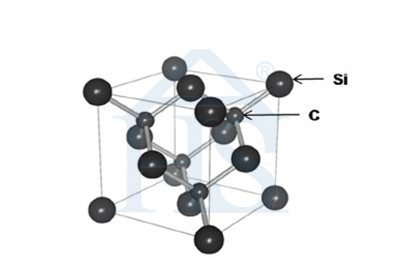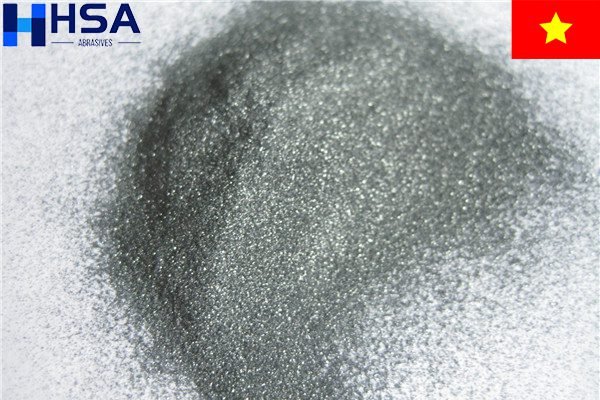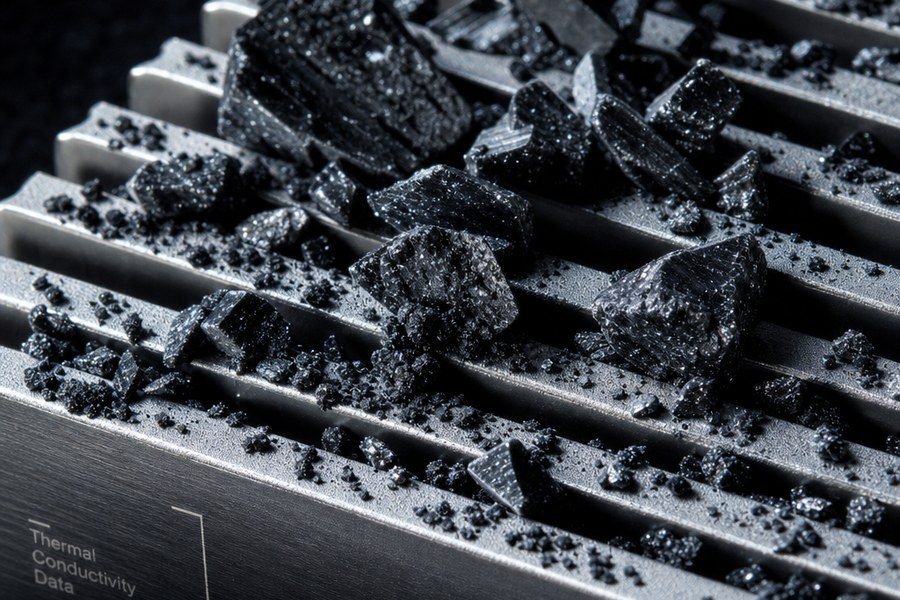
When a thermally conductive polymer compound underperforms, the consequences cascade quickly: junction temperatures exceed rated limits, derating curves force costly over-engineering, and field return rates climb. Filler selection is typically the root cause. Macrokorrels van zwart siliciumcarbide and fine powders are increasingly displacing alumina and boron nitride in heat sink filler applications where cost-to-conductivity ratio is the governing specification. This article presents the thermal conductivity data engineers need to evaluate that substitution rigorously.
Intrinsic Thermal Conductivity of Black Silicon Carbide Versus Common Fillers
Bulk zwart siliciumcarbide (SiC, 98–99% purity) carries an intrinsic thermal conductivity of 100–120 W/m·K at room temperature, measured by the laser flash method per ASTM E1461. This figure is roughly four to five times higher than alumina (Al₂O₃ at 20–30 W/m·K) and comparable in order of magnitude to hexagonal boron nitride platelets, though hBN is strongly anisotropic. Aluminum nitride reaches 170–220 W/m·K but at a price premium of three to six times over black SiC on a per-kilogram basis.
The data below summarises representative room-temperature thermal conductivity values for fillers used in polymer thermal interface compounds:
| Filler Material | Intrinsic λ (W/m·K) | Typical Loaded Compound λ at 60 vol% (W/m·K) | Relative Cost Index (Al₂O₃ = 1) |
|---|---|---|---|
| Zwart siliciumcarbide | 100–120 | 6–12 | 1.5–2.0 |
| Aluminiumoxide (Al₂O₃) | 20–30 | 2–4 | 1.0 |
| Aluminum Nitride (AlN) | 170–220 | 10–18 | 6–10 |
| Hexagonal Boron Nitride (hBN) | 60–400 (anisotropic) | 4–8 (random orientation) | 4–7 |
| Magnesium Oxide (MgO) | 35–60 | 2–5 | 1.2–1.6 |
How Particle Size Distribution Controls Packing Density and Compound Conductivity
Thermal conductivity in a filled polymer is not simply a function of filler intrinsic conductivity — particle packing efficiency governs how effectively conductive pathways form across the matrix. A monomodal distribution of spherical particles caps random packing at roughly 64% by volume. Black SiC powders are typically angular and irregular, which reduces free-flow packing but increases interparticle contact area once consolidated, benefiting phonon transfer at grain boundaries.
Combining a coarse fraction (D50 ~ 45–100 µm) with a fine fraction (D50 ~ 3–10 µm) in a 70:30 tot 60:40 mass ratio allows the fine particles to fill interstitial voids, pushing achievable loading past 70 vol% without proportionally increasing viscosity. At this loading level in an epoxy or silicone matrix, bulk compound conductivity values in the range of 10–15 W/m·K have been independently reported. Surface treatment with organosilane coupling agents — particularly aminopropyltriethoxysilane — reduces agglomeration and improves filler-matrix adhesion, measurably reducing interfacial thermal resistance.
Effect of SiC Loading Level on Measured Compound Thermal Conductivity
Thermal conductivity scales nonlinearly with filler volume fraction. Below the percolation threshold — typically 20–30 vol% for angular SiC — conductivity gains are modest because conductive pathways remain discontinuous. Above this threshold, each incremental volume percent of black SiC delivers progressively larger gains as particle chains bridge across the polymer. Published data from compounding trials using a silicone base resin show the following representative relationship:
- 30 vol% black SiC: compound λ ≈ 2.5–3.5 W/m·K (baseline thermal interface improvement over neat resin)
- 50 vol% black SiC: compound λ ≈ 5–7 W/m·K (approaching practical minimum for passive heat sink pad applications)
- 60 vol% black SiC: compound λ ≈ 8–12 W/m·K (target range for potting compounds around power modules)
- 70+ vol% black SiC (bimodal distribution): compound λ ≈ 12–18 W/m·K (requires optimised coupling agent and high-shear mixing)
Processing constraints impose a practical ceiling. Pastes exceeding 75 vol% loading require heated dispensing equipment and exhibit sharply elevated viscosity, making void-free encapsulation of complex geometries difficult without vacuum-assisted casting.
Electrical Resistivity Considerations in Thermally Conductive Applications
Unlike alumina and boron nitride, black silicon carbide is a halfgeleider, with bulk electrical resistivity in the range of 10¹ to 10³ Ω·cm depending on purity and impurity type. This limits its direct application in compounds where electrical isolation between conductors must be maintained — standard requirements for insulated gate bipolar transistor (IGBT) module potting typically specify volume resistivity above 10¹⁰ Ω·cm. At high loading levels, even a small number of interconnected SiC particles can create leakage paths that violate dielectric specifications.
Two mitigation strategies are employed in practice. Eerst, encapsulating individual SiC particles with a thin alumina or silica shell via sol-gel coating raises the effective compound resistivity to acceptable levels while preserving most of the thermal performance. Seconde, blending black SiC with an electrically insulating filler such as hBN or AlN allows formulators to tune both conductivity and dielectric properties simultaneously. Procurement teams sourcing for such blends should verify particle surface chemistry and purity certificates, as iron-contaminated SiC substantially degrades resistivity.
Temperature Dependence: Performance Stability from Cryogenic to 300 ° C
Phonon-dominated heat conduction in SiC follows an inverse temperature relationship — conductivity decreases as temperature rises, from approximately 120 W/m·K at 25 °C to around 70 W/m·K at 200 °C and 50 W/m·K at 400 ° C. For filled polymer systems, Echter, the polymer matrix degrades well before SiC exhibits meaningful conductivity loss. Silicone-based compounds remain functional to roughly 200–220 °C, while high-temperature epoxies extend this to 250–280 °C. Within these service windows, black SiC filler conductivity decreases only modestly (~15–20%), and compound-level thermal performance remains substantially stable.
This stability profile makes black SiC-filled compounds suitable for automotive power electronics, where IEC 60068 thermal cycling tests between −40 °C and +150 °C are standard qualification requirements. The low coefficient of thermal expansion of SiC (4.0–4.5 × 10⁻⁶ /°C) also reduces thermomechanical stress at the filler-matrix interface during cycling, contributing to longer compound service life relative to fillers with higher CTE mismatches.
Selecting the Right Particle Grade for Your Formulation
Grade selection depends on the end-use geometry, verwerkingsmethode, and target conductivity. For thin bond-line applications such as thermal interface pads below 250 µm, maximum particle size must be tightly controlled — D99 below 40 µm is a common specification to prevent bondline voiding. For potting and casting into heat sink cavities, coarser distributions down to F46 or F60 grit sizes deliver higher loading efficiency and superior conductivity. Black SiC is also used across other industrial sectors — for example, as an abrasive in stone polishing operations — which means established global supply chains exist at scale, supporting reliable procurement for thermal management volumes.
Key specification parameters a formulator should request from the supplier include: chemical purity (SiC ≥ 98.5 gew%), free carbon content (≤ 0.3 gew%), iron content (≤ 0.1 gew%), D10/D50/D90 particle size distribution by laser diffraction per ISO 13320, and BET surface area. Tight purity control on iron and free carbon is particularly important because both introduce electronic conductivity pathways that compromise dielectric performance in the final compound. Unlike the chemistry behind green silicon carbide used in coating industries, black SiC is produced with slightly different impurity profiles stemming from its Acheson furnace position and raw material selection, making grade-specific data sheets essential rather than generic SiC specifications.
Veelgestelde vragen
Q: What is the measured thermal conductivity of a black silicon carbide-filled epoxy compound at 60 vol% loading?
EEN: Bij 60 vol% black SiC loading in a standard epoxy matrix, bulk compound thermal conductivity typically falls between 8 en 12 W/m·K, measured by the transient hot-wire method per ASTM D7984 or the laser flash method per ASTM E1461. Exact values depend on particle size distribution, surface treatment quality, and void content during cure. Bimodal distributions pushing loading toward 70 vol% can extend this range to 12–15 W/m·K.
Q: Can black silicon carbide be used in electrically insulating thermal interface materials?
EEN: Not in its unmodified bulk form for high-voltage applications. Black SiC has bulk electrical resistivity of only 10¹–10³ Ω·cm, far below the 10¹⁰ Ω·cm minimum typically required for IGBT or power module potting compounds. Encapsulating SiC particles with a dielectric shell (alumina or silica via sol-gel) or blending with insulating fillers such as AlN or hBN are both viable strategies to recover dielectric performance while retaining thermal benefit.
Q: How does black SiC compare to alumina as a heat sink filler on a cost-performance basis?
EEN: Black SiC costs approximately 1.5–2× more per kilogram than alumina but delivers intrinsic thermal conductivity of 100–120 W/m·K versus 20–30 W/m·K for alumina. At equivalent 60 vol% loading, SiC-filled compounds reach 8–12 W/m·K versus 2–4 W/m·K for alumina-filled systems — a factor of three to four improvement in compound conductivity for roughly double the filler cost. For applications where junction temperature reduction has a direct impact on device reliability or derating, the cost premium is typically justified.
Q: What particle size specification should I request for thin-bondline thermal interface pad applications?
EEN: For bondline thicknesses below 250 µm, specify D99 ≤ 40 µm to prevent individual particles from bridging the bondline gap and creating stress concentrations or incomplete wetting. A bimodal blend with D50 of approximately 8–12 µm (coarse fraction) and 1–3 µm (fine fraction) in a 65:35 mass ratio is a widely used starting point. Confirm D99 by laser diffraction per ISO 13320, not sieve analysis, as sieve methods undercount elongated angular particles.
Q: How does black SiC filler thermal conductivity change over a –40 °C to +150 °C automotive operating range?
EEN: Intrinsic SiC conductivity decreases from ~120 W/m·K at 25 °C to ~95 W/m·K at 150 °C — approximately a 20% vermindering. Within a silicone or high-temperature epoxy compound, this translates to a modest 10–18% reduction in bulk compound conductivity across the full automotive range. The material remains mechanically and chemically stable throughout IEC 60068-2-14 thermal cycling tests between −40 °C and +150 ° C, with no documented phase changes or oxidation onset below 800 °C in air.
Over Henan Superior Schuurmiddelen (HSA)
Henan Superior Schuurmiddelen (HSA) is een in China gevestigde fabrikant en wereldwijde leverancier van hoogwaardige schuurmiddelen en geavanceerde keramische materialen voor industriële toepassingen over de hele wereld. Ons kernproductassortiment omvat zwart siliciumcarbide, groen siliciumcarbide, siliciumcarbide van elektronische kwaliteit (SiC), wit gesmolten aluminiumoxide, bruin gesmolten aluminiumoxide, boorcarbide, gefuseerde calciumaluminaten, en SG-schuurmiddelen.
Klanten binnen bedienen 30+ landen, HSA levert betrouwbare materialen voor schuurmiddelen, vuurvaste materialen, technische keramiek, halfgeleider toepassingen, precisie polijsten, zandstralen, metallurgie, en hoogwaardige bouwmaterialen.
Ontvang een offerte of een gratis monster
Op zoek naar een betrouwbare leverancier van premium schuurmiddelen en geavanceerde keramische materialen? Neem vandaag nog contact op met ons technische team – wij reageren binnen 24 uur en kan gratis monsters regelen voor gekwalificeerde projecten.
- 📧 E-mail: sales@superior-abrasives.com
- 💬 WhatsApp: +86-186-3863-8803