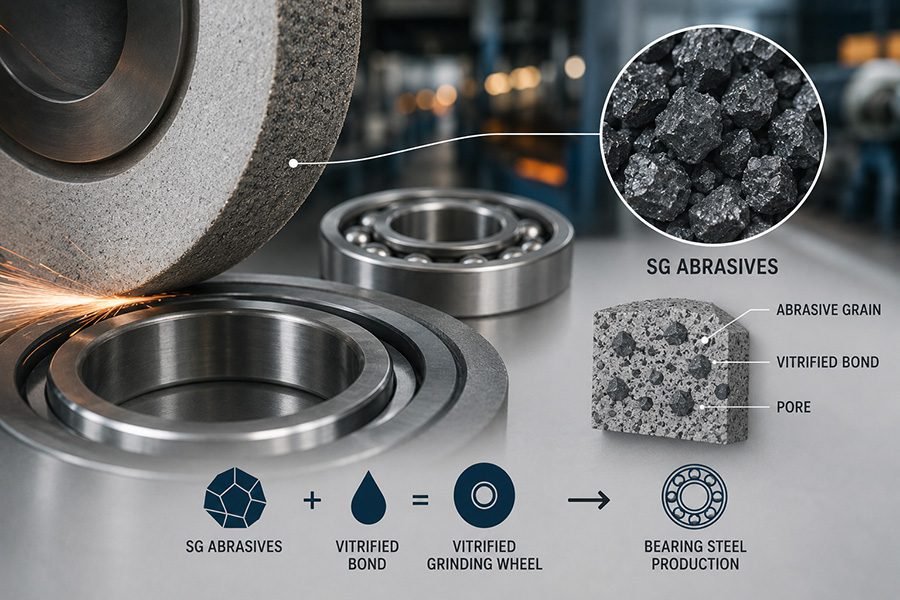
Specificare la grana abrasiva sbagliata per la rettifica dell'acciaio dei cuscinetti non solo rallenta i tempi del ciclo, ma rischia di creare microfessurazioni nel sottosuolo che si propagano in scheggiature premature sotto carico ciclico. In high-volume production of AISI 52100 and similar through-hardened steels, maintaining a cool, self-sharpening cut while holding sub-micron roundness tolerances defines process viability. This article dissects how sol-gel (SG) ceramic alumina abrasives in vitrified bonds address the exact failure modes that conventional fused alumina wheels create.
Microfracture Mechanics and Self-Sharpening Behavior
SG abrasive grain derives its performance not from bulk hardness alone but from the controlled subgrain structure engineered during the sol-gel sintering process. Each grain contains thousands of crystallites approximately 0.2–0.5 µm in size. Under grinding forces, microfracture propagates along crystallite boundaries rather than causing catastrophic grain pullout. This progressive fragmentation continuously exposes sharp, unworn cutting edges—a mechanism fundamentally absent in standard fused alumina where macrofracture dominates.
In bearing steel applications, self-sharpening directly limits power draw drift over extended grind cycles. Wheel dulling forces a compensatory increase in normal force, which elevates contact zone temperature past the austenitization threshold. SG microcrystallite design sustains a stable low-force regime, preserving surface integrity even during aggressive stock removal rates exceeding 10 mm³/mm·s.
Proper grain selection should account for wheel grade and structure. For context on how abrasive type interacts with bond systems, review the principles detailed in our guide on choosing the perfect grinding wheel.
Thermal Management During Raceway Profile Grinding
Bearing inner and outer raceways concentrate grinding energy into a narrow, curved contact zone bounded by shoulders. Without adequate thermal conduction from the abrasive–steel interface, local hot spots exceed 800°C within microseconds—sufficient to produce untempered martensite white layers 1–3 µm thick. These rehardened zones act as crack initiation sites.
SG abrasive grains contribute to thermal control through three simultaneous pathways:
- Lower specific grinding energy (often 25–35% reduction over fused alumina in equivalent conditions) due to sharper cutting edges and reduced rubbing friction.
- Più alto porosity retention in vitrified bonds; the irregular grain shape resists premature compaction, preserving chip clearance capacity.
- More consistent grit protrusion height, which optimizes coolant delivery into the arc of cut rather than deflecting off blunt crests.
Collectively these factors keep average surface temperature below the critical tempering range for hardened bearing steel, eliminating rehardening burns without slowing infeed rates. Mills targeting extended wheel life often evaluate alternative abrasive feedstocks; inquiries about silicon carbide abrasives price in China reflect a parallel interest in managing thermal conductivity through grain composition, though SG alumina remains the first choice for ferrous precision grinding.
Vitrified Bond Formulation for SG Grain Anchoring
SG abrasive demands a bond engineered specifically for microcrystalline fracture mechanics. A traditional vitrified bond formulated for fused alumina will either release SG grains prematurely—wasting material—or grip too aggressively, negating the controlled fracture advantage. The ideal bond composition balances two competing requirements:
- High-temperature flux chemistry that wets the SG grain surface without dissolving the nanocrystallite structure during firing.
- Controlled post-firing porosity with interconnected channels exceeding 40–50 vol%, enabling debris evacuation during deep bearing roller path cuts.
- Modulus-matched thermal expansion between bond bridges and SG grains, preventing microcrack formation during thermal cycling from intermittent cut—idle sequences common in automated bearing lines.
Advanced vitrified systems incorporate low-melting frit compositions and carefully graded pore formers. The firing cycle must remain below the temperature at which SG grain crystallites begin to coalesce—typically under 1250°C—a parameter that limits bond maturity but preserves abrasive integrity.
Comparative Performance Metrics: SG vs. Fused Alumina in Bearing Steel
Quantifying the advantage of SG over white or brown fused alumina requires monitoring specific parameters under controlled cylindrical plunge grinding conditions on AISI 52100 (60–62 HRC). The table below synthesizes data from industrial trials conducted at a constant material removal rate of 8 mm³/mm·s with water-soluble coolant at 8 bar pressure.
| Parametro | SG Ceramic Alumina | Alumina bianca fusa (WA) | Alumina fusa marrone (UN) |
|---|---|---|---|
| Specific grinding energy (J/mm³) | 45–55 | 70–85 | 75–90 |
| G-ratio (volume ratio) | 80–120 | 15–25 | 20–30 |
| Surface roughness Ra (µm) | 0.15–0.25 | 0.30–0.45 | 0.35–0.50 |
| Power consumption stability (drift % over 100 parts) | <5% | 15–25% | 18–28% |
| White layer depth (µm) | None detected | 2–4 | 3–6 |
The tenfold G-ratio improvement eliminates frequent wheel changeovers, maintaining continuous production in bearing lines that operate 24-hour shifts. Absence of measurable white layer formation ensures compliance with OEM bearing fatigue life specifications without post-grind etching inspection bottlenecks.
SG Grain Selection Criteria by Bearing Component Geometry
Not all bearing surfaces tolerate identical grit size and grade combinations. Tapered roller rib faces, for instance, present a thin-edge entry condition where excessive grit penetration depth initiates edge breakout. Cylindrical roller ODs demand a different balance of surface finish and stock removal.
For outer ring raceways with interrupted cut from lubrication holes, coarser SG grit (60–80 mesh) in a softer grade avoids loading without sacrificing form retention. Inner ring bores, where grinding occurs on a small-diameter wheel with high spindle speed, require finer grit (100–120 mesh) to limit individual grain penetration depth below 0.5 µm. Maintaining this depth prevents residual tensile stress reversal that distorts ring roundness after unclamping.
Procurement specifications should reference abrasive composition explicitly. While bearing steel grinding relies on ceramic alumina, other manufacturing steps sometimes require alternative media; UN silicon carbide supplier in USA can address non-ferrous secondary operations within the same facility.
Integration with High-Performance Coolant Strategies
SG abrasive wheels in vitrified bonds respond predictably to optimized coolant delivery, but the synergy goes beyond simple flooding. The self-dressing action of SG grain maintains consistent surface porosity at the wheel periphery, allowing coolant to penetrate the grinding zone even as the wheel wears. Straight oil coolants, frequently specified for bearing steel to maximize lubricity, effectively wet SG grain surfaces without glazing, unlike their behavior with certain fused alumina formulations that trap swarf.
When paired with high-pressure through-coolant spindle delivery at 70–100 bar, SG vitrified wheels enable creep-feed grinding of ball screw grooves in integrated bearing assemblies—a process once deemed too thermally aggressive. The economic benefit accumulates from reduced cobalt-based bond system dependency, since vitrified bonds with SG grain significantly undercut the cost profile of resin-bonded CBN superabrasive alternatives in this hardness range.
For facilities exploring complementary raw material options in adjacent manufacturing cells, documentation on boron carbide for sale in India E silica fume for silicon carbide is available through our technical resource library.
Domande frequenti
Q: What does SG stand for in SG abrasives, and how does it differ from conventional white fused alumina?
UN: SG stands for Seeded Gel—a sol-gel-derived alpha-alumina grain nucleated with submicron seed particles. Unlike conventional white fused alumina (WFA) which fractures randomly, SG grains exhibit a microcrystalline structure that promotes controlled microfracture under grinding loads. This self-sharpening mechanism maintains grain sharpness and reduces specific grinding energy (PER ESEMPIO., ~30% lower than WFA in many bearing steel operations).
Q: Why are SG abrasives particularly effective for grinding bearing steels such as 52100 or 100Cr6?
UN: Bearing steels like 52100 (1.0% C, 1.5% Cr) have high hardness after heat treatment—typically 60–66 HRC—and generate intense frictional heat. SG grains, with their nano-scale crystallites (0.1–0.5 µm), enable controlled grain pullout at the submicron level, exposing fresh cutting edges continuously. This minimizes thermal damage (PER ESEMPIO., grinding burn and white etching layer formation) while achieving surface finishes below Ra 0.2 µm.
Q: What bond system works best with SG abrasives in vitrified wheels for bearing rings?
UN: Alkali-free borosilicate or high-strength lithium-aluminosilicate vitrified bonds are most effective, as they fire at 1100–1250°C and create a strong, porous matrix that retains SG grains without chemical attack. The bond content is typically optimized to 8–14 vol%; excessive bond reduces porosity (needed for coolant flow) and can cause glazing. For bearing raceway grinding, bond hardness grades around K–L are common.
Q: How does SG abrasive wheel life compare to conventional wheels in centerless grinding of bearing rollers?
UN: In production data from precision bearing plants, SG vitrified wheels last 3–5 times longer than standard WFA wheels in centerless grinding of 100Cr6 rollers. Dressing intervals extend from every 100–150 parts to every 400–600 parts, while maintaining consistent roundness (PER ESEMPIO., ≤ 1.5 µm) and reducing dressing diamond wear. Metal removal rates can increase by 20–40% without sacrificing surface integrity.
Q: Can SG wheels run dry or with minimal coolant on hardened bearing steel?
UN: For bearing steel grinding, flood coolant is strongly recommended—even with SG wheels. SG abrasives reduce specific energy but still generate substantial heat at high MRR. In one test with 52100 acciaio, switching from WFA to SG reduced workpiece temperature rise by 15–20°C under identical coolant flow, but dry grinding still risked microstructural softening. Use a high-cetane, water-miscible oil at ≥15 L/min per wheel cm width.
Informazioni su Henan Superior Abrasives (HSA)
Henan Superior Abrasives (HSA) è un produttore e fornitore globale con sede in Cina di materiali ceramici avanzati e abrasivi ad alte prestazioni per applicazioni industriali in tutto il mondo. La nostra gamma di prodotti principale comprende il carburo di silicio nero, Carburo di silicio verde, carburo di silicio di grado elettronico (Sic), allumina fusa bianca, allumina fusa marrone, Carburo di boro, alluminati di calcio fusi, e abrasivi SG.
Servire i clienti in 30+ Paesi, HSA fornisce materiali affidabili per abrasivi, Refrattari, ceramica tecnica, applicazioni dei semiconduttori, lucidatura di precisione, sabbiatura, metallurgia, e materiali da costruzione ad alte prestazioni. Our products are manufactured under strict quality control standards to ensure consistent particle size distribution, purity, and stable performance across demanding industrial applications.
Ottieni un preventivo o un campione gratuito
Alla ricerca di un fornitore affidabile di materiali ceramici avanzati e abrasivi di alta qualità? Contatta il nostro team tecnico oggi: rispondiamo entro 24 ore e può organizzare campioni gratuiti per progetti qualificati.
- 📧 E-mail: sales@superior-abrasives.com
- 💬 WhatsApp: +86-186-3863-8803