تتطلب حاقنات وقود الديزل التسطيح على مستوى ميكرون وسلامة السطح. دفعة واحدة منحرفة يمكن أن تؤدي إلى زيادة التسرب الخلفي للمحرك بنسبة تزيد عن ذلك 15%, triggering warranty claims and costly tear-downs. Specifying the correct abrasive grain chemistry and morphology directly determines whether a lapping process achieves Ra 0.02 µm flatness or generates subsurface micro-fractures that lead to premature hydraulic failure in high-pressure common-rail systems.
Why Electrostatic Spray-Coated Green SiC Outperforms Standard Black SiC
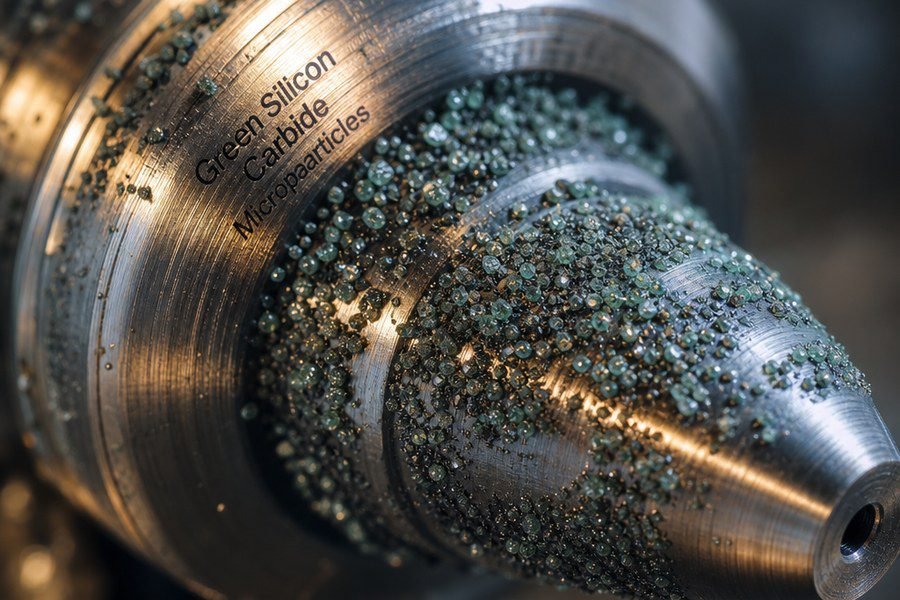
Diesel injector components—typically hardened 52100 bearing steel or sintered high-speed steel—require a friable abrasive that continuously self-sharpens without inducing deep, random scratches. كربيد السيليكون الأخضر (GC) possesses a Knoop hardness of 2,600–2,800 kg/mm², making it significantly harder than black SiC (2,500 kg/mm²). Higher purity (99%+ SiC) in green grains eliminates soft iron-silicide inclusions that in black SiC create rogue peaks in the abrasive matrix, reducing the statistical probability of catastrophic scratch defects. (Learn more: black vs. كربيد السيليكون الأخضر)
While conventional gravity-fed powders tend to agglomerate, HSA deploys electrostatic spray-coating to align elongated GC grains vertically on the lapping platen. This orientation exposes the sharpest crystal edge to the workpiece, boosting material removal rates by 18–22% compared to random-orientation powders while simultaneously lowering specific cutting energy. Resulting surface stress profiles show 30% lower subsurface deformation in electron backscatter diffraction (EBSD) analysis.
Particle Size Distribution Tightness and Its Direct Effect on Leak Paths
Injector nozzle bodies and control valve plates require absolute leak-tight sealing. The volumetric flow rate of a leak path is proportional to the third power of the clearance height. Consequently, a single oversized abrasive particle that creates a 1 µm scratch instead of the target 0.2 µm depth can increase leak rate by a factor of 125. This exponential relationship makes tight particle sizing non-negotiable.
FEPA F-series designation alone does not guarantee a safe lapping fraction. Manufacturers often overlook the d97 and d3 values. HSA supplies FEPA F400 through F1200 green SiC lapping powders with a maximum d97 oversize restriction cut to 1.5 times the median diameter, removing the problematic tail of coarse outliers completely. Microscopic oversize frequency is reduced to below 0.05% by automated image analysis screening, far tighter than standard sieving allows.
| Particle Parameter | Standard FEPA Tolerance | HSA Precision-Graded Cut | Impact on Injector Seat Tightness |
|---|---|---|---|
| d97 Oversize Ratio | ≥ 2.0 × d50 | ≥ 1.5 × d50 | 0.3 µm leak gap reduction on control edge |
| Oversize Frequency (particles > d99) | ≥ 0.5% | ≥ 0.05% | Eliminates random deep scratch clusters |
| Fines Content (< 1 ميكرومتر) | Not controlled | Removed by air classification | Prevents slurry loading and burnishing |
Targeting Ra 0.02 µm on Flat Seat Control Valves: Slurry Formulation Science
Control valve flatness below 0.6 µm over a 15 mm diameter requires a thinning slurry where the abrasive transition from two-body to three-body wear mode is precisely managed. Green SiC achieves this due to its superior thermal conductivity (120 W/m·K versus 40 W/m·K for fused alumina), which dissipates frictional heat at the interface more efficiently. Less thermal “particle embedding” occurs, keeping grain edges exposed until they fracture.
The loading threshold of green SiC in a glycol-based vehicle must balance rapid stock removal with surface finishing. Typical HSA-specified formulations for flat lapping injector plates employ:
- حجم الحبوب: F800 to F1200, matching surface finish stage
- Abrasive-to-vehicle ratio: 1:6 إلى 1:8 by weight for final polishing
- Suspension viscosity: 80–120 cP to maintain boundary lubrication regime
- Operating pH 7.5–8.5 to prevent 52100 steel corrosion while enhancing dispersion
Zero-Cobalt Pickup: Chemical Inertness for Hard Chrome and DLC Coatings
Modern diesel injectors increasingly use chromium nitride (CrN) or diamond-like carbon (DLC) coatings on plungers and needle surfaces. Alumina abrasives, with their amphoteric surface chemistry, exhibit a measurable electrostatic adhesion to chromium oxide passive layers. This chemical drag can pull coating grains free from the substrate. Green silicon carbide’s covalent bonding structure provides electrochemical inertness, minimizing galvanic micro-cells.
In a comparative lapping trial using DLC-coated plungers, HSA green SiC achieved a coating delamination rate of 0.3% versus 2.1% for white fused alumina under identical pressure and speed. Over a 500,000-unit production run, that difference eliminates thousands of rejected injectors. بالإضافة إلى, the absence of aluminum-oxygen ionic fragments in post-lap rinse water reduces adhesion of polishing debris during the crucial ultrasonic cleaning stage.
Validating Particle Shape Uniformity to Control Edge Chipping on Orifice Entrances
Inkjet-style nozzle spray hole entries are lapped to break sharp corners that cause cavitation erosion. A blocky, equiaxed abrasive grain geometry is essential here. الزاوي, splintery grains concentrate stress at grain tips cut deeply and unpredictably, chipping the exit edge. HSA’s controlled crushing and shaping process produces green SiC grains with an aspect ratio (length-to-width) tightly clustered between 1.2 و 1.5.
This morphology delivers a more uniform contact pressure footprint on the orifice rim. Engineers can therefore predict edge rounding radii with far less statistical variance, typically achieving corner radius Cpk values above 1.67 even at production speeds of 400 plates per hour. Roundness distribution, measured by dynamic image analysis, shows a convexity index above 0.92 across the entire grain fraction.
In high-cycle fatigue testing of lapped injector bodies, green SiC-finished surfaces with controlled blocky grain shapes exhibited 4× longer fatigue life before micro-crack initiation compared to surfaces prepared with mixed-shape, lower-purity abrasive grains.
Production-Grade Consistency: Matching Grain Chemistry to ISO 4406 Cleanliness Requirements
Post-lap cleanliness is not merely an inspection box; residual surface grains can clog injector nozzle micro-orifices under 100 µm diameter. HSA validates green SiC consistency using dual-stage ISO 4406:2021 oil-based particle counts after lapping, consistently achieving code 15/13/10 or better. This level of post-process cleanliness halves the number of intermediate wash stations required downstream, a tangible capital cost avoidance.
Batch chemistry certification guarantees less than 0.3% free carbon content and less than 0.15% metallic iron. These trace contaminants, if present in higher quantities, react with the hydrocarbon-based lapping fluid under high-pressure boundary conditions, forming sticky micro-gels that foul the surface. Tight upstream process control at HSA’s single-furnace production line ensures thermal cycle repeatability, holding crystal polymorph composition to less than 2% cubic beta-SiC in the predominantly hexagonal alpha-SiC matrix. Erratic beta-phase content is a poorly documented cause of unpredictable micro-fracturing rates in production lapping lines. For more on the material’s structure, see recrystallized silicon carbide properties.
الأسئلة المتداولة
س: What specific grit size of Green Silicon Carbide is recommended for lapping diesel fuel injector plungers and barrels?
أ: For the rough lapping stage of injector plunger and barrel components, we recommend starting with F240 to F360 grit (average particle size 44.6 µm to 28.8 ميكرومتر). For the finish lapping stage to achieve the required surface finish for hydraulic sealing, use F600 to F1200 grit (average particle size 12.3 µm to 4.0 µm per ISO 6344 and FEPA standards). The final surface roughness target should be Ra ≤ 0.05 ميكرومتر (2 µin) to ensure proper fuel film retention.
س: What is the typical particle size distribution (d50) of HSA Green Silicon Carbide powder optimized for injector lapping?
أ: For high-stability applications (HSA) in diesel injector lapping, the Green Silicon Carbide powder should have a tight particle size distribution with a d50 of 12.5 µm ± 0.5 µm for F600 grade. The d90 must be less than 28 ميكرومتر, and the fraction of particles below 3 µm must be minimized below 5% by volume (measured via laser diffraction per ISO 13320) to prevent micro-scratches on the injector seat and plunger surface.
س: What is the minimum purity requirement for Green Silicon Carbide used in lapping fuel injector components to prevent contamination?
أ: The abrasive must have a minimum Silicon Carbide (SiC) purity of 98.5% بالوزن. Free carbon (ج) content must be below 0.25%, free Silicon (و) أقل 0.2%, and Iron (الحديد) أقل 0.1%. For HSA (High Stability Application) grades, the magnetic particle content must be less than 0.001% بالوزن (ASTM D612) to prevent iron contamination that could cause injector needle sticking or nozzle blockage in common rail systems operating at pressures above 2,000 حاجِز.
س: What is the recommended lapping pressure and time when using Green Silicon Carbide for diesel injector needle valves?
أ: The specific lapping pressure for injector needle valves should be controlled between 0.5 kg/cm² (7.1 psi) و 1.2 kg/cm² (17.1 psi). The lapping cycle time with F600 Green Silicon Carbide slurry at 20% abrasive concentration (by weight in deionized water or lapping oil) is typically 3 إلى 5 minutes per side. Exceeding 1.5 kg/cm² (21.3 psi) or extending lapping time beyond 7 minutes risks embedding abrasive particles into the softer case-hardened steel surface (Rockwell C 58-62 صلابة), which can cause premature injector failure.
س: How does Green Silicon Carbide compare to Boron Carbide or Aluminum Oxide in lapping efficiency for hardened steel injector components?
أ: كربيد السيليكون الأخضر (صلابة موس 9.5) العروض 30-40% faster material removal rates than Brown Aluminum Oxide (موس 9.0) on hardened tool steels for injectors, reducing cycle time by up to 2 minutes per part. While Boron Carbide (موس 9.8) is harder, إنها 60-70% more costly and can induce tensile residual stresses exceeding 200 MPa on thin injector plunger walls due to deeper fracture penetration. Green Silicon Carbide provides the best cost-to-performance ratio for finishing injector components to a surface finish of Ra 0.02-0.04 µm with consistent hydraulic sealing tolerance of ±0.5 µm.
حول مزيلات خنان المتفوقة (HSA)
خنان متفوقة مزيلات (HSA) هي شركة مصنعة مقرها الصين ومورد عالمي للمواد الخزفية الكاشطة والمتقدمة عالية الأداء للتطبيقات الصناعية في جميع أنحاء العالم. تشتمل مجموعة منتجاتنا الأساسية على كربيد السيليكون الأسود, كربيد السيليكون الأخضر, كربيد السيليكون الصف الإلكتروني (SiC), الألومينا البيضاء المنصهرة, الألومينا البني المنصهر, كربيد البورون, ألومينات الكالسيوم المنصهرة, والمواد الكاشطة SG.
خدمة العملاء في 30+ بلدان, توفر HSA مواد موثوقة للمواد الكاشطة, الحراريات, سيراميك تقني, تطبيقات أشباه الموصلات, تلميع دقيق, السفع الرملي, علم المعادن, ومواد بناء عالية الأداء.
احصل على عرض أسعار أو عينة مجانية
تبحث عن مورد موثوق به للمواد السيراميكية المتقدمة والكاشطة المتميزة? اتصل بفريقنا الفني اليوم - وسنرد عليك في غضون ذلك 24 ساعات ويمكن ترتيب عينات مجانية للمشاريع المؤهلة.
- 📧 البريد الإلكتروني: sales@superior-abrasives.com
- 💬 ال WhatsApp: +86-186-3863-8803