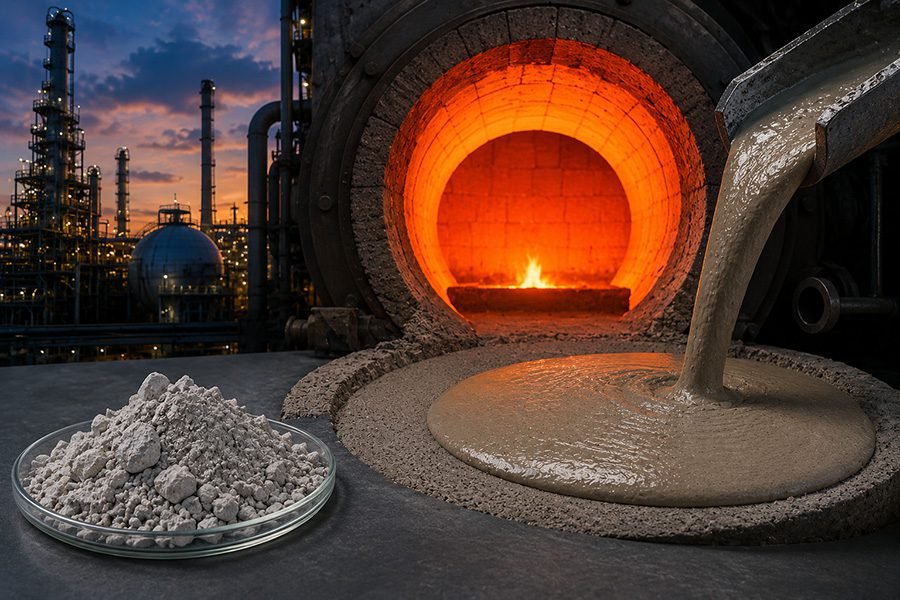
When a self-flowing castable loses workability mid-pour in a petrochemical reformer or cracking furnace, the consequences are not merely cosmetic. Incomplete fill leaves cold joints and voids that concentrate thermal stress; under cyclic heating above 1300 °C, those defects propagate into spalling failures that force unplanned shutdowns costing operators tens of thousands of dollars per day. The root cause is almost always binder chemistry — specifically, the choice and grading of the calcium aluminate cement (CAC) veya fused calcium aluminate aggregate that controls both early fluidity and long-term hot strength.
What Fused Calcium Aluminate Actually Is — and Why It Differs From Sintered Grades
Fused calcium aluminate is produced by melting a stoichiometrically controlled blend of high-purity limestone and calcined alumina in an electric arc furnace, then casting and crushing the solidified melt. The fusion process suppresses porosity to below 2 % and eliminates the intercrystalline silica impurities that are unavoidable in sintered production routes. The result is a material whose dominant crystalline phase — typically CA₂ (CaAl₄O₇) or CA₆ (hibonite, CaAl₁₂O₁₉) depending on the Al₂O₃/CaO ratio — is uniform throughout each particle rather than concentrated at grain boundaries.
In self-flowing castable formulations this matters because phase homogeneity directly governs dissolution rate into the cement paste. Fused grades dissolve more predictably, enabling formulators to dial in the induction period and peak fluidity window — critical when gravity-fed systems must fill complex furnace geometries without vibration assistance. Sintered grades, by contrast, can release localized CaO-rich zones that accelerate flash setting and destroy flow before placement is complete.
How Fused Calcium Aluminate Controls Flow in Low-Cement and Ultra-Low-Cement Castables
Modern petrochemical refractory linings increasingly rely on low-cement castables (LCC) and ultra-low-cement castables (ULCC), where total CaO content is held below 2.5 wt% and 1.0 wt% respectively. At these cement levels, the self-flowing mechanism shifts from cement-paste lubrication to colloidal dispersion: microsilica and dispersants create a repulsive electrostatic layer around aggregate particles, and the fused calcium aluminate component must not disrupt that layer by contributing excess free lime.
Fused grades with Al₂O₃ ≥ 70 wt% and free CaO below 0.5 wt% integrate without destabilizing the dispersion, allowing water additions as low as 4.5–5.5 % by weight while maintaining a flow value of 130–160 mm on the standard flow table test (ISO 1927-4). Sintered or partially fused material with irregular free-CaO distribution routinely requires 1–2 % additional water to achieve equivalent flow, which in turn reduces hot modulus of rupture (HMOR) -den 1000 °C by 15–25 % — a direct structural liability in tube-sheet or burner-block applications.
Performance Comparison: Fused vs. Sintered Calcium Aluminate Aggregate in Petrochemical Service
The table below consolidates representative test data from LCC formulations (tabular alumina matrix, 5 % microsilica, 0.1 % dispersant) targeting alumina contents of 75–80 wt%. Test bars were fired at 1100 °C × 5 h and 1500 °C × 3 h to simulate the thermal history typical of a naphtha cracking furnace floor lining.
| Mülk | Fused CA Aggregate | Sintered CA Aggregate | Test Standard |
|---|---|---|---|
| Flow value (water: 5.0 wt%) | 148 mm | 121 mm | ISO 1927-4 |
| Bulk density after 1100 °C | 2.92 g/cm³ | 2.81 g/cm³ | ISO 1927-6 |
| CCS after 1100 °C | 68 MPa | 54 MPa | ISO 1927-8 |
| HMOR at 1000 °C | 14.2 MPa | 10.8 MPa | ISO 1893 |
| Linear change after 1500 °C | −0.3 % | −0.8 % | ISO 1927-7 |
| Apparent porosity after 1500 °C | 13.1 % | 16.4 % | ISO 1927-6 |
Lower porosity and reduced linear shrinkage after high-temperature firing translate directly into improved resistance to sulfur-bearing gas infiltration — the dominant chemical attack vector in hydrodesulfurization (HDS) and Claus-unit linings. Procurement teams sourcing material for North American projects can review additional grade specifications, including fused calcium aluminate for sale in Canada, at the HSA fused calcium aluminate product page.
Sulfur and Alkali Resistance Mechanisms in High-Alumina Fused Binders
Petrochemical furnace environments subject refractory linings to simultaneous attack by H₂S, SO₂, alkali vapors (K₂O, Na₂O) from process feed, and steam. In conventional high-cement castables, the gehlenite (Ca₂Al₂SiO₇) and anorthite phases that form during service are vulnerable to alkali exchange reactions that cause volumetric expansion and cracking. Fused calcium aluminate at the CA₂ or CA₆ composition range avoids silica-bearing secondary phases entirely when paired with a low-SiO₂ matrix, leaving corundum (α-Al₂O₃) as the predominant high-temperature phase.
Corundum exhibits negligible reactivity with H₂S below 1400 °C and resists K₂SO₄ condensation damage far better than calcium silicate phases. Laboratory crucible tests at 950 °C with K₂SO₄ flux show that ULCC formulations based on fused CA₂ aggregate retain more than 85 % of their as-fired CCS after 24-hour exposure, compared with 55–60 % retention in equivalent formulations using sintered aggregate with SiO₂ > 1.5 wt%.
Particle Size Distribution and Packing Design for Self-Flowing Systems
Self-flow in zero-vibration placement depends on achieving a packing density that minimizes inter-particle friction while maintaining enough paste volume to coat all aggregate surfaces. For fused calcium aluminate used as reactive binder or fine filler in the 0–0.5 mm fraction, the following grading targets are widely adopted in petrochemical castable design:
- D90 ≤ 45 µm for cement-replacement reactive fines — ensures complete dissolution within the induction period and avoids coarse particles that act as nucleation sites for premature hydrate precipitation.
- D50 in the range of 8–15 µm optimizes specific surface area without raising water demand beyond the LCC threshold.
- A bi-modal aggregate blend (3–5 mm coarse / 0.1–1 mm medium) following the modified Andreasen equation with distribution modulus q = 0.26–0.30 maximizes packing efficiency and supports unaided flow at the target water addition.
- Total fines below 100 µm should account for 28–35 % of the mix by mass to maintain sufficient paste volume without over-diluting the aggregate matrix.
- Iron oxide (Fe₂O₃) in the fused CA fraction should not exceed 0.15 wt% to prevent brown discoloration and glass-phase formation that weakens grain boundaries above 1300 °C.
Quality Verification: Key Parameters to Specify When Sourcing
Engineers qualifying fused calcium aluminate for petrochemical castable production should request and verify the following documentation and test data from any supplier before approving a material for use in a critical lining system. Consistency between production lots is as important as absolute chemistry — a ± 0.5 wt% shift in Al₂O₃ between deliveries can alter setting behavior enough to require a full mix redesign.
Mandatory supplier data package items include XRF bulk chemistry (minimum Al₂O₃, CaO, SiO₂, Fe₂O₃, Na₂O reporting), XRD phase quantification confirming CA₂ or CA₆ phase dominance, particle size distribution by laser diffraction per ISO 13320, and apparent porosity of the as-fused material. For projects subject to ASME or EN refractory specifications, a third-party test report from an accredited laboratory is standard practice. Companies comparing advanced ceramic binder materials may also find technical parallels in HSA’s work on silicon carbide for structural material uygulamalar, where similar phase-purity and porosity arguments apply to high-temperature performance.
Beyond chemistry, assess the supplier’s production lot traceability and minimum order flexibility. Petrochemical turnaround schedules rarely allow for extended lead times — partnering with a manufacturer that carries stock inventory in key commercial grades and can provide SDS, certificate of analysis, and export documentation on short notice substantially reduces procurement risk. For context on how HSA approaches technical ceramics supply in demanding Asian markets, en HSA black silicon carbide supply case in Japan illustrates the same documentation and traceability standards applied across product lines.
Sık sorulan sorular
Q: What Al₂O₃ content should fused calcium aluminate have for use in ultra-low-cement castables for petrochemical furnaces?
A: For ULCC formulations (CaO ≤ 1.0 wt%), fused calcium aluminate with Al₂O₃ ≥ 70 wt% and free CaO below 0.5 wt% is the standard specification. At these levels, the material contributes the CA₂ or CA₆ binding phase without introducing excess lime that destabilizes the microsilica dispersion system or raises water demand above the 5.5 wt% threshold critical to maintaining target hot strength.
Q: How does fused calcium aluminate improve sulfur resistance in Claus unit and HDS refractory linings?
A: Fused CA₂ or CA₆ aggregate, when formulated in a low-SiO₂ matrix, avoids forming calcium silicate secondary phases (gehlenite, anorthite) that are susceptible to sulfate attack. The dominant high-temperature phase is corundum (α-Al₂O₃), which shows negligible reactivity with H₂S below 1400 °C. ULCC castables based on fused aggregate retain > 85 % of as-fired CCS after 24-hour K₂SO₄ flux testing at 950 °C, versus 55–60 % for sintered-aggregate equivalents with SiO₂ > 1.5 wt%.
Q: What particle size specification is recommended for fused calcium aluminate used as reactive binder fines?
A: Reactive fines intended to replace a portion of conventional CAC binder should have D90 ≤ 45 µm and D50 in the 8–15 µm range, measured by laser diffraction per ISO 13320. This grading ensures complete dissolution within the castable’s induction period and avoids large particles that act as heterogeneous nucleation sites for premature C₃AH₆ or AH₃ precipitation, which would shorten workable life below the 20–30 minutes typically required for furnace lining pours.
Q: What are the key differences in flow performance between fused and sintered calcium aluminate at a fixed water addition?
A: In a representative LCC formulation (75–80 wt% Al₂O₃ target, 5 % microsilica, 0.1 % dispersant) -den 5.0 wt% water addition, fused CA aggregate delivers a flow value of approximately 148 mm per ISO 1927-4, compared with 121 mm for sintered aggregate. bu 22 % improvement in flow value allows either better cavity fill at equal water content or a reduction in water addition of 1–2 %, which improves HMOR at 1000 °C by 15–25 % — a meaningful structural benefit in burner-block and tube-sheet applications.
Q: What documentation should be required from a fused calcium aluminate supplier before approving the material for a critical petrochemical refractory project?
A: The minimum required supplier data package should include: XRF bulk chemistry (reporting Al₂O₃, CaO, SiO₂, Fe₂O₃, Na₂O at minimum), XRD phase quantification confirming CA₂ or CA₆ dominance, laser-diffraction PSD per ISO 13320, apparent porosity of as-fused material, and — for ASME or EN-governed projects — a third-party test certificate from an ISO/IEC 17025-accredited laboratory. Lot-to-lot Al₂O₃ consistency within ± 0.5 wt% should be contractually specified, as larger variation can shift setting behavior enough to require mix redesign.
Henan Üstün Aşındırıcılar Hakkında (HSA)
Henan Üstün Zımparalar (HSA) is a China-based manufacturer and global supplier of high-performance abrasive and advanced ceramic materials for industrial applications worldwide. Our core product range includes black silicon carbide, yeşil silisyum karbür, elektronik dereceli silisyum karbür (SiC), beyaz erimiş alümina, kahverengi erimiş alümina, bor karbür, fused calcium aluminates, ve SG aşındırıcılar.
Serving customers in 30+ ülkeler, HSA supplies reliable materials for abrasives, refrakterler, teknik seramik, semiconductor applications, precision polishing, kumlama, metalurji, and high-performance construction materials.
Get a Quote or Free Sample
Looking for a reliable supplier of premium abrasive and advanced ceramic materials? Contact our technical team today — we respond within 24 hours and can arrange free samples for qualified projects.
- 📧 E-posta: sales@superior-abrasives.com
- 💬 Naber: +86-186-3863-8803