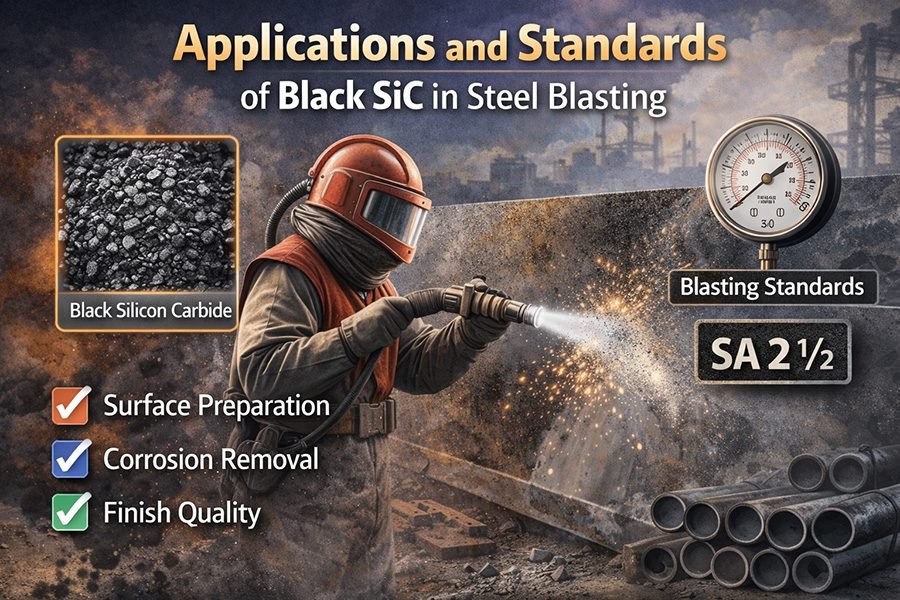
ซิลิกอนคาร์ไบด์สีดำ (สีดำ SiC) ได้กลายเป็นหนึ่งในสื่อที่มีฤทธิ์กัดกร่อนที่ได้รับความไว้วางใจมากที่สุดในการเตรียมพื้นผิวเหล็กอุตสาหกรรม โดยผสมผสานความแข็งเป็นพิเศษเข้าด้วยกัน, เรขาคณิตเชิงมุมที่คมชัด, และความคุ้มค่าในวัสดุเดียว. บทความนี้จะสำรวจว่า Black SiC ทำงานอย่างไรในการดำเนินการทำความสะอาดด้วยการระเบิด, ซึ่งมาตรฐานสากลควบคุมการใช้งาน, และวิธีการเลือกเกรดให้เหมาะสมกับการสมัครของคุณ.
ซิลิคอนคาร์ไบด์สีดำคืออะไร?
ซิลิกอนคาร์ไบด์สีดำ (สูตรทางเคมี SiC) ผลิตโดยการหลอมรวมทรายซิลิกาที่มีความบริสุทธิ์สูงและปิโตรเลียมโค้กในเตาต้านทานไฟฟ้าที่อุณหภูมิเกิน 2,200 °C — กระบวนการที่เรียกว่าวิธีแอจิสัน. คริสตัลที่ได้มีความแข็งเป็นอันดับสองรองจากเพชรและคิวบิกโบรอนไนไตรด์เท่านั้น, คะแนน 9.1–9.5 ในระดับ Mohs. มันมืด, สีมันวาวมาจากเศษเหล็กและคาร์บอนเจือปนที่ลดความบริสุทธิ์ลงเหลือ SiC โดยทั่วไป 95–98% (เปรียบเทียบกับ 99%+ สำหรับ สีเขียว SiC), แต่สิ่งนี้ทำให้ Black SiC ประหยัดมากขึ้นอย่างเห็นได้ชัดโดยไม่กระทบต่อประสิทธิภาพการระเบิด.
วัสดุจะแตกหักแบบก้นหอยเมื่อถูกกระแทก, เผยความสดใหม่อย่างต่อเนื่อง, คมตัดที่คมกริบ — คุณสมบัติที่สำคัญต่อประสิทธิภาพในการขัดถู. โดยที่สารกัดกร่อนที่มีลักษณะโค้งมน เช่น กระสุนเหล็ก ทำให้เกิดการขัดถู, รายละเอียดการบีบอัด, Black SiC สร้างเชิงมุมที่ลึก, โปรไฟล์พื้นผิวรูปแบบสมอที่ปรับปรุงการยึดเกาะของสารเคลือบได้อย่างมาก.
ทำไม Black SiC ถึงเป็นเลิศในการพ่นเหล็กกล้า
การเตรียมพื้นผิวเหล็กไม่ใช่แค่การกำจัดสนิมหรือตะกรันในโรงสีเท่านั้น แต่ยังเกี่ยวกับการออกแบบโปรไฟล์พื้นผิวเฉพาะและระดับความสะอาดเพื่อให้แน่ใจว่าระบบการเคลือบจะยึดติดอย่างถูกต้องและทำงานได้ตลอดอายุการใช้งานที่ต้องการ. Black SiC ส่งมอบได้หลายด้าน:
1. ความดุดันในการตัดที่เหนือกว่า
เชิงมุม, สัณฐานวิทยาที่แตกเป็นเสี่ยงของอนุภาค Black SiC ทำให้เกิดการตัดเหล็กที่รุนแรง. ที่แรงดันระเบิดเท่ากัน, SiC สีดำมีรูปแบบพุกที่ลึกกว่าและมีอัตราการทำความสะอาดเร็วกว่าเม็ดแก้วหรืออะลูมิเนียมออกไซด์. ส่งผลให้รอบการระเบิดสั้นลงและลดต้นทุนด้านพลังงานต่อตารางเมตรของพื้นผิวที่ผ่านการบำบัด.
2. มีความแข็งสูงพร้อมการควบคุมความกร่อน
SiC สีดำมีความแข็งพอที่จะตัดผ่านเหล็กที่มีขนาดหนักหรือสึกกร่อนได้ แต่เปราะพอที่จะแตกหักแทนที่จะฝังลงในวัสดุพิมพ์. ลักษณะการลับคมได้เองนี้มีประโยชน์อย่างยิ่งเมื่อทำการพ่นส่วนประกอบเหล็กกล้าคาร์บอนที่ใช้สำหรับการเคลือบป้องกัน ซึ่งช่วยลดการปนเปื้อนของโลหะในพื้นผิวที่เตรียมไว้ให้เหลือน้อยที่สุด.
3. ความเฉื่อยของสารเคมี
ต่างจากสารขัดถูที่มีธาตุเหล็ก (กรวดเหล็ก, ยิงเหล็ก), Black SiC เป็นสารเฉื่อยทางเคมีและไม่ทำให้เกิดการปนเปื้อนของเหล็กบนพื้นผิวที่เสียหาย. สิ่งนี้มีความสำคัญอย่างมากในการใช้งานที่พื้นผิวจะถูกเคลือบด้วยไพรเมอร์ที่อุดมด้วยสังกะสีหรือระบบป้องกันการกัดกร่อนอื่นๆ ที่ไวต่อการปนเปื้อนของเหล็ก.
4. Recyclability and Cost Efficiency
Although Black SiC is more friable than steel abrasives, its hardness provides reasonable multi-cycle recyclability in closed-loop blast systems. Typical usage yields 3–6 recycles depending on blast pressure and equipment type, significantly reducing per-cycle media cost compared to single-use abrasives.
💡 Engineering InsightFor maximum surface profile depth (Rz 70–100 μm) on heavy structural steel, Black SiC in the F16–F36 grit range blasted at 90–110 PSI consistently outperforms steel grit GL40 in cycle time — while eliminating iron flash rusting risk in humid environments.
Key Industry Standards Governing Black SiC Blast Media
Specifying Black SiC for steel blasting requires compliance with internationally recognized standards that define particle size distribution, chemical composition, and surface cleanliness outcomes. Procurement engineers and coating inspectors rely on the following frameworks:
- FEPA F/P
The Federation of European Producers of Abrasives defines grit sizing standards (F8 through F1200 for bonded abrasives; P-grades for coated). FEPA F-grades are the global benchmark for coarse blast grit sizing of Black SiC, specifying d50 values and permissible fines content.
- ISO 11126-7
Specifies requirements for non-metallic blast-cleaning abrasives — including silicon carbide. Defines chemical composition, moisture content, water-soluble contaminants, and chloride levels. ISO 11127 provides the corresponding test methods for physical and chemical verification.
- SSPC-AB 1
The Steel Structures Painting Council’s Mineral and Slag Abrasive standard governs cleanliness and conductivity requirements for blast media used in steel surface preparation in North America. Black SiC used on infrastructure and marine projects in the U.S. market typically requires SSPC-AB 1 compliance.
- ISO 8501-1
Defines rust grade and preparation grade of steel surfaces (Sa 1, Sa 2, Sa 2½, Sa 3). Black SiC is capable of achieving Sa 2½ (near white metal) and Sa 3 (white metal) finishes depending on blast parameters — required by most industrial protective coating specifications.
- SAE J444
Provides cast steel shot and grit specifications in North America. While primarily for metallic abrasives, SAE J444 particle size classification is often referenced as a cross-check baseline when specifying angular SiC grit for equivalent profile comparisons.
- GB/T 2480
China’s national standard for corundum and silicon carbide abrasive grain sizing. ควบคุมคุณภาพการผลิตภายในประเทศสำหรับ Black SiC ที่ส่งออกจากผู้ผลิตในจีน และสอดคล้องกับ FEPA F-series ในแง่การปฏิบัติอย่างใกล้ชิด.
สถานการณ์การใช้งานและคู่มือการเลือกเกรด
การเลือกขนาดกรวด Black SiC ที่ถูกต้องเป็นปัจจัยที่สำคัญที่สุดประการเดียวในการบรรลุโปรไฟล์พื้นผิวเป้าหมาย. ตารางต่อไปนี้จะแมปการใช้งานการพ่นเหล็กทั่วไปกับช่วงเม็ดกรวดที่แนะนำและเกรดความสะอาดเป้าหมาย:
| แอปพลิเคชัน | กรวดที่แนะนำ | โปรไฟล์เป้าหมาย (รซ) | เกรดความสะอาด | แรงดันระเบิดทั่วไป |
|---|---|---|---|---|
| Heavy structural steel (bridges, offshore) | F16 – F24 | 75–100 μm | Sa 2½ / Sa 3 | 90–120 PSI |
| Pipeline & tank exterior | F24 – F36 | 50–75 μm | Sa 2½ | 80–110 PSI |
| ยานยนต์ & machinery frames | F36 – F60 | 30–55 μm | Sa 2 / Sa 2½ | 70–90 PSI |
| Stainless steel & light alloy parts | F80 – F120 | 15–30 μm | Sa 2 / Sa 2½ | 50–70 PSI |
| Precision components / thin sheet | F150 – F220 | 5–15 μm | Sa 2 | 40–60 PSI |
SiC สีดำเทียบกับ. Other Blast Abrasives
Understanding where Black SiC fits in the broader abrasive landscape helps procurement professionals make cost-effective, specification-compliant choices:
| สารกัดกร่อน | ความแข็ง (Mohs) | Profile Type | Iron Contamination | Cost Index |
|---|---|---|---|---|
| สีดำ SiC | 9.1–9.5 | Angular / Deep | ไม่มี | Medium |
| Steel Grit (GL/GH) | 6.0–7.5 | Angular | สูง | Low (reusable) |
| อะลูมิเนียมออกไซด์ (สีน้ำตาล) | 8.5–9.0 | Angular | ไม่มี | Medium-High |
| Glass Beads | 5.5–6.0 | Rounded / Peened | ไม่มี | Low-Medium |
| โกเมน | 7.5–8.5 | Sub-angular | ไม่มี | Medium |
Black SiC occupies a unique position: it delivers the angularity and depth of steel grit without the iron contamination risk, and it cuts more aggressively than อลูมิเนียมออกไซด์สีน้ำตาล at comparable particle sizes. For applications where chemical cleanliness matters — stainless steel equipment, marine coatings, or zinc-based primer systems — Black SiC is frequently the preferred specification.
คำถามที่พบบ่อย
Looking for a reliable Black SiC supplier that meets international blasting standards?
Henan Superior Abrasives (HSA) manufactures FEPA-graded Black Silicon Carbide abrasives from F16 to F1200, with full ISO 11126-7 compliance documentation and third-party test reports available upon request. Whether you’re preparing structural steel for heavy-duty coatings, blasting pipeline exteriors, or finishing precision components, our technical team can help you identify the right grit size and purity grade for your specific application. We supply to clients in over 60 countries with consistent batch quality, flexible MOQ, and fast lead times. Contact us today to request a free sample or get a customized quote for your project.