Specify the wrong particle morphology in a green silicon carbide grinding wheel and the consequences are measurable within a single production shift: elevated grinding temperatures, accelerated wheel wear, and surface finishes that fall outside tolerance. For engineers optimising cycle times or reducing cost-per-part, understanding how grain shape governs cutting action is not academic — it directly determines whether a wheel finishes a batch or glazes over halfway through it.
Why Grain Morphology Is a Primary Performance Variable
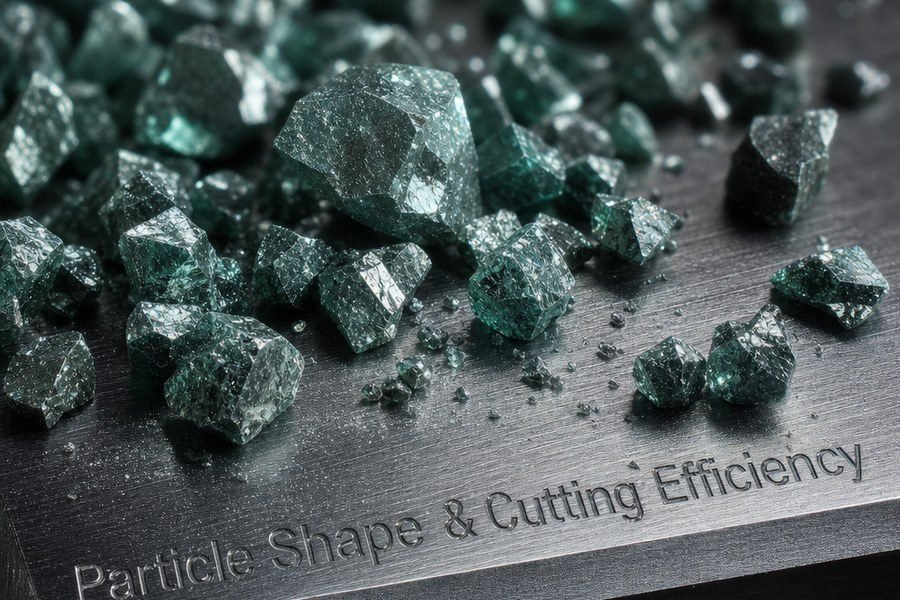
Green silicon carbide is synthesised at temperatures above 2200 °C in an Acheson furnace, and the resulting crystal structure is predominantly hexagonal α-SiC (6H and 4H polytypes). Crushing and milling that feedstock produces grains whose shape depends on fracture mechanics: cleavage planes propagate preferentially along {0001} basal planes and {10-10} prismatic planes, yielding either blocky, 角度のある, or needle-like particles depending on mill type, reduction ratio, and screening protocol.
Each morphology class interacts with a workpiece surface through a distinct cutting geometry. Angular grains present multiple acute rake angles to the cut zone. Blocky grains present fewer cutting edges but distribute load across a larger contact area. Needle-like or elongated grains are mechanically weak and fracture readily under lateral load. These differences propagate directly into material removal rate (MRR), specific grinding energy, and surface roughness Ra.
Angular vs. Blocky Grains: Cutting Action Compared
Angular grains — typically produced by controlled single-pass jaw crushing — deliver high specific cutting pressure at each grit point. The acute tip geometry initiates micro-cutting rather than ploughing, reducing the rubbing and ploughing components of the grinding force balance. In cemented carbide and non-ferrous hard alloy applications, angular F-grade green SiC consistently shows 15–25 % higher MRR compared with semi-blocky equivalents at the same depth of cut.
Blocky grains, 対照的に, are preferred where edge retention and wheel form stability matter more than raw cutting speed. Lower aspect ratios resist early pullout from vitrified bond matrices, and the larger grain-bond contact area sustains higher normal forces before fracture. For precision optical glass grinding, blocky morphology reduces chipping events and holds Ra below 0.2 µm more reliably than angular stock.
Morphology Classification and Measurement Standards
Grain shape is quantified through several parameters defined in ISO 9137 およびFEPA規格. The most operationally relevant are aspect ratio (長さから幅まで), angularity index (AI), and percentage of elongated particles. Laser diffraction and dynamic image analysis instruments — such as those compliant with ISO 13322-2 — can resolve particle silhouettes at high throughput and flag out-of-spec batches before bonding.
| Morphology Type | Aspect Ratio (Typical) | Primary Application | Key Performance Trade-off |
|---|---|---|---|
| 角度のある / シャープ | 1.5 – 2.2 | 超硬合金, セラミック, hard alloys | High MRR; faster self-sharpening; shorter wheel life |
| Semi-Blocky | 1.2 – 1.5 | 精密粉砕ホイール, honing sticks | Balanced MRR and wheel wear; versatile bond compatibility |
| Blocky / Equiaxed | 1.0 – 1.2 | 光学ガラス, 高度なセラミック, ラッピング | Low surface roughness; high load resistance; slower cut rate |
| Elongated / Needle-like | >2.5 | Coated abrasive specialties, loose lapping | Micro-scribing action; fragile under lateral load |
How Particle Shape Interacts with Bond Type and Grit Size
Morphology does not operate in isolation — it interacts with bond chemistry and grit size to determine the effective cutting geometry at the wheel surface. の vitrified bond systems, the glass matrix bridges across grain facets; blocky grains maximise this contact area, while angular grains can present stress concentration points that initiate micro-cracking in the bond bridge at high normal forces. Resin-bonded wheels tolerate angular particles more readily because the polymer matrix provides viscoelastic damping.
Grit size amplifies morphology effects. At coarse designations (F24–F46), angular green SiC grains produce aggressive stock removal with relatively open chip clearance. As grit finishes move into F120–F220 territory, the absolute grain dimension shrinks to the point where morphology differences become secondary to surface chemistry and clustering behaviour. This is one reason that precision applications — including those discussed in our article on silicon carbide vs. fused alumina for wood finishing — often specify narrow particle size distributions alongside morphology criteria.
Morphology Effects in Coated Abrasive vs. Bonded Abrasive Products
Coated abrasives impose a fundamentally different set of constraints on grain shape. In a coated product, grains are deposited in a single layer and oriented — in electrostatic coating — with their longest axis perpendicular to the backing. This means elongated grains actively improve cutting edge density on the abrasive surface. For belt grinding non-ferrous metals and composites, elongated green SiC grains increase cutting edges per unit area, reducing unit forces and heat generation per grit point.
In bonded wheels, that same elongation becomes a liability. Grains protruding well beyond the bond line are prone to early fracture under the cyclic impact loading of interrupted cuts. Procurement teams sourcing green SiC for multiple product types must therefore specify morphology separately for coated and bonded applications — a single-grade purchase decision based on chemistry alone will produce sub-optimal results in at least one product line. The same principle applies when green SiC is evaluated for specialised industrial environments, そのような silicon carbide in downhole oil and gas applications, where mechanical reliability under cyclic stress is critical.
Practical Specification Checklist for Procurement
When requesting quotations or reviewing certificates of conformance, engineers should validate the following parameters to ensure morphology aligns with the intended process:
- Aspect ratio range — request the D10/D50/D90 from dynamic image analysis, not just mean size from laser diffraction, since diffraction cannot resolve shape.
- Percentage of elongated particles exceeding aspect ratio 2.0 — a value above 8 % in F60–F120 grades typically signals inadequate milling control.
- Angularity index per FEPA or equivalent — confirm the method used, since AI values from different instruments are not directly comparable.
- SEM photomicrograph of representative sample — a single image at ×100 magnification reveals clustering, surface contamination, and gross shape anomalies that quantitative data can miss.
- Bulk density and tap density ratio — a tap/bulk density ratio above 1.25 indicates high angularity and packing inefficiency that will affect bond volume calculation in wheel formulation.
Green silicon carbide produced to consistent morphology standards also underpins performance in thermal and structural applications. The same crystallographic sharpness that drives cutting efficiency at ambient temperature contributes to thermal shock resistance in high-temperature environments — a connection explored in our coverage of silicon carbide for refractory material use cases.
よくある質問
Q: What aspect ratio is considered optimal for green silicon carbide used in vitrified grinding wheels?
あ: A semi-blocky morphology with an aspect ratio of 1.2–1.5 is generally optimal for vitrified bond systems. This range maximises grain-bond contact area to resist pullout under normal grinding forces while retaining enough angularity to sustain a reasonable material removal rate. Aspect ratios above 2.0 in vitrified wheels accelerate bond bridge fracture, particularly at wheel peripheral speeds above 35 MS.
Q: How does particle shape affect surface roughness Ra in precision ceramic grinding?
あ: Blocky, equiaxed grains consistently produce lower Ra values than angular equivalents at the same grit designation. In precision alumina and zirconia grinding at F220, blocky green SiC typically holds Ra in the 0.08–0.15 µm range, while angular stock at the same grit produces Ra of 0.18–0.28 µm due to deeper individual scratch channels and irregular chip formation.
Q: Which standard governs particle shape measurement for abrasive grains, and what instruments are acceptable?
あ: ISO 13322-2 covers dynamic image analysis methods for particle shape characterisation and is the most widely referenced standard for abrasive grain morphology. Instruments from Retsch (Camsizer X2), Sympatec (QICPIC), and Malvern (Morphologi 4) are commonly accepted by major wheel manufacturers. Laser diffraction alone (ISO 13320) is insufficient since it calculates an equivalent sphere diameter and cannot resolve aspect ratio or angularity index.
Q: Can the same green SiC grit grade be used for both coated abrasive belts and bonded grinding wheels?
あ: Not without morphology verification. Coated abrasive belts benefit from elongated particles (aspect ratio 1.8–2.5) that orient vertically during electrostatic coating and increase cutting edge density. Bonded wheels perform better with blocky or semi-blocky grains. Using a coated-abrasive-optimised lot in a vitrified wheel formulation increases the risk of premature grain fracture and reduced G-ratio (volume of material removed per unit volume of wheel worn) by as much as 20–30 %.
Q: Does green SiC particle shape degrade during storage, and how should bulk material be handled to preserve morphology?
あ: Angular grain tips are susceptible to attrition during bulk handling. Free-fall drops exceeding 1.5 m and pneumatic conveying at velocities above 18 m/s measurably increase the proportion of rounded or chipped grains, particularly in F46–F80 grades where individual grains are large enough to impact each other at high kinetic energy. Bulk bags should be stored on flat pallets, never stacked more than two high, and transferred using screw augers or belt conveyors rather than high-velocity pneumatic lines when morphology preservation is critical.
河南高級研磨材について (HSA)
河南優れた研磨剤 (HSA) は、中国に本拠を置き、世界中の産業用途向けの高性能研磨材および先端セラミック材料を提供する世界的なサプライヤーです。. 当社の主力製品には黒色炭化ケイ素が含まれます, グリーン炭化ケイ素, 電子グレードの炭化ケイ素 (SiC), 白色溶融アルミナ, 褐色電融アルミナ, 炭化ホウ素, 溶融アルミン酸カルシウム, SG研磨材.
顧客にサービスを提供する 30+ 国, HSA は信頼性の高い研磨材材料を供給します, 耐火物, テクニカルセラミックス, 半導体応用, 精密研磨, サンドブラスト, 冶金, および高機能建材.
見積もりまたは無料サンプルを入手する
高品質の研磨材および先進的なセラミック材料の信頼できるサプライヤーを探しています? 今すぐ当社の技術チームにご連絡ください - 以内に返答させていただきます 24 適格なプロジェクト向けに無料サンプルを手配できます.
- 📧 Eメール: sales@superior-abrasives.com
- 💬 WhatsApp: +86-186-3863-8803