Choosing the wrong slag conditioner in ladle refining does not merely affect chemistry — it directly impacts tap-to-tap time, refractory wear rate, and final inclusion populations in the solidified strand. Plants that substitute lime-alumina briquettes のために fused calcium aluminate without accounting for dissolution kinetics frequently report elevated Al₂O₃ clusters in ultra-low carbon grades and premature ladle lining erosion, both of which carry measurable downstream costs.
How Each Material Is Manufactured and Why It Matters
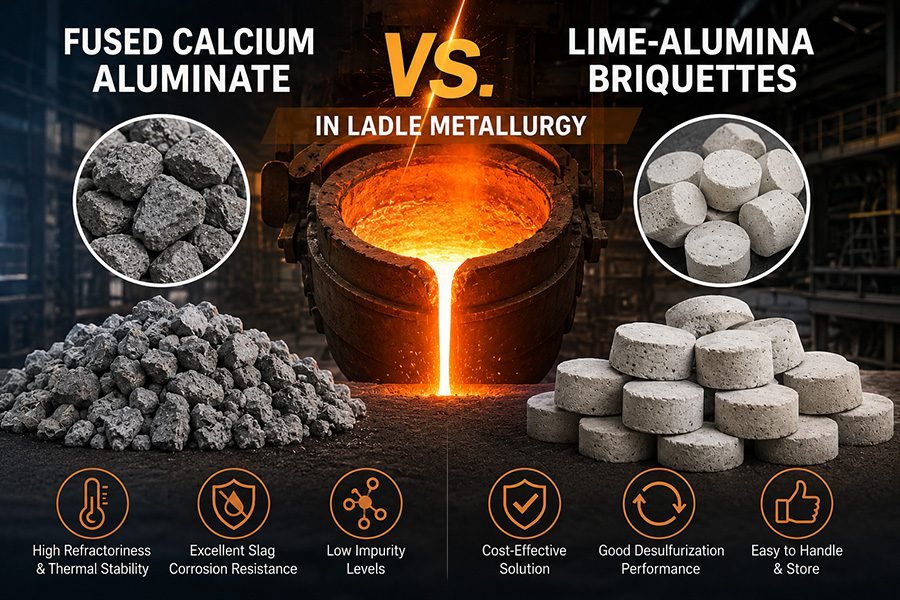
Fused calcium aluminate (FCA) is produced by co-melting limestone and alumina in an electric arc furnace at temperatures exceeding 1700 °C, yielding a homogeneous, glassy or crystalline ingot that is then crushed to specification. The fusion process drives off all free moisture and carbonate phases, leaving a stoichiometrically stable product with a fixed CaO/Al₂O₃ ratio — most commonly in the CA (CaAl₂O₄) or CA₂ (CaAl₄O₇) mineralogical phase.
Lime-alumina briquettes, 対照的に, are cold-bonded agglomerates of calcined lime and alumina fines held together with a binder such as molasses or sodium silicate. The raw materials never reach fusion temperature, so each particle retains its distinct chemical identity. Upon addition to the ladle, バインダーが先に燃えてしまう, 練炭が崩れる, 個々の酸化物相は独立して溶解します。この 2 段階のシーケンスは、事前に反応させた化合物を直接溶解するよりも本質的に遅くなります。. 高純度アルミナフラックスを必要とする用途向け, 理解 白色電融アルミナとは何ですか 融合が酸化物の反応性をどのように変化させるかについて、FCA の性能を評価するための有用なコンテキストを提供します.
溶解速度論: 主要なプロセスの違い
取鍋精錬中, the slag must reach its target basicity and fluidity within a defined window — typically 8–15 minutes after the initial flux addition at stations operating with LF (ladle furnace) or RH degasser circuits. FCA dissolves rapidly because the pre-reacted calcium aluminate phases melt congruently or near-congruently in contact with the liquid slag bath, releasing no gaseous by-products and requiring no additional thermal energy to drive a decomposition reaction.
石灰焼成が不完全な場合、練炭には CO₂ が残留します, また、バインダーの燃焼により乱流が発生し、大気中の窒素を取り込む可能性があります。これは、低窒素パイプラインや自動車用シートグレードにおける重大な欠陥ベクトルです。. 完全な 溶融アルミン酸カルシウムの利点 常温圧着による代替品の優位性は、まさにこの動力学的ウィンドウで最も明白です。, 一貫した溶融挙動により、LF 電極での電力消費が削減され、全体の熱サイクル時間が短縮されます。.
特性の比較: FCA vs. 石灰アルミナ練炭
| パラメータ | 溶融アルミン酸カルシウム | 石灰アルミナ練炭 |
|---|---|---|
| 典型的な CaO 含有量 (%) | 35–50 | 30–55 (ブレンドによって変化します) |
| Al₂O₃含有量 (%) | 40–55 | 30–55 (ブレンドによって変化します) |
| 自由水分 (%) | <0.5 | 1–4 (バインダーに依存する) |
| 解散時間 1600 °C (最小) | 3–8 | 10–20 |
| 水素ピックアップのリスク | 非常に低い | 中程度から高程度 |
| 組成の一貫性 (熱から熱へ) | 高 — 固定鉱物学 | 中程度 — ブレンドに依存する |
| 一般的なコスト (米ドル/トン, 元中国) | 180–260 | 90–150 |
総消費率と二次コスト(LF 電力時間が追加される)を考慮すると、コストの差は大幅に縮小します。, 耐火物の修理, 拒否リスクは考慮に入れられます. 植物の加工 800 kt/year of electrical steel commonly finds FCA reduces flux addition rates by 15–25 % compared with equivalent briquette additions, because less material is lost to premature reaction or incomplete dissolution before the slag skimming stage.
Inclusion Control and Steel Cleanliness Outcomes
Alumina inclusions (Al₂O₃) in liquid steel are highly detrimental in thin-strip, wire rod, and bearing steel applications. The refining mechanism in both systems relies on transferring dissolved Al₂O₃ from the steel into a basic, 流動スラグ — ただし、スラグの流動性は、精製温度範囲内で CaO-Al₂O₃-SiO₂ 系の正しい液体分率を達成することに依存します。 (1560–1620 °C).
FCA の添加により、CaO-Al₂O₃ の二元系図の低融点谷にあるスラグ組成が得られます。 (約50~60 % Al₂O₃, 周りの液体 1400 °C) 練炭を追加するよりもはるかに確実です, これは相を連続的に導入し、介在物の吸収を妨げる高融点 CaO に富むゾーンを一時的に生成する可能性があります。. 製鉄所をターゲットとする 以下の総酸素 15 ppm in bearing grades (per ASTM A295 / ISO 683-17) consistently report more stable results with FCA-conditioned slags.
Refractory Compatibility and Ladle Campaign Life
A slag that is too CaO-rich dissolves magnesia–carbon (MgO–C) bricks aggressively; one that is too Al₂O₃-rich corrodes alumina–spinel linings. Because FCA delivers a predictable, pre-set CaO/Al₂O₃ ratio, refractory engineers can design lining systems with a known chemical environment. With briquettes, the actual slag composition at any given moment depends on which component has dissolved fastest — introducing a variance that complicates lining wear modelling.
- MgO–C brick wear is reduced when slag basicity (CaO/SiO₂) stays between 3.0 と 5.0 — a range FCA additions maintain more consistently than briquettes in high-aluminium heats.
- Spinel formation at the slag–brick interface acts as a sacrificial barrier; FCA-conditioned slags with moderate Al₂O₃ activity promote this protective layer without dissolving it.
- Plants using briquettes in ultra-low silicon heats (と < 0.005 %) report 8–14 % shorter ladle campaign life on average compared with FCA-based flux schedules, based on operational data from multiple EAF melt shops in East Asia.
When Lime-Alumina Briquettes Remain a Viable Choice
Briquettes are not universally inferior. In applications where steel hydrogen content is not tightly specified, heat cycle time is flexible, and the slag basicity target is relatively forgiving — such as in rebar or structural section grades — the lower unit cost of briquettes can outweigh their kinetic disadvantages. Producers with open-top ladle stirring and no LF station have less precise control over slag evolution anyway, reducing the value of FCA’s controlled dissolution behaviour.
さらに, some facilities use a hybrid approach: briquettes for bulk basicity adjustment in the tap-ladle, followed by a trim addition of FCA at the LF for final composition control and fluidity optimisation. This strategy captures cost efficiency in the high-volume early addition while preserving precision in the critical refining window. Procurement teams evaluating total flux costs may also compare this against other refractory and abrasive commodity benchmarks to contextualise per-unit pricing within their broader raw material spend.
よくある質問
Q: What CaO/Al₂O₃ ratio in fused calcium aluminate is best for ladle slag conditioning?
あ: For most ladle refining applications targeting low-oxide bearing or electrical steel grades, a CA-phase FCA (approximately 35–40 % CaO, 50–55 % Al₂O₃) positions the final slag composition near the 1400 °C liquidus minimum in the CaO–Al₂O₃ binary system. CA₂-phase material (roughly 22 % CaO, 72 % Al₂O₃) is preferred when the steel already carries significant carryover slag with elevated SiO₂, as the higher Al₂O₃ input dilutes basicity less aggressively.
Q: Do lime-alumina briquettes increase hydrogen in steel?
あ: はい, measurably. Binders such as molasses introduce carbon and hydroxyl groups; residual moisture in cold-bonded briquettes (typically 1–4 %) releases hydrogen at steel temperatures. Heats produced with briquette additions in EAF-LF routes have been documented at 3–5 ppm [H] before degassing versus 1.5–2.5 ppm with FCA additions under equivalent stirring conditions. For grades requiring [H] ≤ 2 ppm (pipeline steels per API 5L PSL2), this difference can determine whether a vacuum degassing cycle is mandatory.
Q: How does FCA affect ladle refractory life compared with briquette-based slag practice?
あ: The key variable is slag fluidity and composition stability. FCA-conditioned slags maintain a more consistent CaO/Al₂O₃ ratio throughout the heat, allowing MgO–C linings to develop a stable spinel (MgAl₂O₄) protective layer. Field data from EAF melt shops in East Asia shows 8–14 % longer ladle campaigns with FCA-based flux schedules compared with equivalent briquette programmes in heats where silicon content is below 0.01 %.
Q: Can FCA replace synthetic slag entirely, or is it a partial additive?
あ: FCA functions as a primary synthetic slag former in many LF operations — it can constitute the full flux addition when target basicity aligns with FCA mineralogy. でも, in heats with high carryover FeO (その上 8 %) or when targeting basicity above 5.0, supplemental lime additions remain necessary because FCA alone cannot achieve high enough CaO activity to reduce FeO rapidly. In those cases, FCA is used as the Al₂O₃ source and fluidiser, with lime providing additional basicity.
Q: What particle size of FCA is standard for ladle addition?
あ: The industry norm for pneumatic injection is 0–1 mm or 0–3 mm (powder/granule); for wire-feeder or direct ladle-top addition, 5–50 mm lumps are common. Finer sizes dissolve faster but increase dust loss during handling. ISO 11323 and ASTM C71 do not specify FCA particle size directly; individual steel plant technical specifications typically govern, with most specifying a maximum –3 mm fraction of ≥ 85 % for injection-grade material.
河南高級研磨材について (HSA)
河南優れた研磨剤 (HSA) は、中国を拠点とする製造業者であり、世界中の産業用途向けの高性能研磨材および先端セラミック材料の世界的サプライヤーです。. 当社の主力製品には黒色炭化ケイ素が含まれます, グリーン炭化ケイ素, 電子グレードの炭化ケイ素 (SiC), 白色溶融アルミナ, 褐色電融アルミナ, 炭化ホウ素, 溶融アルミン酸カルシウム, SG研磨材.
顧客にサービスを提供する 30+ 国, HSA は信頼性の高い研磨材材料を供給します, 耐火物, テクニカルセラミックス, 半導体応用, 精密研磨, サンドブラスト, 冶金, および高機能建材.
見積もりまたは無料サンプルを入手する
高品質の研磨材および先進的なセラミック材料の信頼できるサプライヤーを探しています? 今すぐ当社の技術チームにご連絡ください - 以内に返答させていただきます 24 適格なプロジェクト向けに無料サンプルを手配できます.
- 📧 Eメール: sales@superior-abrasives.com
- 💬 WhatsApp: +86-186-3863-8803