Especifique la morfología incorrecta de las partículas en una muela abrasiva de carburo de silicio verde y las consecuencias se podrán medir en un solo turno de producción.: temperaturas de molienda elevadas, desgaste acelerado de las ruedas, y acabados superficiales que quedan fuera de la tolerancia. Para ingenieros que optimizan los tiempos de ciclo o reducen el costo por pieza, Comprender cómo la forma del grano gobierna la acción de corte no es académico: determina directamente si una rueda termina un lote o vidria más de la mitad del mismo..
Por qué la morfología del grano es una variable principal de rendimiento
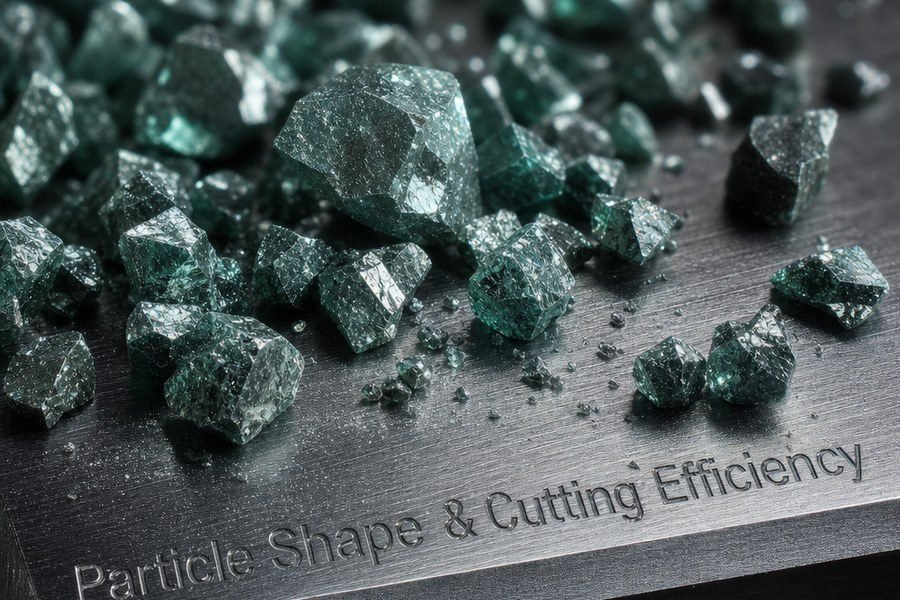
El carburo de silicio verde se sintetiza a temperaturas superiores 2200 °C en un horno Acheson, y la estructura cristalina resultante es predominantemente α-SiC hexagonal (6Politipos H y 4H). La trituración y molienda de esa materia prima produce granos cuya forma depende de la mecánica de fractura.: Los planos de escisión se propagan preferentemente a lo largo {0001} planos basales y {10-10} planos prismáticos, cediendo ya sea en bloque, angular, o partículas en forma de agujas dependiendo del tipo de molino, relación de reducción, y protocolo de detección.
Cada clase de morfología interactúa con la superficie de una pieza de trabajo a través de una geometría de corte distinta.. Los granos angulares presentan múltiples ángulos de inclinación agudos con respecto a la zona de corte.. Los granos en bloques presentan menos bordes cortantes pero distribuyen la carga en un área de contacto más grande. Los granos alargados o en forma de aguja son mecánicamente débiles y se fracturan fácilmente bajo carga lateral.. Estas diferencias se propagan directamente a la tasa de eliminación de material. (MRR), energía de molienda específica, y rugosidad superficial Ra.
Angular vs.. Granos en bloques: Acción de corte comparada
Los granos angulares, generalmente producidos mediante trituración controlada de mandíbulas en un solo paso, entregan alta presión de corte específica en cada punto de arena. La geometría de la punta aguda inicia el microcorte en lugar de arar, Reducción de los componentes de fricción y arado del equilibrio de fuerza de rectificado.. En aplicaciones de carburo cementado y aleaciones duras no ferrosas, El SiC verde angular de grado F muestra consistentemente entre 15 y 25 % MRR más alto en comparación con equivalentes de semibloques a la misma profundidad de corte.
Granos en bloques, por el contrario, Se prefieren cuando la retención del borde y la estabilidad de la forma de la rueda son más importantes que la velocidad de corte bruta.. Las relaciones de aspecto más bajas resisten la retirada temprana de las matrices de bonos vitrificados, y el área de contacto de unión de grano más grande sostiene fuerzas normales más altas antes de la fractura. Para rectificado de precisión de vidrio óptico, La morfología en bloques reduce los eventos de desconchado y mantiene Ra por debajo. 0.2 µm más confiable que el material angular.
Clasificación Morfológica y Estándares de Medición
La forma del grano se cuantifica a través de varios parámetros definidos en ISO 9137 y estándares FEPA. Los más relevantes desde el punto de vista operativo son relación de aspecto (largo a ancho), índice de angularidad (AI), y porcentaje de partículas alargadas. Instrumentos de difracción láser y análisis dinámico de imágenes, como los que cumplen con ISO 13322-2 — puede resolver siluetas de partículas con un alto rendimiento y marcar lotes fuera de especificaciones antes de unirlos.
| Tipo de morfología | Relación de aspecto (Típico) | Aplicación primaria | Compensación clave de rendimiento |
|---|---|---|---|
| Angular / Afilado | 1.5 – 2.2 | Carburo cementado, cerámica, aleaciones duras | MRR alto; autoafilado más rápido; vida útil más corta de la rueda |
| Semi-bloques | 1.2 – 1.5 | Ruedas de muelle de precisión, palos de afilar | MRR equilibrado y desgaste de las ruedas; compatibilidad de enlace versátil |
| en bloque / equiaxial | 1.0 – 1.2 | Vidrio óptico, cerámica avanzada, lapeando | Baja rugosidad superficial; alta resistencia a la carga; tasa de corte más lenta |
| alargada / Como una aguja | >2.5 | Especialidades abrasivas recubiertas, lapeado suelto | Acción de microtrazado; frágil bajo carga lateral |
Cómo interactúa la forma de las partículas con el tipo de enlace y el tamaño del grano
La morfología no opera de forma aislada: interactúa con la química de los enlaces y el tamaño del grano para determinar la geometría de corte efectiva en la superficie de la rueda.. En sistemas de unión vitrificada, la matriz de vidrio forma un puente entre las facetas del grano; Los granos en bloques maximizan esta área de contacto., mientras que los granos angulares pueden presentar puntos de concentración de tensiones que inician microfisuras en el puente de unión ante fuerzas normales elevadas.. Las ruedas unidas con resina toleran las partículas angulares más fácilmente porque la matriz polimérica proporciona amortiguación viscoelástica..
El tamaño del grano amplifica los efectos de la morfología. En designaciones aproximadas (F24–F46), Los granos de SiC verdes y angulares producen una eliminación agresiva del material con una evacuación de viruta relativamente abierta.. Cuando termine la arena, muévase al territorio F120-F220, La dimensión absoluta del grano se reduce hasta el punto en que las diferencias morfológicas se vuelven secundarias a la química de la superficie y al comportamiento de agrupamiento.. Esta es una de las razones por las que las aplicaciones de precisión, incluidas las analizadas en nuestro artículo sobre carburo de silicio vs.. alúmina fundida para madera Acabado: a menudo especifican distribuciones de tamaño de partículas estrechas junto con criterios de morfología..
Efectos de la morfología en abrasivo recubierto vs.. Productos abrasivos adheridos
Los abrasivos revestidos imponen un conjunto de restricciones fundamentalmente diferentes sobre la forma del grano.. En un producto recubierto, Los granos se depositan en una sola capa y se orientan (en un recubrimiento electrostático) con su eje más largo perpendicular al soporte.. Esto significa Los granos alargados mejoran activamente la densidad del filo. en la superficie abrasiva. Para el lijado con cinta de metales no ferrosos y compuestos, Los granos de SiC verdes y alargados aumentan los filos de corte por unidad de superficie., Reducir las fuerzas unitarias y la generación de calor por punto de arena..
En ruedas adheridas, ese mismo alargamiento se convierte en una responsabilidad. Los granos que sobresalen mucho más allá de la línea de unión son propensos a fracturarse tempranamente bajo la carga de impacto cíclico de cortes interrumpidos.. Por lo tanto, los equipos de adquisiciones que obtienen SiC verde para múltiples tipos de productos deben especificar la morfología por separado para aplicaciones recubiertas y adheridas: una decisión de compra de un solo grado basada únicamente en la química producirá resultados subóptimos en al menos una línea de productos.. El mismo principio se aplica cuando se evalúa el SiC verde para entornos industriales especializados., como Carburo de silicio en aplicaciones de petróleo y gas en el fondo de pozo., donde la confiabilidad mecánica bajo estrés cíclico es crítica.
Lista de verificación de especificaciones prácticas para adquisiciones
Al solicitar cotizaciones o revisar certificados de conformidad, Los ingenieros deben validar los siguientes parámetros para garantizar que la morfología se alinee con el proceso previsto.:
- Rango de relación de aspecto — solicitar la D10/D50/D90 desde el análisis dinámico de imágenes, no sólo significa el tamaño de la difracción láser, ya que la difracción no puede resolver la forma.
- Porcentaje de partículas alargadas que exceden la relación de aspecto 2.0 - un valor superior 8 % en los grados F60–F120 normalmente indica un control de fresado inadecuado.
- Índice de angularidad según FEPA o equivalente: confirme el método utilizado, dado que los valores de IA de diferentes instrumentos no son directamente comparables.
- Microfotografía SEM de una muestra representativa: una sola imagen con un aumento de ×100 revela agrupación, contaminación de la superficie, y anomalías de forma groseras que los datos cuantitativos pueden pasar por alto.
- Densidad aparente y relación de densidad aparente: una relación de densidad aparente/densidad aparente superior 1.25 indica alta angularidad e ineficiencia del empaque que afectarán el cálculo del volumen de unión en la formulación de la rueda.
El carburo de silicio verde producido según estándares de morfología consistentes también respalda el rendimiento en aplicaciones térmicas y estructurales.. La misma nitidez cristalográfica que impulsa la eficiencia de corte a temperatura ambiente contribuye a la resistencia al choque térmico en entornos de alta temperatura, una conexión explorada en nuestra cobertura de carburo de silicio para material refractario casos de uso.
Preguntas frecuentes
q: ¿Qué relación de aspecto se considera óptima para el carburo de silicio verde utilizado en muelas abrasivas vitrificadas??
A: Una morfología de semibloque con una relación de aspecto de 1,2 a 1,5 es generalmente óptima para sistemas de aglomerante vitrificado.. Esta gama maximiza el área de contacto entre el grano y el grano para resistir el desprendimiento bajo fuerzas de esmerilado normales y, al mismo tiempo, conserva suficiente angularidad para mantener una tasa de eliminación de material razonable.. Relaciones de aspecto anteriores 2.0 en ruedas vitrificadas aceleran la fractura del puente de unión, particularmente a velocidades periféricas de las ruedas superiores 35 EM.
q: ¿Cómo afecta la forma de las partículas a la rugosidad de la superficie Ra en el rectificado cerámico de precisión??
A: en bloque, Los granos equiaxiales producen consistentemente valores Ra más bajos que los equivalentes angulares con la misma designación de grano.. En rectificado de precisión de alúmina y circonio a F220, El SiC verde en bloques normalmente mantiene Ra en el rango de 0,08 a 0,15 µm, mientras que el material angular con el mismo grano produce Ra de 0,18 a 0,28 µm debido a canales de rayado individuales más profundos y a la formación irregular de virutas..
q: ¿Qué norma regula la medición de la forma de las partículas de granos abrasivos?, y qué instrumentos son aceptables?
A: YO ASI 13322-2 Cubre métodos de análisis de imágenes dinámicas para la caracterización de la forma de partículas y es el estándar de mayor referencia para la morfología de granos abrasivos.. Instrumentos de Retsch (Camsizador X2), Sympatec (QICPIC), y malvern (Morfología 4) Son comúnmente aceptados por los principales fabricantes de ruedas.. Difracción láser sola (YO ASI 13320) es insuficiente ya que calcula un diámetro de esfera equivalente y no puede resolver la relación de aspecto o el índice de angularidad.
q: ¿Se puede utilizar el mismo grado de grano de SiC verde tanto para bandas abrasivas recubiertas como para muelas abrasivas aglomeradas??
A: No sin verificación de morfología.. Las bandas abrasivas revestidas se benefician de las partículas alargadas (relación de aspecto 1,8–2,5) que se orientan verticalmente durante el recubrimiento electrostático y aumentan la densidad del filo. Las ruedas adheridas funcionan mejor con granos en bloques o semibloques. El uso de un lote optimizado con abrasivo recubierto en una formulación de muela vitrificada aumenta el riesgo de fractura prematura del grano y una relación G reducida. (Volumen de material eliminado por unidad de volumen de rueda desgastada.) hasta entre 20 y 30 %.
q: ¿La forma de las partículas verdes de SiC se degrada durante el almacenamiento?, y ¿cómo se debe manipular el material a granel para preservar la morfología??
A: Las puntas de grano angulares son susceptibles al desgaste durante el manejo a granel. Caídas en caída libre que superan 1.5 m y transporte neumático a velocidades superiores 18 m/s aumenta considerablemente la proporción de granos redondeados o astillados, particularmente en los grados F46-F80 donde los granos individuales son lo suficientemente grandes como para impactarse entre sí con alta energía cinética. Los supersacos deben almacenarse en tarimas planas., nunca apilados más de dos de alto, y transferidos usando sinfines o cintas transportadoras en lugar de líneas neumáticas de alta velocidad cuando la preservación de la morfología es crítica.
Acerca de los abrasivos superiores de Henan (HSA)
Abrasivos superiores de Henan (HSA) es un proveedor global con sede en China de materiales cerámicos avanzados y abrasivos de alto rendimiento para aplicaciones industriales en todo el mundo.. Nuestra gama principal de productos incluye carburo de silicio negro., carburo de silicio verde, carburo de silicio de grado electrónico (Sic), alúmina fundida blanca, alúmina fundida marrón, Carburo de boro, aluminatos de calcio fundidos, y abrasivos SG.
Atendiendo a los clientes en 30+ países, HSA suministra materiales fiables para abrasivos, refractarios, cerámica técnica, aplicaciones de semiconductores, pulido de precisión, arenado, metalurgia, y materiales de construcción de alto rendimiento.
Obtenga una cotización o una muestra gratis
Buscando un proveedor confiable de materiales cerámicos avanzados y abrasivos de primera calidad? Póngase en contacto con nuestro equipo técnico hoy: respondemos dentro de 24 Horas y podemos organizar muestras gratuitas para proyectos calificados..
- 📧 Correo electrónico: sales@superior-abrasives.com
- 💬 WhatsApp: +86-186-3863-8803